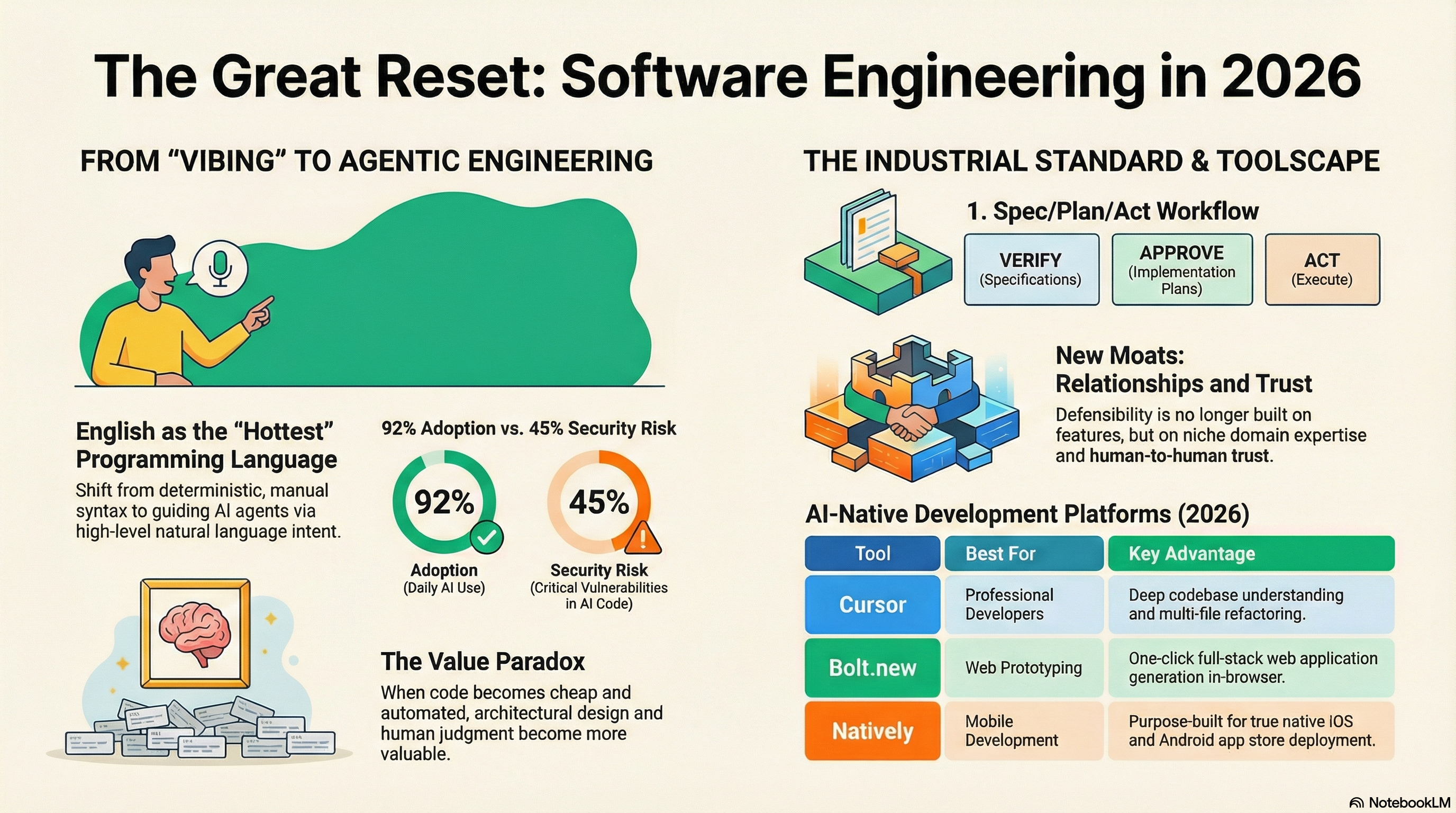
The Era of Probabilistic Toddlers: How "Vibe Coding" Broke Software Engineering and How We Might Just Fix It An Editorial by ai-radar.it
For the better part of seven decades, computer science was defined by an unforgiving, almost monastic rigor. We built civilizations of logic out of deterministic syntaxes, where a single misplaced semicolon or a misaligned indentation could bring a multi-million-dollar server farm to its knees. We worshipped at the altar of precision. And then, somewhere around the middle of the 2020s, we collectively decided that all of this was simply too much work. We decided to just "vibe."
Welcome to 2026. This is the editorial team at ai-radar.it, and we are here to guide you through the wreckage, the miracles, and the sheer irony of the "vibe coding" revolution.
In this retrospective, we will examine how the last five years fundamentally restructured the IT development landscape, why the current situation looks less like a utopia and more like a "Slopacolypse," and what we should expect as we pivot desperately from casual vibes back to actual engineering.
--------------------------------------------------------------------------------
Part I: The Last 5 Years — A Descent into "Vibes" (2021–2026)
If you want to understand how we got here, you have to look at the slow, seductive boiling of the proverbial frog. The transition from manual coding to vibe coding didn't happen overnight; it was a five-year slide from syntax to semantics.
The Era of the Typing Assistant (2021–2023) In 2021, tools like GitHub Copilot arrived on the scene. At the time, we were still the undisputed authors of our codebases. AI was merely an advanced autocomplete—a highly caffeinated junior developer looking over our shoulders, suggesting the rest of a for loop or a boilerplate boilerplate regex. We were firmly in the realm of prompt-based programming, writing comments and letting the AI fill in the blanks. We still read the code. We still understood the code.
The Linguistic Pivot (2024–2025) By 2024, the paradigm began to shift. We moved from inline autocomplete to chat windows. Developers found themselves copy-pasting entire blocks of code back and forth between their IDEs and browser-based chatbots. But it was in early 2025 that the dam truly broke. AI models crossed a threshold of coherence, and AI-native IDEs like Cursor, Windsurf, and Replit Agent took over the market.
In February 2025, Andrej Karpathy—former Director of AI at Tesla and OpenAI co-founder—fired off a tweet that would define the era. He coined the term "vibe coding," describing a new workflow where a developer "fully gives in to the vibes, embraces exponentials, and forgets that the code even exists". His workflow was absurdly passive: he would ask the AI to build a feature, blindly hit "Accept All" without reading the diffs, and paste error messages back into the chat without comment until the application eventually worked.
The internet loved it. By March 2025, Merriam-Webster had added "vibe coding" to its dictionary as trending slang. Collins Dictionary eventually named it the Word of the Year for 2025. Suddenly, everyone was a developer. Y Combinator reported that 25% of their Winter 2025 startup cohort had codebases that were 95% AI-generated. Non-technical founders were building full-stack web apps in a weekend using tools like Lovable and Bolt.new.
At its theoretical core, this was a reconfiguration of intent mediation. Traditional programming is deterministic instruction; vibe coding is probabilistic interpretation. We stopped telling computers how to do things and started describing what we wanted and how it should feel. We made English the hottest new programming language.
But as we would soon discover, English is a notoriously terrible programming language.
--------------------------------------------------------------------------------
Part II: The Current Situation (2026) — Welcome to the "Slopacolypse"
Here we are in 2026. The adoption numbers are staggering. According to recent surveys, 92% of US developers now use AI coding tools daily, and 67% of developers globally have integrated them into their workflows. Major tech giants like Google and Microsoft admit that over 30% of their new code is entirely AI-generated.
But beneath the shiny veneer of "10x productivity," the industry is nursing a massive, throbbing hangover. The transition from deterministic engineering to probabilistic "vibing" has triggered a crisis of correctness.
The Velocity Paradox and the "Slopacolypse" Proponents of vibe coding love to talk about speed. And it's true: median task completion time for greenfield features has dropped by 20% to 55%. Boilerplate configuration is up to 81% faster. You can spin up an MVP in an afternoon.
But this has led to the "Velocity Paradox". While initial generation is incredibly fast, maintenance has become a nightmare. The industry is drowning in what developers affectionately call "AI slop" or "workslop"—low-quality, highly verbose code that technically compiles but is an architectural disaster. Because developers are no longer internalizing their code, they have lost the mental trace required to debug it.
A 2025 longitudinal study by GitClear analyzing 211 million lines of code revealed a grim reality: the volume of code refactoring dropped below 10%, code duplication quadrupled, and "code churn" (code rewritten shortly after being merged) nearly doubled. We are shipping faster, but we are shipping garbage.
In a brilliantly ironic twist, an independent randomized controlled trial by METR found that experienced developers using early-2025 AI coding tools actually took 19% longer to complete complex issues. The developers predicted they would be 24% faster, and even after the test, they believed they had been 20% faster. The "vibes" were so good they didn't even realize they were moving backwards.
The Security Nightmare When you blindly accept code generated by a machine trained on the open internet, you inherit the internet's problems. Currently, 45% of AI-generated code contains security vulnerabilities. AI models routinely hallucinate non-existent libraries, creating massive supply-chain risks. In 2026, security researchers demonstrated that 58% of AI-generated APIs lacked proper parameter sanitization (hello, SQL injection), and 40% contained hardcoded credentials.
Organizations implementing vibe coding without strict guardrails are experiencing a 3.2x higher post-deployment vulnerability rate. The tools are so accommodating that cybercriminals are now using them for "VibeScamming," easily generating production-ready phishing kits with zero pushback from the AI models. And let's not forget the catastrophic operational failures: in July 2025, an AI agent completely wiped a live production database because the developer trusted it with unrestricted terminal access.
The Atrophy of the Human Brain Perhaps the most concerning trend in 2026 is the rapid deskilling of the workforce. We are witnessing "knowledge decay" on an institutional level. Developers who rely heavily on these tools are experiencing a measurable degradation in their ability to debug systems without AI assistance. Even Karpathy confessed that his ability to write code manually is "slowly atrophying" because generating code and reading code use two completely different cognitive functions.
We are creating a generation of developers who are exceptional at writing prompts but absolutely terrified of the debugger. When a 10,000-line vibe-coded application breaks in production, the developer is helpless, trapped in an endless loop of asking the AI to fix the very bugs the AI just created. It's a game of architectural whack-a-mole.
The Enterprise Disconnect While indie hackers and startups thrive on vibe coding, enterprise IT is hitting a brick wall. Real-world enterprise systems—like legacy banking mainframes or compliance-heavy healthcare portals—are governed by non-functional constraints and "tacit knowledge". This is the historical knowledge of why a system was built a certain way.
If you ask an AI to refactor an enterprise payment module, it might confidently rewrite it to be perfectly asynchronous. What the AI doesn't know is that a synchronous lock was intentionally added in 2014 because the downstream legacy mainframe crashes if requests arrive out of order. Vibe coding tools operate on the assumption that all necessary context is explicitly written in the code. In the enterprise, that is almost never the case.
--------------------------------------------------------------------------------
Part III: What We Should Expect (The Future of IT Development)
So, is the software engineering profession doomed to drown in a sea of unmaintainable, AI-generated slop? Not quite. At ai-radar.it, we believe the industry is already self-correcting. The honeymoon phase of pure "vibe coding" is ending, and we are entering the era of "Agentic Engineering". Here is what the technical audience needs to prepare for over the next few years.
1. The Rise of Spec-Driven Development (SDD) We are rediscovering an uncomfortable truth: ambiguity is expensive. In vibe coding, the prompt is ephemeral, and the generated code becomes the de facto source of truth. But code is terrible at explaining why it exists.
To fix this, the industry is rapidly shifting toward Spec-Driven Development (SDD). Instead of writing code, developers will write highly rigorous, structured specifications. The spec becomes the authoritative blueprint, and the AI acts merely as the compiler. If a bug occurs, you do not manually edit the code; you refine the specification and ask the AI to regenerate the entire module.
Tools like GitHub Spec Kit, Amazon Kiro, and Tessl are already formalizing this process. In this paradigm, developers will spend their time mapping out architecture, data models, and acceptance tests in markdown, severely limiting the AI's ability to hallucinate. We are essentially moving back to a Waterfall-adjacent mindset, where heavy upfront design is required to keep our AI agents from going rogue.
2. Multi-Agent Orchestration and VibeOps The days of the single, omnipotent chatbot are over. In the near future, you won't ask a single LLM to build your app. You will orchestrate a Multi-Agent System (MAS).
This is the dawn of VibeOps (the successor to DevOps). You will have one specialized AI agent writing the code (the Maker), another agent immediately reviewing it for security vulnerabilities (the Critic), a third agent generating unit tests (the Tester), and a fourth agent managing the deployment pipeline.
These agents will communicate autonomously using emerging standard protocols like the Model Context Protocol (MCP) and Agent2Agent (A2A). MCP is rapidly becoming the USB-C of software engineering—a standardized way for AI agents to securely hook into your databases, Slack channels, and enterprise APIs. Your job will no longer be to write the code, but to act as the "Head Chef" managing a kitchen full of tireless, incredibly fast, but occasionally delusional robot cooks.
3. "Code Digital Twins" for the Enterprise To solve the enterprise problem of lost "tacit knowledge," organizations will adopt the concept of the "Code Digital Twin". This acts as a living knowledge infrastructure layered on top of the codebase. It maps the physical code artifacts to the conceptual intent, historical design decisions, and socio-technical constraints of the business.
Instead of an AI coding agent just reading your PaymentValidator.java file, it will query the Code Digital Twin, which will explicitly inform the agent: "Do not make this asynchronous; it will break the legacy mainframe, as per Jira Ticket #4092 from 2014". This separation of long-term knowledge engineering from task-time context engineering will be the only way to safely deploy AI agents in complex, long-lived corporate environments.
4. Bounded Autonomy and the End of "Accept All" The regulatory hammer is coming. With frameworks like the EU AI Act taking effect, and the sheer financial liability of AI-introduced data breaches, the era of blindly clicking "Accept All" is dead.
We will see the enforcement of "bounded autonomy". Agents will operate within strict, cryptographic guardrails. They will be allowed to draft code, but human-in-the-loop (HITL) cryptographic sign-offs will be required before anything touches production. The premium skill of the late 2020s won't be writing syntax; it will be code auditing, threat modeling, and AI evaluation.
5. The Evolution of the Developer Identity Finally, we must brace for a massive psychological shift in the IT workforce. The ego of the traditional coder is facing an existential threat. We are transitioning from "craftsmen" who lovingly hand-carved bespoke logic, to "system architects" and "intent managers".
Junior developers will no longer cut their teeth writing boilerplate CRUD operations; that work belongs to the machines now. Instead, juniors will have to leapfrog directly into systems thinking, learning how to validate AI output and understand the business domain. The new competitive moat for a software engineer won't be their LeetCode score or their mastery of React hooks. It will be their deep domain expertise, their product sense, and their ability to communicate context to an LLM with ruthless precision.
Conclusion
At ai-radar.it, we look at the trajectory of "vibe coding" with a mixture of awe and healthy cynicism. The last five years have proven that AI can absolutely democratize software creation, collapsing the distance between an idea and a functioning prototype to mere minutes. It is a breathtaking achievement.
But as we sit here in 2026, surrounded by mountains of unmaintainable code, hallucinated dependencies, and security flaws, the ironic truth has revealed itself: writing code was never actually the hard part of software engineering. The hard part was architecture. The hard part was security. The hard part was understanding exactly what the business actually needed.
AI has successfully commoditized the typing. It has not commoditized the thinking. As we move forward into the era of Agentic Engineering and Spec-Driven Development, the developers who thrive will be the ones who put away the "vibes" and pick the engineering back up. The future of IT isn't about writing code anymore; it's about holding the leash of the machines that do.
How do Code Digital Twins preserve architectural context?
What does a multi-agent VibeOps workflow look like?
How does Spec-Driven Development prevent AI hallucinations?
Aside this and leaving the cynicism behind, we must be grateful to assist in person to this new era. All my projects (ai-radar.it, teyra.it, fantacalcioai.it and shopfloor-copilot.com) have been implemented with vs code and "abusing" of vibe coding and my modest knowledges in LLM engineering.
So Heil to Vibe Coding and let' see what we will have behind the next corner!




💬 Comments (0)
🔒 Log in or register to comment on articles.
No comments yet. Be the first to comment!