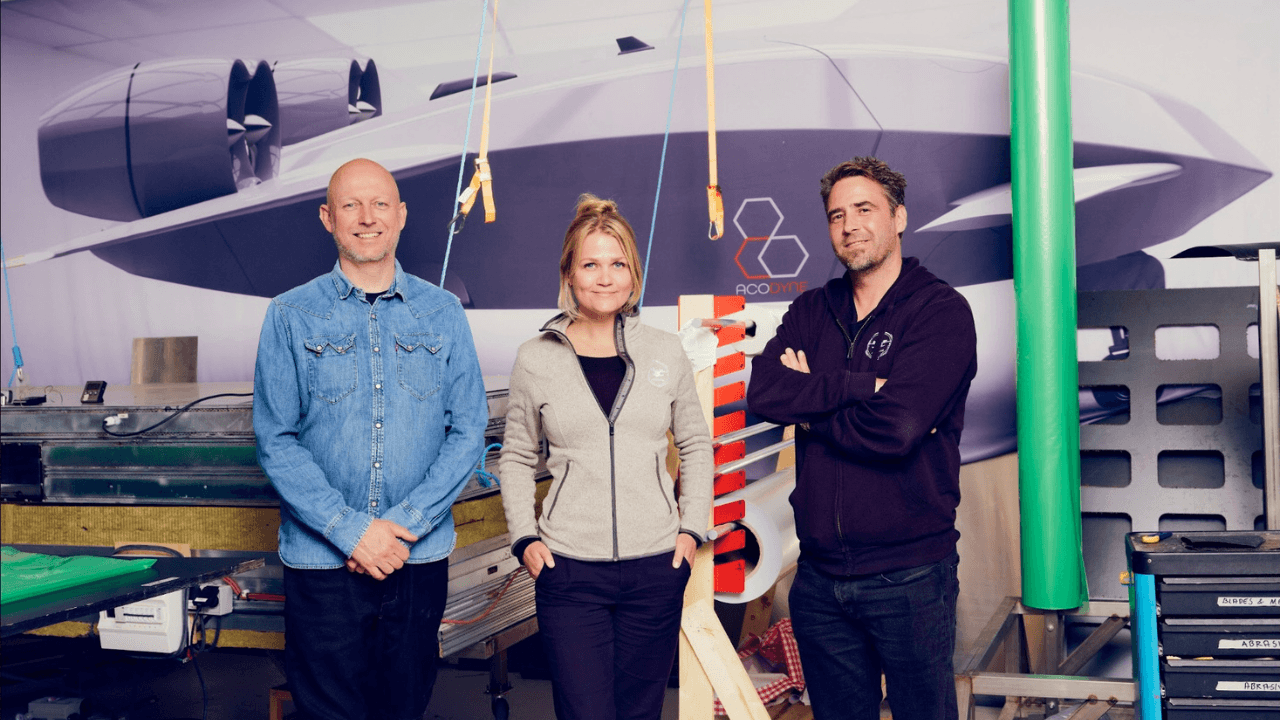
Military logistics, offshore platforms, and remote communities share a bottleneck: when a critical component is missing or urgent supplies are needed, the only fast option remains the helicopter, with extremely high operating costs and personnel exposed to risk. Danish deep tech startup Acodyne has just closed a €2.5 million pre-seed round to change this equation with fully autonomous eVTOL cargo drones.
The round was co-led by Swedish defence VC Gungnir Capital and Danish fund PSV Hafnium, with participation from EIFO, SAP9 Group, and GreenUP IV Invest. Modest by aviation standards, but sufficient — according to the company — to build three prototypes and take them to flight testing before the end of 2026.
From helicopter to drone: autonomy and speed
Acodyne’s aircraft combine electric vertical take-off and landing with fixed-wing forward flight, achieving a cruise speed of 450 km/h. Payload ranges from 100 to 500 kg depending on the model, with a range of up to 500 km in fully electric configuration, extendable to 1,000 km in hybrid mode (electric VTOL, kerosene range extender during cruise).
A modular design with detachable wings allows the entire system to fit inside a standard 20-foot shipping container for easy transport and deployment. The first models, designated E100, are designed for resupply missions, airdrops, medical evacuation, and communications support. The architecture is scalable, and the company expects to exceed 500 kg payload capacity within two years.
eTHOR: the onboard brain and the challenge of local inference
What sets Acodyne apart is not just its proprietary ducted-fan electric propulsion, but the AI autonomy stack called eTHOR, developed in collaboration with DTU Compute. “The system enables autonomous takeoff and landing, which is essential for beyond-visual-line-of-sight operations,” explains Jasmina Pless, CCO. “Our vision is a future with no human in the loop at all — neither in the aircraft nor in ground handling: cargo drones operating between logistics hubs, connecting directly to robotic cargo-handling systems.”
The crucial point, for those watching the evolution of distributed AI, is that all intelligence resides on board. There is no reliance on cloud connections during the mission: perception, planning, and flight control must work locally, on hardware with severe constraints on weight, power, and reliability. It is an extreme case of on-device inference, where latency and robustness are non-negotiable, and aviation certification demands standards of verifiability that echo the needs of regulated sectors in IT too.
Why edge autonomy matters (also for on-premise LLM practitioners)
Acodyne’s choice — full autonomy without a remote link — reflects a principle that is becoming familiar to those designing on-premise deployments of Large Language Models: keeping inference where data is generated reduces the attack surface, eliminates dependency on external networks, and ensures operability even in hostile or disconnected environments. Whether it is a drone flying over a theatre of operations or an enterprise chatbot processing sensitive documents, the logic is the same: control, predictable latency, and data sovereignty.
It is no coincidence that the defence market is the first proving ground. The lack of charging infrastructure in many operational scenarios has already pushed Acodyne to plan a hybrid version, and the same pragmatism appears in discussions about hybrid on-premise/cloud architectures for enterprise AI: the right trade-off between autonomy and flexibility depends on context, not on dogma.
Infrastructure and outlook
The European U-space regulatory framework, designed to safely manage drone traffic in dedicated corridors, and NATO’s push for defence-industrial autonomy are creating the conditions for an unmanned cargo market. For Acodyne, the immediate priority is to get the prototype flying and demonstrate the transition from vertical take-off to forward flight — “the part we really need to validate,” according to Pless. After that, the company aims for a much larger round to scale and for partnerships with cargo corridor operators in various parts of the world, from the Netherlands to Canada.
Meanwhile, the fact that an investor like Gungnir Capital describes the platform as “a way to collapse one of the most expensive line items in modern operations, manned helicopter logistics, into a system that needs no crew in the threat envelope” says a lot about the expected disruption. For anyone working with on-machine AI — drones, robots, autonomous vehicles — Acodyne is a signal: local inference is leaving the data centre and literally taking flight.







💬 Comments (0)
🔒 Log in or register to comment on articles.
No comments yet. Be the first to comment!