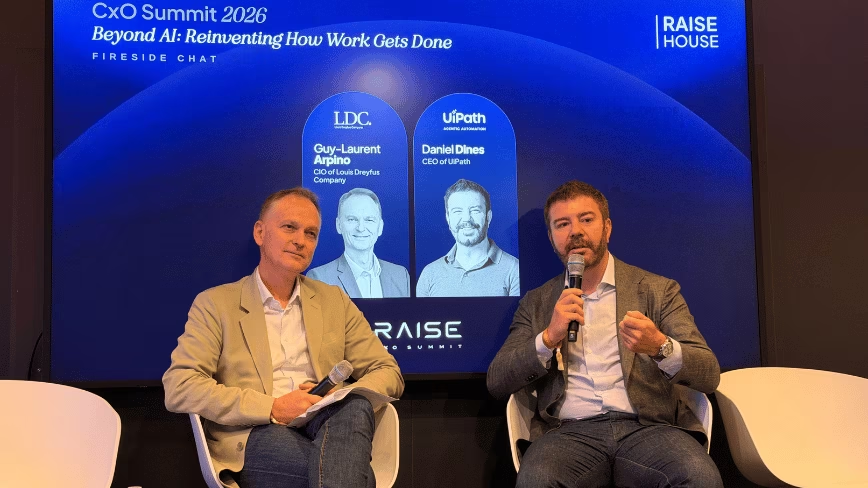
UiPath CEO Daniel Dines was surgical in diagnosing the paralysis that hits enterprise AI agents. On stage at the Raise Summit in Paris, he said: no juniors on board, no production. The fault lies not with LLMs, but with organizational culture and a shortage of talent willing to get their hands dirty with complex integrations.
That analysis is true, yet incomplete — especially for those operating in on-premises environments. When a company considers pushing an AI agent into production on local stacks, the lack of entry-level hires is just a symptom. The structural issue is the gap between promises of cloud-native frameworks and the operational reality of corporate data centers, segmented networks, and data sovereignty requirements. Inference pipelines on self-hosted hardware demand skills you don’t learn in a crash course: VRAM configuration, model quantization, container orchestration on bare-metal GPUs. If those skills are absent, hiring juniors won’t help — you need seniors who can build the scaffolding.
The short-circuit is familiar to anyone designing on-premises deployments. Proofs of concept run smoothly in the cloud, where resources are elastic and managed services hide complexity. But when the same agent must query legacy databases behind a firewall, respecting GDPR policies and operating at low latency on sensitive data, the infrastructure reveals itself for what it is: an industrial system that punishes improvisation. GPUs need to be right-sized, serving must be optimized outside artificial benchmarks, and TCO stops being a theoretical line item and becomes the daily project compass.
There is a second-order implication Dines didn’t spell out but that surfaces from his talk. If the human factor is the primary obstacle, the deployment environment’s quality is the secondary one. Companies that have already invested in on-premises stacks — perhaps for compliance or sovereignty reasons — discover their AI agents stall not because of the models, but because the software glue between LLM, data sources, and user interfaces is still brittle. And that glue must be built in-house, tested on real hardware, and distributed with logic different from the cloud. This requires a blend of automation expertise (the UiPath world) and systems expertise (the world of those administering GPU servers 24/7).
Who wins? Vendors offering AI engineering platforms designed for hybrid and on-premises environments, providing orchestration tools that abstract the hardware without hiding it. Who loses? Cloud-only AI agent startups that hit the wall of data gravity: the more strategic the data, the more inference must live within the same perimeter. The structural signal is clear: the experiment phase is over, and on-premises production is the next battleground. It’s not just about hiring graduates; it’s about rethinking the stack starting from silicon, not from SaaS.






💬 Comments (0)
🔒 Log in or register to comment on articles.
No comments yet. Be the first to comment!