
Agentic finance AI improves business efficiency and ROI only when deployed with strict governance and clear return on investment targets.
A recent FT Longitude survey of 200 finance leaders across the US, UK, France, and Germany showed 61 percent have deployed AI agents merely as experiments. Meanwhile, one in four executives admit they do not fully grasp what these agents look like in practice.
Advancing agentic finance AI beyond experiments
Finance departments need governed systems that combine language processing with business logic to deliver actual value. Providers of Invoice Lifecycle Management platforms are introducing new agents designed to accelerate invoice processing and push accounts payable toward greater autonomy. Recent market solutions use generative AI, deep learning, and natural language processing to manage the entire workflow, from initial data ingestion through to final reconciliation.
These digital teammates handle task execution, allowing human employees to focus on higher-level business planning rather than replacing them entirely.
Within these ecosystems, specialised business agents provide contextual and real-time guidance regarding the next best actions for handling invoices. Data agents allow staff to query system information using natural language, easily finding answers about awaiting approvals in specific regions or identifying suppliers offering early payment discounts.
Governing autonomous finance workflows
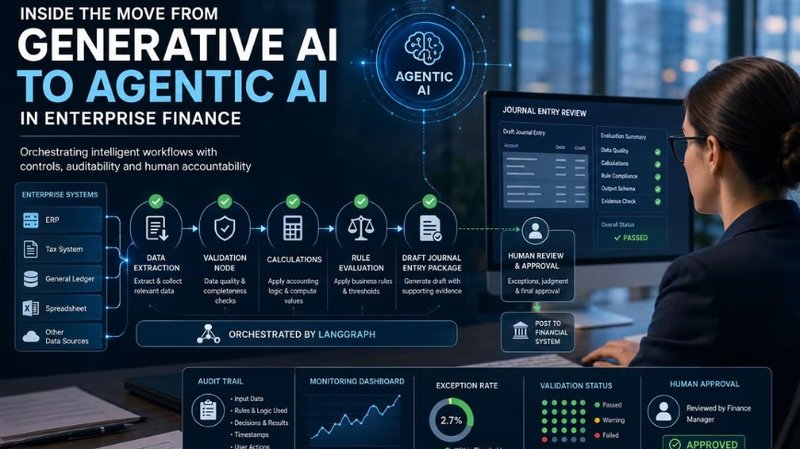
Finance teams will only hand over tasks to agentic AI if they retain control. Finance departments require verifiable audit trails and explainable logic for every action, avoiding networks of disconnected bots.
Industry leaders note that autonomy without trust isn’t acceptable, especially in sensitive industries like finance. Platforms must ensure every AI decision is explainable, auditable, and governed through existing finance controls. This approach helps safely delegate workloads to algorithms while remaining fully compliant and protected.
To enable this trust, every action performed by an AI agent routes through a central policy engine. Before executing any task, the system passes the proposed action through specific autonomy gates that enforce the customer’s business rules, risk thresholds, and compliance requirements. This architecture ensures algorithms manage the bulk of the workload while finance personnel retain total visibility and a complete audit trail.
Building automated procurement operations
Future agentic finance AI capabilities will automate issue resolution and connect data across systems for faster decision-making.
Modern capabilities in 2026 include supplier agents designed to manage invoice disputes and payment queries. These agents will automatically telephone suppliers to explain discrepancies, summarise the conversation, and outline subsequent steps to achieve faster resolutions. Professional agents, meanwhile, will assist clerks in resolving real-time processing questions using natural language to cut manual effort and delays.
AI must operate as an integral business component rather than a bonus feature, requiring intelligent, secure, and ethical application to drive cost efficiencies and enhance operations. By centralising control and ensuring every automated decision from agentic AI passes through established compliance checks, organisations can safely elevate their finance operations to fully autonomous execution.




💬 Comments (0)
🔒 Log in or register to comment on articles.
No comments yet. Be the first to comment!