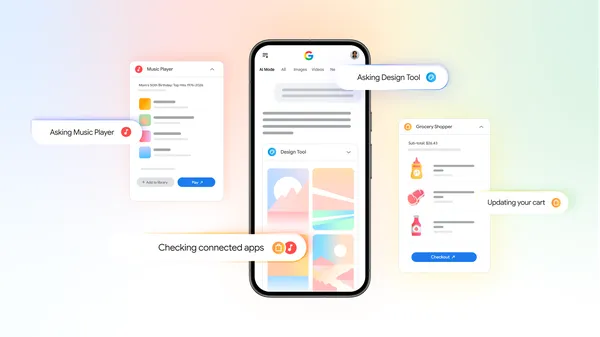
Google has announced that AI Mode will soon be able to securely link and interact with your go-to services. In other words, Search will no longer only crawl indexed web pages: it will tap into apps like calendars, email, and productivity tools, acting as a conversational orchestrator.
The integration is framed as a convenience breakthrough — just ask the assistant to check an appointment or summarize a document without leaving the search interface. But what looks like a user experience feature actually raises structural questions about data flow control.
For the consumer, the barrier between applications and the search engine thins. Tokens move from the browser to Google’s servers, which now become the crossroads for data previously locked inside individual app silos. Security is mentioned (“securely link”), but the term says little about where the models actually run or what retention policies apply to the connected app data.
Anyone evaluating on-premise LLM deployment should read this as a signal. The more cloud providers push deep integration with enterprise apps, the wider the gap becomes for organizations that must preserve data sovereignty — whether due to GDPR rules or internal policies. Connecting a CRM or HR system to a cloud-hosted LLM means exposing access patterns and sensitive information to infrastructure outside the organization’s perimeter.
An alternative is to replicate the same experience on a self-hosted stack. Several inference frameworks now allow building pipelines where a locally running LLM can interact with internal APIs. VRAM and compute are no longer a luxury: consumer-grade cards and servers with sufficient memory capacity can handle quantized models with acceptable latency. Total cost of ownership needs careful weighing, but the absence of monthly fees and the certainty about data residency tip the balance.
Ultimately, Google’s move is not just a product update. It is a reminder that handing over the mediation between apps and natural language to a cloud service breeds dependency and erodes control over your information sources. For those who need auditing, air-gapped isolation, or simply the peace of mind of knowing where their data ends up, this announcement adds yet another argument for looking more seriously at on-premise alternatives.
For now, the average user will see a more powerful search bar. But every time AI Mode accesses a calendar or a to-do list, a part of our digital ecosystem crosses a boundary that deserves to be mapped with clear-eyed awareness.








💬 Comments (0)
🔒 Log in or register to comment on articles.
No comments yet. Be the first to comment!