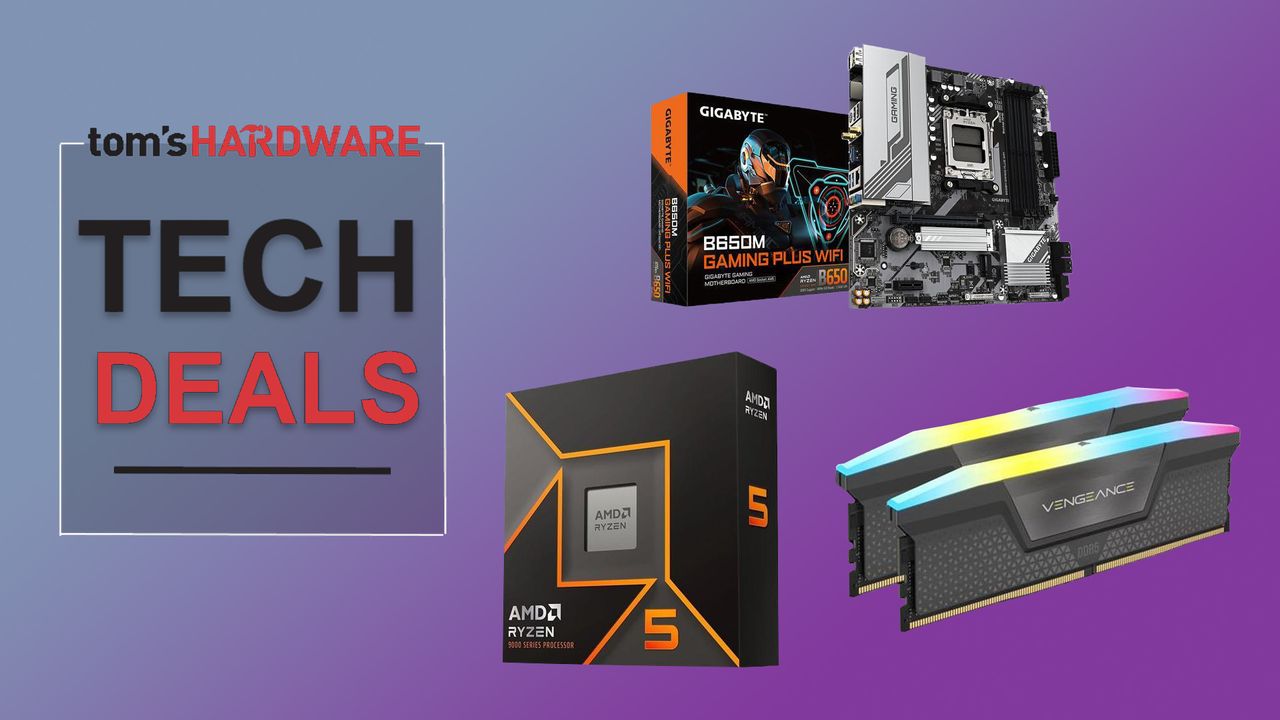
Newegg has assembled a bundle that, on paper, looks custom-made for gaming PC builders: a Ryzen 5 9600X, 16GB of DDR5, a B650 motherboard, and a 240mm All-In-One liquid cooler, all for $520. But on closer inspection, the mix of components opens an interesting window for anyone starting to take local LLM inference seriously, while also holding a few surprises on the thermal front.
The AIO You Didn’t Expect
The detail that immediately stands out is the liquid cooling system paired with a 65‑watt TDP processor. The 6‑core, 12‑thread Zen 5 chip certainly doesn’t need a 240mm radiator; even a compact air cooler would keep it in check, and would likely generate less noise under sustained load. Yet Newegg includes it anyway, turning what could be a freebie into a genuine marketing statement. AIO kits have become a passe-partout for any configuration that wants to look “premium,” and their presence in aggressively priced bundles serves to legitimize an AM5 purchase in the eyes of a user base increasingly conditioned to see liquid cooling as a must-have, even when the numbers don’t justify it.
Behind this choice lies a structural implication: the component industry is progressively decoupling cooling from actual thermal needs, turning it into an upselling mechanism. In the AI space, where servers often run 24/7 and pump noise can become a real issue, this trend could backfire, pushing aspiring self-hosters toward solutions less suited to the quiet operation that a continuous workload demands.
The AM5 Platform as a Foundation for Local Inference
Beyond the cooler, the heart of the bundle is the Ryzen 5 9600X, DDR5 memory, and B650 chipset. AM5 offers a broad upgrade path and supports up to 192GB of RAM on boards like this one, paving the way for the expansions needed as users move from experimental quantized models to larger LLMs. The included 16GB is the bare minimum: it allows running 7‑billion‑parameter models in INT4 quantization with a fair amount of headroom, but it becomes a bottleneck for 13B architectures. The processor’s integrated graphics provide an additional foothold: frameworks such as llama.cpp can offload part of the workload onto the iGPU, even if performance remains an order of magnitude below a discrete card.
With this offer, Newegg lowers the cost of entry to the AM5 socket, creating a domino effect: the more users adopt the platform, the more likely they are to later slot in a dedicated GPU – exactly the component that turns a desktop into a true on‑prem inference node. In doing so, the bundle does more than sell hardware; it feeds an upselling ecosystem that indirectly fosters the spread of machines capable of hosting language models locally.
Who Wins and Who Loses
The package is great news for AI newcomers looking for a basic AM5 system to which they can later add RAM and a GPU. Conversely, it penalizes those who want sober, long‑term‑reliable cooling, forcing them to absorb the cost – or resell – a potentially noisy AIO. Air‑cooler manufacturers, which until yesterday dominated this segment, see their space threatened by competition that retailers themselves are promoting. Meanwhile, Newegg uses the bundle lever to move volume and impose a certain perception of value in a DIY market where aesthetics and thermal fads carry increasing weight.
At an industry level, the spread of bundles that combine mid‑range CPUs, barely sufficient RAM, and overkill cooling signals that the era of the PC as a mere “gaming box” is over: configurations are increasingly designed as open platforms for diverse workloads, including automated reasoning on language models. The challenge for those serious about on‑prem will be to recognize what they really need and resist the allure of components that generate headlines but not compute.



💬 Comments (0)
🔒 Log in or register to comment on articles.
No comments yet. Be the first to comment!