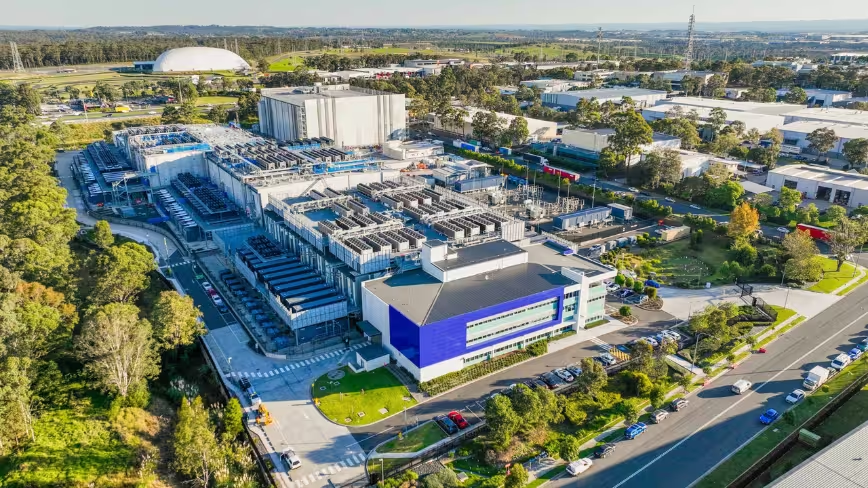
AirTrunk Seeks $3 Billion Loan for Hyperscale Data Center in Sydney
AirTrunk, a data center operator owned by investment giant Blackstone, is seeking significant financing to expand its infrastructure in Australia. The company is in talks with various banks for a loan of A$4.3 billion, equivalent to approximately US$3 billion. This capital is earmarked for the construction of a single data center in Sydney, an initiative that underscores the growing demand for large-scale computational and data storage capacity.
The project, named SYD3, is planned as a hyperscale facility, a term indicating data centers of exceptional size and capacity, designed to host thousands of servers and manage extremely high volumes of data traffic. The scale of the investment and the nature of the project reflect a global trend towards creating increasingly massive digital infrastructures, driven particularly by the explosion of workloads related to artificial intelligence and Large Language Models.
Technical Details and Energy Implications
The SYD3 data center is designed to exceed 400 megawatts of power capacity. This figure is a key indicator of the project's scale and its implications. Such high power consumption is typical of modern hyperscale facilities, which must power not only traditional servers but also increasingly dense arrays of high-performance GPUs, essential for training and Inference of complex AI models. The need to manage such power requirements brings significant challenges in terms of procurement, distribution, and cooling.
The size of the loan requested by AirTrunk is clear evidence of the vastness and complexity of these infrastructural projects. Building a data center of this magnitude requires massive investments not only in computational hardware but also in network infrastructure, advanced cooling systems, and, crucially, a robust and reliable electrical supply. These elements are critical to ensuring continuous operation and energy efficiency, which are decisive factors for the long-term Total Cost of Ownership (TCO).
The Context of AI Deployments and Data Sovereignty
For companies evaluating self-hosted LLM deployments or hybrid strategies, the existence of hyperscale facilities like SYD3 is of fundamental importance. Such data centers offer the possibility of hosting dedicated infrastructure, ensuring greater control over data and security, crucial aspects for data sovereignty and regulatory compliance. Although the ultimate use of SYD3 is not specified, the availability of hyperscale capacity in key regions like Sydney addresses a growing need for local infrastructure that can support sensitive AI workloads, reducing reliance on foreign cloud services.
The choice between building one's own infrastructure, co-locating in a hyperscale data center, or relying entirely on the cloud is a complex strategic decision. Factors such as TCO, latency requirements, Throughput, and compliance needs play a decisive role. For those evaluating on-premise deployments, AI-RADAR offers analytical Frameworks on /llm-onpremise to understand the trade-offs associated with these choices, highlighting the importance of considering not only the initial cost but also long-term operational costs, including energy.
Future Prospects for Digital Infrastructure
AirTrunk's initiative with the SYD3 project is part of a broader trend of massive investments in global digital infrastructure. The demand for computational capacity, largely driven by advancements in artificial intelligence, continues to grow at a sustained pace. This pushes operators like AirTrunk to plan and build increasingly larger and more powerful facilities.
The availability of data centers with capacities exceeding 400 megawatts is not just a matter of scale but also an indicator of the direction in which the technology sector is moving. These "giants" of infrastructure will be the pillars upon which the next generations of AI applications, cloud services, and enterprise solutions will be built, making their planning and realization a critical element for global digital competitiveness.







💬 Comments (0)
🔒 Log in or register to comment on articles.
No comments yet. Be the first to comment!