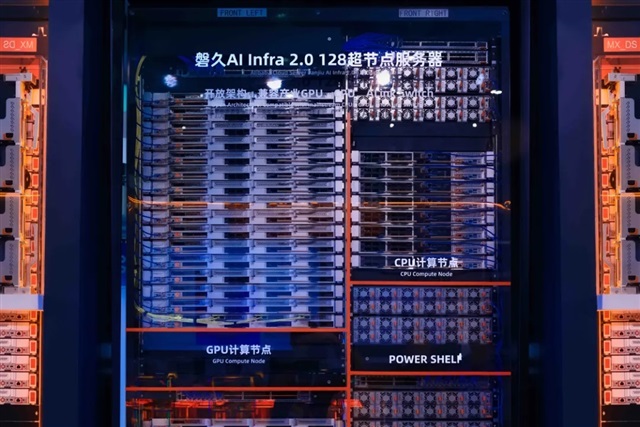
Alibaba Cloud made two related announcements: the company is open-sourcing the software stack for its AI accelerators, and it is launching Zhenwu, a cloud service based on the Panjiu AL128 supernode. The Panjiu AL128 is a rack-scale system that integrates AI accelerators and ALink switching hardware. Beyond the immediate news, this move redraws the boundary between cloud services and on-premise infrastructure, carrying tangible implications for organizations running Large Language Models outside the public cloud.
Open-sourcing chip-level software isn't unprecedented, but when an hyperscaler does it, the signal matters. Making the control layer public allows integrators, OEMs, and even individual enterprises to tailor the hardware to specific requirements—thermal constraints, VRAM management in multi-node setups, custom inference pipelines. The result is a reduction of vendor lock-in: accelerators become more akin to commodity servers, where value shifts from the silicon alone to the orchestration layer. This is particularly relevant for self-hosted deployments, where software freedom directly impacts the ability to keep data local and avoid mandatory cloud dependencies.
For the on-premise landscape, the strategic message is clear. Proprietary drivers and libraries often act as an invisible leash, tying hardware lifecycle to a single vendor's roadmap. With an open control stack, an organization can extend hardware longevity, write bespoke inference pipelines, and enforce stricter data sovereignty. AI-RADAR has consistently tracked this tension: Alibaba's approach suggests a hybrid model where cloud services can coexist with locally deployed hardware running the same open software foundation. It's no longer a binary "cloud vs. on-premise" choice; it becomes a spectrum where the same building blocks can be assembled in different locations depending on compliance, cost, and latency needs.
The Panjiu AL128 supernode, the physical core of the Zhenwu service, is described as a rack-scale system stitching together accelerators and switches through an interconnection technology called ALink. Tight integration of compute and networking is the hallmark of systems designed for large LLM workloads: inter-chip communication latency and aggregate bandwidth directly affect inference throughput in multi-tenant serving scenarios. A well-designed interconnect means that even quantized models can be served at scale without the bottleneck migrating from VRAM to the network. Alibaba is clearly betting that this tight-coupling design will become a reference for AI factories, whether they run in the cloud or on private infrastructure.
The dual move—launching a cloud service while open-sourcing the software—reveals a two-layered strategy. On one layer, Alibaba monetizes shared infrastructure through Zhenwu, offering on-demand compute. On the other, it seeds an ecosystem that can grow outside its own data centers, creating a feedback loop: wider software adoption drives hardware sales or third-party integrations, which in turn refine the software. For competitors, the message is that the AI infrastructure battle isn't just about who builds the fastest chip; it's about who controls the orchestration layer and sets a de facto standard for rack-level integration.
This shift arrives as the industry searches for alternatives to concentrated GPU supply. If accelerator control software becomes a shared commons, competitive pressure moves to hardware efficiency and the maturity of deployment frameworks. Organizations managing on-premise infrastructure might eventually combine accelerators from multiple vendors under a unified open software layer, optimizing Total Cost of Ownership without sacrificing flexibility. It's still an emerging scenario, but moves like Alibaba's accelerate its technical foundations.




💬 Comments (0)
🔒 Log in or register to comment on articles.
No comments yet. Be the first to comment!