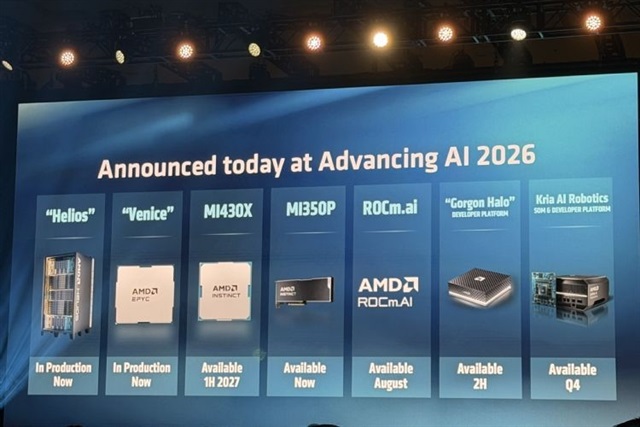
AMD lifted the curtain on ROCm.ai, an initiative aimed at accelerating the development and deployment of agentic AI applications, claiming up to 3.3x inference speedups. The news, reported by Monica Chen for DigiTimes, lands at a time when agentic workflows – characterized by multiple calls, tool orchestration, and step‑by‑step reasoning – are pushing compute infrastructure to its limits, making every percentage point of throughput a competitive multiplier.
The term “agentic AI” is not marketing fluff: it defines LLM systems that operate with partial autonomy, breaking down complex tasks into sub‑problems and interacting with external APIs, databases, and other models. This modality multiplies the number of tokens processed per single interaction and shifts the bottleneck from training to production serving, where cumulative latency and cost per query become critical. Against this backdrop, a promise of 3.3x inference improvement – assuming it refers to metrics such as tokens per second or time‑to‑first‑token on Radeon Instinct or adapted consumer architectures – strikes a nerve for teams evaluating on‑premise deployments.
For the AI‑RADAR audience, focused on local stacks and deployment decisions that prioritize data sovereignty and TCO, ROCm.ai is a concrete signal of AMD’s determination to carve out a space beyond CUDA’s dominion. Historically, the Achilles’ heel of AMD GPUs for LLM workloads has been software: compatibility with frameworks like PyTorch and libraries such as vLLM has improved, but still trails Nvidia’s ecosystem in out‑of‑the‑box support for quantization, fine‑tuning, and custom operators. Today’s announcement hints at a focused investment precisely in the optimization layer, the one that turns raw teraFLOPS into actually processed tokens.
No official details have been released about the cards used for benchmarking, nor about numerical precision levels or context window length. Without those, the 3.3x figure should be taken with a grain of salt. Still, the very existence of a platform dedicated to agentic AI indicates that AMD is building libraries and kernels tailored for compute patterns that go beyond plain text generation: multi‑turn reasoning, function calling, document retrieval. These patterns benefit enormously from optimizations in scheduling and VRAM management, two areas where ROCm has room to improve and which could make AMD GPUs far more competitive in on‑premise multi‑GPU configurations.
Structurally, the launch heats up competition in a segment that has been almost a monopoly. If the promised optimizations translate into reproducible results on cost‑effective hardware, the impact could be a lowering of barriers for labs and companies that currently avoid running agentic pipelines in‑house for fear of runaway cloud bills. At stake is not just a slice of market share, but control of the hardware‑software interface on which the next generation of LLM applications will be built. With ROCm.ai, AMD raises the ante and forces the entire industry to reckon with an alternative that, should it mature, will reshape incentives for anyone designing local stacks.






💬 Comments (0)
🔒 Log in or register to comment on articles.
No comments yet. Be the first to comment!