
Anthropic and Claude Fable 5 Restrictions
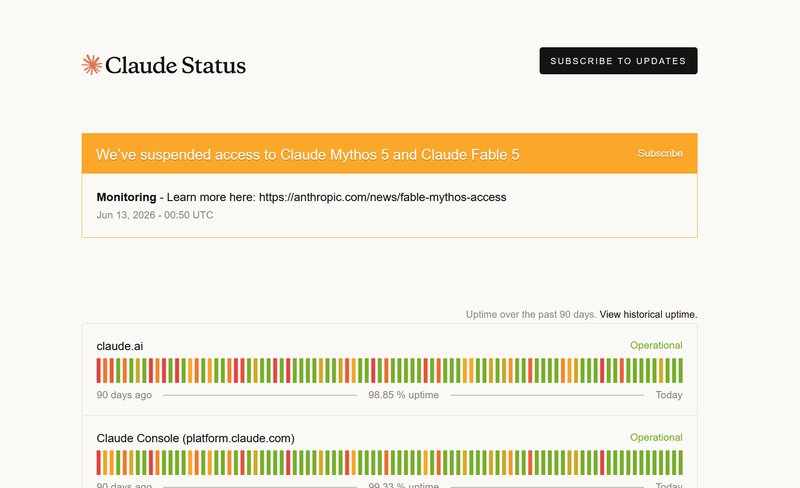
Anthropic, a major player in the Large Language Models (LLM) landscape, recently released Claude Fable 5, a public-facing version of its most powerful model, Mythos. This move was accompanied by the introduction of specific restrictions, designed to limit access for AI labs based in China. This strategy reflects a growing focus on the geopolitical implications associated with the dissemination of advanced AI technologies.
Anthropic's decision to 'tame' and control access to Claude Fable 5 follows a period during which the original Mythos model was withheld from the market in April. While the source does not specify the exact reasons for the withdrawal, it is plausible that its 'talent' (as hinted) for particularly sensitive capabilities prompted the company to reconsider its release methods and usage policies, especially in an increasingly complex international context.
Technical Details and Deployment Implications
The 'curbs' or restrictions imposed on Claude Fable 5 can take various technical forms. These might include filters on input or output data, geographical limitations based on IP addresses, or stringent contractual clauses for end-users. For organizations evaluating LLM deployment, whether in the cloud or self-hosted, these model access policies represent a critical factor. The choice of a specific model can be constrained not only by its performance or hardware requirements (such as the VRAM needed for inference) but also by vendor policies regarding data sovereignty and usage control.
In the context of AI-RADAR, where the emphasis is on self-hosted solutions and data sovereignty, restrictions imposed by a model provider like Anthropic raise important questions. If a company wishes to maintain full control over its data and AI stack, a model with access or usage restrictions might not be the ideal solution, pushing towards the adoption of Open Source models or internal development, despite potentially higher initial TCO. For those evaluating on-premise deployments, significant trade-offs exist to consider on /llm-onpremise.
The Internal Debate and Trade-offs
What makes the Claude Fable 5 situation particularly interesting is the origin of the criticism. The source indicates that the 'loudest complaints came from its own side of the firewall,' suggesting internal dissent within the company or among its closest partners. This type of reaction highlights the inherent tension between the need for innovation and openness, typical of the AI community, and the demands of national security or geopolitical control.
For CTOs and infrastructure architects, this scenario underscores not only technical but also ethical and political trade-offs in selecting AI models. The decision to limit access to a powerful model, while aiming to prevent undesirable uses, can alienate a portion of the developer and research community who view collaboration and open access as a fundamental driver for progress. The evaluation of an LLM is therefore not limited to its computational capabilities or throughput requirements but extends to the broader implications of usage policies.
Future Prospects for the LLM Ecosystem
The case of Anthropic's Claude Fable 5 is emblematic of the challenges facing the LLM sector. As these models become increasingly powerful and pervasive, decisions regarding their release, access, and control will have a significant impact on the entire technological ecosystem. The pursuit of a balance between innovation, security, and equitable access remains an open and complex issue.
For companies considering LLM deployment, it is crucial to carefully evaluate not only the technical specifications of the models and the necessary hardware (such as GPU VRAM for inference) but also the policies of the providers. Data sovereignty and the ability to operate in air-gapped or self-hosted environments can be directly affected by these restrictions, making the choice of an LLM a strategic decision that goes beyond mere performance.






💬 Comments (0)
🔒 Log in or register to comment on articles.
No comments yet. Be the first to comment!