
Anthropic Releases Claude Fable 5: "Mythos-class" Intelligence Goes Public
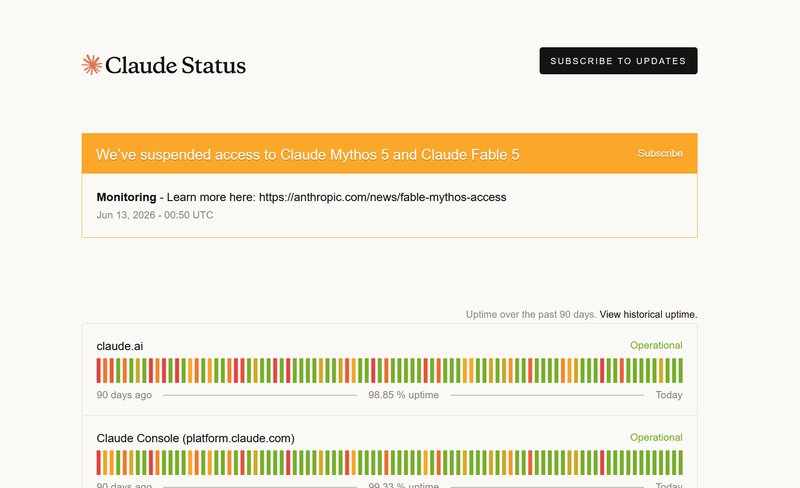
Anthropic has announced the release of Claude Fable 5, a new Large Language Model promising to bring advanced capabilities to a wider audience. This model is built on the same architecture as the previously restricted Mythos system, marking a significant moment: "Mythos-class" intelligence is now accessible for the first time.
The release of Fable 5 is strategic, targeting enterprise customers and paid subscribers. The company emphasizes the integration of new safeguards designed to limit responses in sensitive areas such as cybersecurity, biology, and chemistry. This focus on security and content moderation is a key factor for adoption in business contexts, where risk management and compliance are priorities.
Architectural Details and Deployment Requirements
While specific details on Fable 5's architecture have not been deeply disclosed, the reference to "Mythos-class" intelligence suggests a model of considerable complexity and capability. Managing LLMs of this scale requires robust infrastructure, whether opting for a cloud deployment or self-hosted solutions. Its availability to enterprise customers implies that Anthropic has considered the scalability, performance, and security needs typical of these environments.
For companies evaluating the integration of advanced models like Fable 5, hardware and infrastructure decisions are crucial. Running large LLMs on-premise, for instance, can require significant investments in high-VRAM GPUs and an optimized Inference pipeline to ensure acceptable Throughput and latency. The choice between a cloud approach and a bare metal deployment often depends on factors such as TCO, data sovereignty, and the need for air-gapped environments.
Implications for Data Sovereignty and Compliance
Fable 5's enterprise focus, coupled with the new safeguards, highlights the growing importance of data management and compliance in LLM adoption. For regulated industries or companies with stringent privacy requirements, the ability to control where and how data is processed is fundamental. The safeguards implemented by Anthropic may be an attempt to mitigate risks associated with using generative models in critical areas, but they do not eliminate the need for companies to carefully evaluate their deployment strategies.
The decision to adopt an LLM like Fable 5 often clashes with the need to maintain data sovereignty. An on-premise deployment offers maximum control over data and the execution environment but entails higher initial costs and operational complexities. Conversely, cloud solutions can offer greater flexibility and scalability but require careful evaluation of the provider's data management policies and compliance implications (e.g., GDPR).
Market Outlook and Final Considerations
The release of Claude Fable 5, just days before a potential record IPO for Anthropic, underscores the dynamism and competitiveness of the LLM market. The company aims to consolidate its position by offering powerful models with a specific focus on enterprise needs and constraints. This positioning is crucial in a landscape where differentiation is based not only on pure model capability but also on its security, controllability, and suitability for critical applications.
For technical decision-makers, the arrival of models like Fable 5 enriches the landscape of options but also complicates the choice. Evaluating an LLM cannot disregard a thorough analysis of the trade-offs between performance, costs, security, and control. AI-RADAR, for example, offers analytical Frameworks on /llm-onpremise to help navigate these complexities, providing tools to evaluate self-hosted and cloud alternatives based on concrete parameters.





💬 Comments (0)
🔒 Log in or register to comment on articles.
No comments yet. Be the first to comment!