
Anthropic Withdraws Claude Fable 5 for Government Compliance
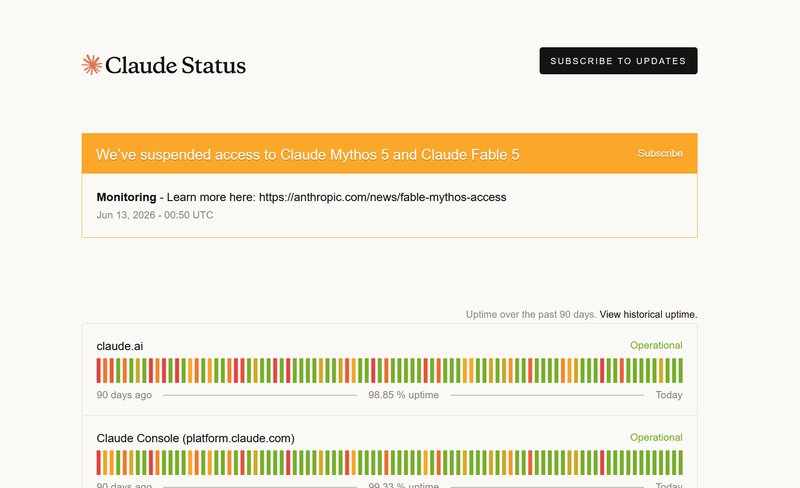
Anthropic, a leading developer of Large Language Models (LLMs), recently announced a significant move: the withdrawal of its "Claude Fable 5" model from platforms. This decision, communicated by the company via a blog post, was not voluntary but made in compliance with a direct injunction from the United States government.
According to Anthropic's statement, government authorities reportedly identified an effective method to "bypass" or, in technical jargon, "jailbreak" the Fable 5 model. This discovery triggered the government's intervention, highlighting growing concerns regarding the security and controllability of advanced artificial intelligence systems.
The Phenomenon of "Jailbreaking" in Large Language Models
"Jailbreaking" an LLM refers to the ability to circumvent the built-in safeguards and security filters of the model, prompting it to generate content that would normally be blocked. This content can range from inappropriate or offensive responses to instructions for illegal or dangerous activities. For companies considering LLM adoption, vulnerability to "jailbreaking" represents a significant risk.
A compromised model can expose an organization to compliance issues, reputational risks, and potential data security breaches. The ability of a malicious actor to manipulate an LLM for unintended purposes undermines trust in the system and raises questions about its reliability in critical contexts, such as enterprise or government environments.
Implications for On-Premise Deployments and Data Sovereignty
For CTOs, DevOps leads, and infrastructure architects evaluating LLM solutions, the Claude Fable 5 incident underscores the importance of rigorous model security assessment. In on-premise deployments, where data sovereignty and complete control over the infrastructure are priorities, the robustness of the model itself becomes a critical factor.
The choice of an LLM, whether proprietary or Open Source, must consider not only its performance capabilities (throughput, latency, VRAM required for inference) but also its resilience to manipulation attempts. The possibility of "jailbreaking" a model can compromise efforts to maintain an air-gapped environment or adhere to stringent privacy and security regulations. AI-RADAR offers analytical frameworks on /llm-onpremise to evaluate these complex trade-offs.
Future Outlook and Risk Management in LLMs
The episode involving Anthropic and Claude Fable 5 highlights an evolving challenge for the entire artificial intelligence industry: the need to develop increasingly secure and attack-resistant LLMs. Model providers must invest in advanced alignment and risk mitigation techniques, while adopting organizations must implement multi-layered security strategies.
This includes not only selecting reliable models but also adopting continuous validation pipelines and integrating monitoring systems to detect anomalous behavior. Risk management associated with Large Language Models is set to become an increasingly central component in infrastructure deployment decisions, especially in environments where control and security are non-negotiable.







💬 Comments (0)
🔒 Log in or register to comment on articles.
No comments yet. Be the first to comment!