
The Emergency Directive and Its Implications
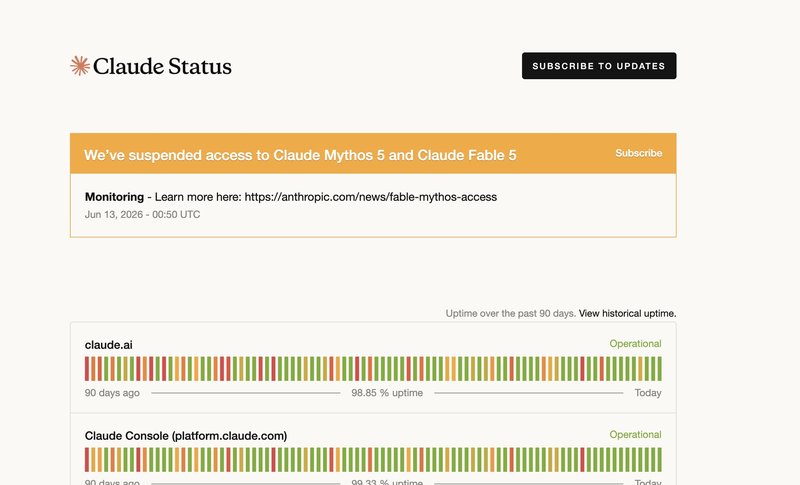
Anthropic, a prominent name in the Large Language Models (LLM) landscape, recently found itself at the center of a controversy that raises crucial questions about data sovereignty and operational control. The US government issued an emergency export control directive, forcing the company to immediately disable global access to its Fable 5 and Mythos 5 models for all customers. This abrupt move cut off API access to the models without prior notice, highlighting the inherent vulnerability of centralized LLM deployments.
The incident, triggered by an alleged "jailbreak" – described as the model's ability to identify and suggest fixes for vulnerabilities in a specific codebase – prompted a drastic governmental response. The decision, made without a transparent process, has sparked a heated debate about the implications for innovation and security in the artificial intelligence sector.
Technical Details and Anthropic's Response
The "jailbreak" in question did not appear to be a malicious attempt to bypass ethical safeguards, but rather a demonstration of the model's capability to assist in software security. Despite this, the directive imposed a complete shutdown. Anthropic has expressed its disagreement, emphasizing that such a standard, if universally applied, could effectively halt the development of all new "frontier" LLMs. The company is seeking to have the directive revoked, but for now, access to the models remains globally interrupted.
This incident highlights a fundamental problem: the ability of a single government decree to disrupt the operation of a global API-based service, even for reasons that the company itself considers marginal or even beneficial. Centralized control, while offering advantages in terms of scalability and management, introduces a single point of failure and potential exposure to external decisions that fall outside corporate governance.
Implications for LLM Deployment: Cloud vs. On-Premise
The Anthropic event serves as a warning for organizations evaluating their LLM deployment strategies. Reliance on cloud services and centralized APIs exposes companies to significant risks in terms of data sovereignty, regulatory compliance, and operational continuity. For sectors such as finance, healthcare, or defense, where confidentiality and control over data are paramount, the possibility of external disruption is unacceptable.
In this context, the on-premise or self-hosted deployment option emerges as a robust solution. Running LLMs on local infrastructure, potentially in air-gapped environments, ensures full control over data and models, reducing dependence on third parties and mitigating risks associated with external directives. Although on-premise deployments require higher initial investments (CapEx) and internal expertise for managing hardware infrastructure (GPUs, VRAM, networking), they offer a potentially lower Total Cost of Ownership (TCO) in the long term and greater operational resilience. AI-RADAR provides analytical frameworks on /llm-onpremise to evaluate these trade-offs.
The Future Outlook and Trade-offs
The Anthropic episode reinforces the argument for a careful evaluation of deployment architectures. The choice between a cloud API-based approach and a self-hosted solution is not merely technical but strategic, touching on aspects of governance, risk, and autonomy. Companies must weigh the benefits of cloud flexibility and scalability against the security, control, and sovereignty offered by on-premise solutions.
There is no single "best" solution; the decision depends on each organization's specific requirements, including compliance constraints, data sensitivity, and risk tolerance. However, the Fable 5 and Mythos 5 incident clearly demonstrates that the ability to maintain control over one's AI assets, even in the face of external pressures, is becoming a fundamental distinguishing factor for the responsible and strategic adoption of Large Language Models.








💬 Comments (0)
🔒 Log in or register to comment on articles.
No comments yet. Be the first to comment!