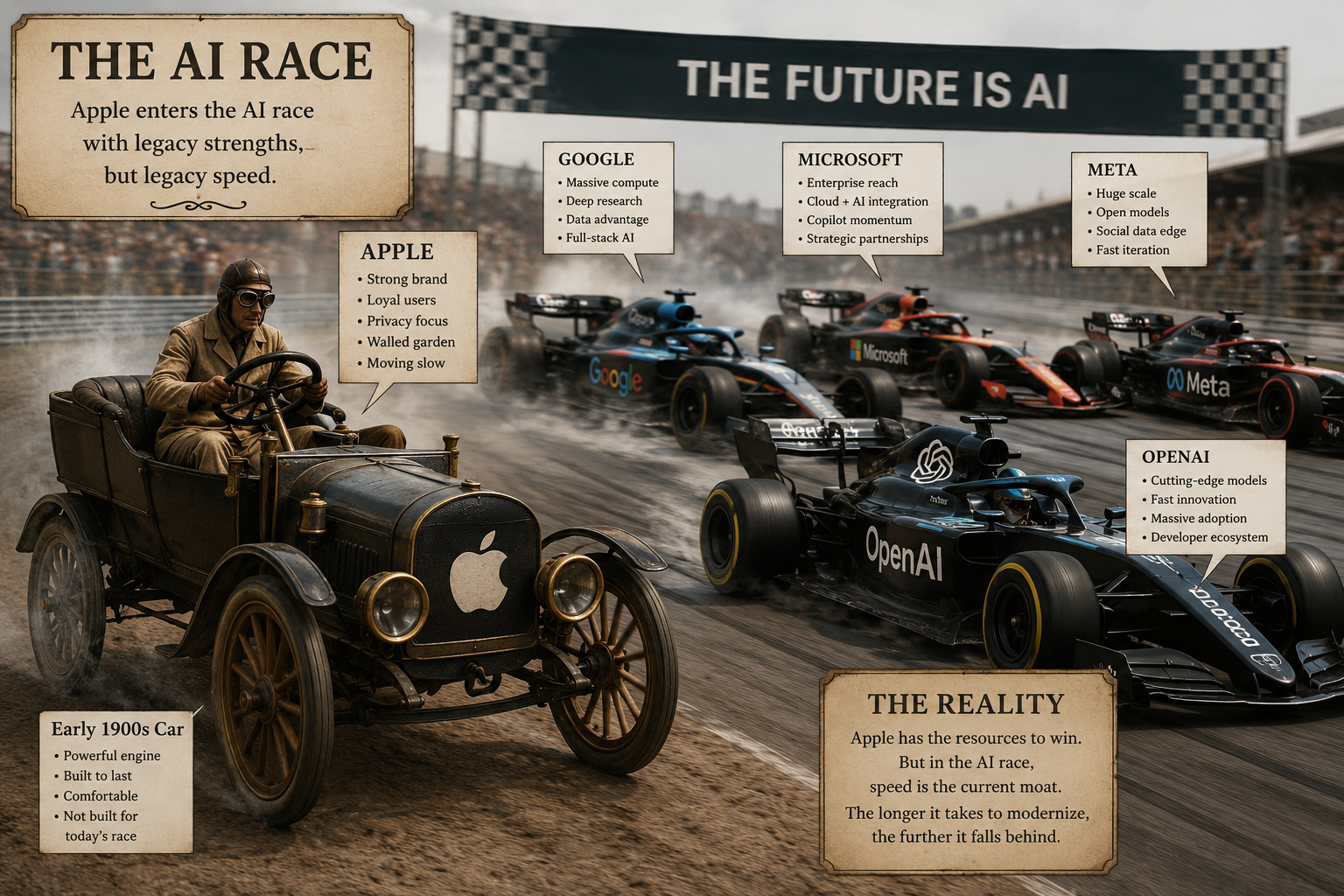
Is Apple the AI Dinosaur, or the Apex Predator?
For the better part of two years, the prevailing narrative in Silicon Valley has been that Apple was asleep at the wheel. While Microsoft, Meta, Google, and Amazon engaged in a hundred-billion-dollar infrastructure arms race, hoarding NVIDIA GPUs like apocalyptic preppers hoarding canned beans, Apple seemed content to sit on the sidelines. Wall Street pundits declared Apple a passive, lagging participant in the generative artificial intelligence landscape, structurally reluctant to participate in the data center capital expenditure (CapEx) bloodbath.
But as the dust settles following the Worldwide Developers Conference (WWDC) in June 2026—marking CEO Tim Cook’s final keynote before handing the reins to John Ternus—a radically different picture is emerging. Apple hasn’t been passive; it has been executing a masterclass in financial pragmatism and ecosystem control. Apple is not trying to build the most expensive "brain" in the world. Instead, it has orchestrated a capital-light strategy to become the sovereign gateway of the generative AI economy.
Are Mac Studios and Mac Minis enough to prove Apple is still in the AI race? Is the company hopelessly behind, or simply playing a game its hyperscaler rivals haven't figured out yet? Let’s launch a deep-dive investigation into Apple’s AI strategy, examining it from the boardroom to the silicon, and down to the trenches of on-premise Local LLM development.
--------------------------------------------------------------------------------
The "AIMLess" Years and the Pragmatic Pivot
To understand where Apple is in 2026, we must acknowledge how badly they stumbled in 2024. Prior to its recent course correction, Apple’s internal AI division was plagued by fragmented direction, earning the derisive internal nickname "AIMLess". Early iterations of Apple Intelligence suffered from integration delays, and the legacy Siri assistant failed to execute complex, multi-step queries approximately 33% of the time. Furthermore, Apple suffered a severe talent drain, losing prominent foundation model researchers to Meta.
Initially, Apple tried to bridge this gap by partnering with OpenAI. But that relationship fractured spectacularly. Apple had little interest in driving users to premium ChatGPT tiers, and OpenAI’s aggressive hardware ambitions—including a secret collaboration with former Apple design chief Jony Ive to build an "AI agent" device—presented a direct threat to the iPhone.
Faced with a crisis, Apple's senior leadership convened a secret summit in early 2025. Software chief Craig Federighi assumed total control of the AI strategy, and Vision Pro founder Mike Rockwell was tasked with tearing Siri down to the studs. The result? Apple formally ditched OpenAI and signed a landmark, multi-year licensing agreement with Google.
For an estimated $1 billion annually (scaling up to $5 billion over time), Apple secured Google’s Gemini 3 architecture as the technological underpinning for its next generation of Apple Foundation Models (AFM 3). This was a stroke of genius. Let Google spend the $100 billion to build the data centers; Apple would simply rent the intellect and wrap it in its proprietary, privacy-preserving operating systems.
--------------------------------------------------------------------------------
The Third-Generation Apple Foundation Models (AFM 3): A Technical Marvel
By renting Google’s massive compute power to train its systems, Apple focused its internal engineering on what it does best: edge-device optimization. At WWDC 2026, Apple introduced the third generation of Apple Foundation Models, a family of five models that represent a massive generational leap.
| Model Name | Parameter Size | Primary Deployment Target | Technical Specialty |
|---|---|---|---|
| AFM 3 Core | 3 Billion (Dense) | On-Device (iPhone, iPad, Mac) | Optimized for low-latency text processing and everyday suggestions. |
| AFM 3 Core Advanced | 20 Billion (Sparse MoE) | Premium Apple Silicon (M-series, A18 Pro) | Uses Instruction-Following Pruning (IFP) to bypass local memory limits. |
| AFM 3 Cloud | Proprietary (PT-MoE) | Private Cloud Compute (Apple Silicon) | Server-side workhorse for speed, efficiency, and multimodal reasoning. |
| ADM 3 Cloud | Diffusion Architecture | Private Cloud Compute | Advanced image generation, Spatial Reframing, and Clean Up tools. |
| AFM 3 Cloud Pro | Frontier Scale | Private Cloud Compute (NVIDIA GPUs) | Deep agentic tool use and complex reasoning, running on Google Cloud. |
The true engineering crown jewel here is AFM 3 Core Advanced. Running a 20-billion parameter model locally would normally choke a smartphone's Random Access Memory (DRAM). Apple solved this using a novel sparsely activated architecture built on Instruction-Following Pruning (IFP).
Instead of forcing the entire model into DRAM, the model's bulk resides in flash storage (NAND). Because moving data from NAND to DRAM is usually too slow for real-time AI, the model makes routing decisions per prompt. A lightweight block selects a fixed set of "routed experts" to swap into DRAM alongside permanently active "shared experts". As a result, the model only activates 1 to 4 billion parameters at any given time. Apple essentially taught a 20B model how to successfully hide in a phone's flash drive like a squirrel hoarding nuts, only surfacing the exact knowledge it needs at millisecond speeds.
--------------------------------------------------------------------------------
The Local LLM Perspective: Are Mac Studios and Mac Minis Keeping Apple in the Race?
To answer whether Apple is still in the AI race, we have to look away from the cloud and examine the desks of AI researchers and developers. In the on-premise, Local LLM market, Apple is not just participating; it has carved out a highly defensible, near-monopolistic moat thanks to its Unified Memory Architecture (UMA).
Traditional PCs suffer from a fractured memory system: the CPU has its system RAM, and the GPU has its VRAM (Video RAM). If a developer wants to run a massive open-source model locally—say, Meta's Llama 3.1 405B or DeepSeek R1 671B—they are hard-capped by the VRAM on their graphics card. The mighty NVIDIA RTX 5090, the undisputed king of consumer GPUs, maxes out at 32GB of GDDR7 VRAM. To fit a 405B parameter model, a developer would need to buy a rack of enterprise-grade NVIDIA GPUs costing tens of thousands of dollars.
Enter the Mac Studio and Mac Mini. Because Apple Silicon integrates memory directly into a shared pool accessible by both the CPU and GPU with zero-copy latency, a Mac Studio M3 Ultra configured with 192GB or 256GB of unified memory can load these colossal frontier models in one piece. Apple’s hardware turns consumer desktops into cost-efficient, low-power AI workstations idling at under 20 watts, while a dual-RTX 5090 rig would pull 400+ watts and sound like a Boeing 747 taking off in your office.
Tools like Ollama, LM Studio, and Apple’s own MLX framework have made running local AI on Macs incredibly frictionless. With zero API costs, zero internet dependency, and absolute privacy, Apple Silicon has become the gold standard for independent AI developers.
Capacity vs. Bandwidth: The Apple Silicon Compromise
However, to say Apple has "beaten" NVIDIA in local hardware would be disingenuous. The Local LLM space is governed by one immutable law of physics: Tokens per second = Memory Bandwidth / Model Size in bytes.
Apple wins on capacity (the size of the parking lot), but NVIDIA absolutely obliterates Apple on bandwidth (the number of lanes on the highway).
Table 1: Apple Silicon vs. NVIDIA GPUs - Hardware Specifications
| Hardware | VRAM / Unified Memory | Memory Bandwidth | AI Compute Hardware |
|---|---|---|---|
| Mac mini (M4 Pro) | Up to 64 GB | 273 GB/s | 16-core Neural Engine |
| Mac Studio (M4 Max) | Up to 128 GB | 546 GB/s | 16-core Neural Engine |
| Mac Studio (M3 Ultra) | Up to 256 GB | 819 GB/s | 32-core Neural Engine |
| NVIDIA RTX 5090 | 32 GB GDDR7 | 1,792 GB/s | 5th Gen Tensor Cores (~209 TFLOPS) |
| NVIDIA RTX PRO 6000 | 96 GB GDDR7 ECC | 1,792 GB/s | 5th Gen Tensor Cores (~250 TFLOPS) |
If a model is small enough to fit inside the RTX 5090's 32GB VRAM (like a quantized 8B or 27B model), NVIDIA's 1,792 GB/s bandwidth means it will spit out tokens at blinding speeds.
Table 2: Tokens Per Second (t/s) Benchmark Comparison (at 65% Efficiency)
| Model & Size (Q4_K_M) | Mac mini (M4 Pro) | Mac Studio (M3 Ultra) | Single RTX 5090 | Dual RTX 5090 |
|---|---|---|---|---|
| Llama 3.1 8B (~4.9 GB) | ~36 t/s | ~109 t/s | ~238 t/s | ~238 t/s |
| Gemma 3 27B (~16.5 GB) | ~11 t/s | ~32 t/s | ~71 t/s | ~141 t/s |
| Llama 3.3 70B (~42.5 GB) | ~4 t/s | ~13 t/s | Does Not Fit | ~55 t/s |
| DeepSeek R1 671B (~404 GB) | Does Not Fit | Does Not Fit | Does Not Fit | Does Not Fit |
(Note: The 671B model requires specialized enterprise rigs or extreme quantization to run locally, though Apple's 256GB configurations can run smaller 200B+ MoE models at ~4 t/s where NVIDIA consumer cards simply crash.)
There is another severe limitation to Apple's Unified Memory: The Multi-User Cliff. Because the CPU, GPU, and Neural Engine all share the same memory bus, Apple Silicon suffers a catastrophic 70% drop in throughput when multiple users attempt to query the model simultaneously. NVIDIA hardware, with dedicated VRAM, only experiences a 48% drop under similar 8-user loads. Furthermore, the industry's fine-tuning and production serving frameworks (like vLLM and TensorRT-LLM) are built strictly for NVIDIA's CUDA ecosystem, leaving Apple's Metal framework playing catch-up.
The Verdict on Hardware: Are Mac Studios and Minis enough to keep Apple in the race? Absolutely. For solo developers, privacy-conscious enterprise workers, and interpretability researchers, the Mac Studio is the most cost-efficient high-capacity AI workstation on earth. Apple has essentially built a quiet, reliable minivan that can carry a 400-billion parameter payload. NVIDIA builds Formula 1 cars—they are vastly faster, but only if your payload fits in the passenger seat.
--------------------------------------------------------------------------------
Private Cloud Compute (PCC): The Ultimate Security Trojan Horse
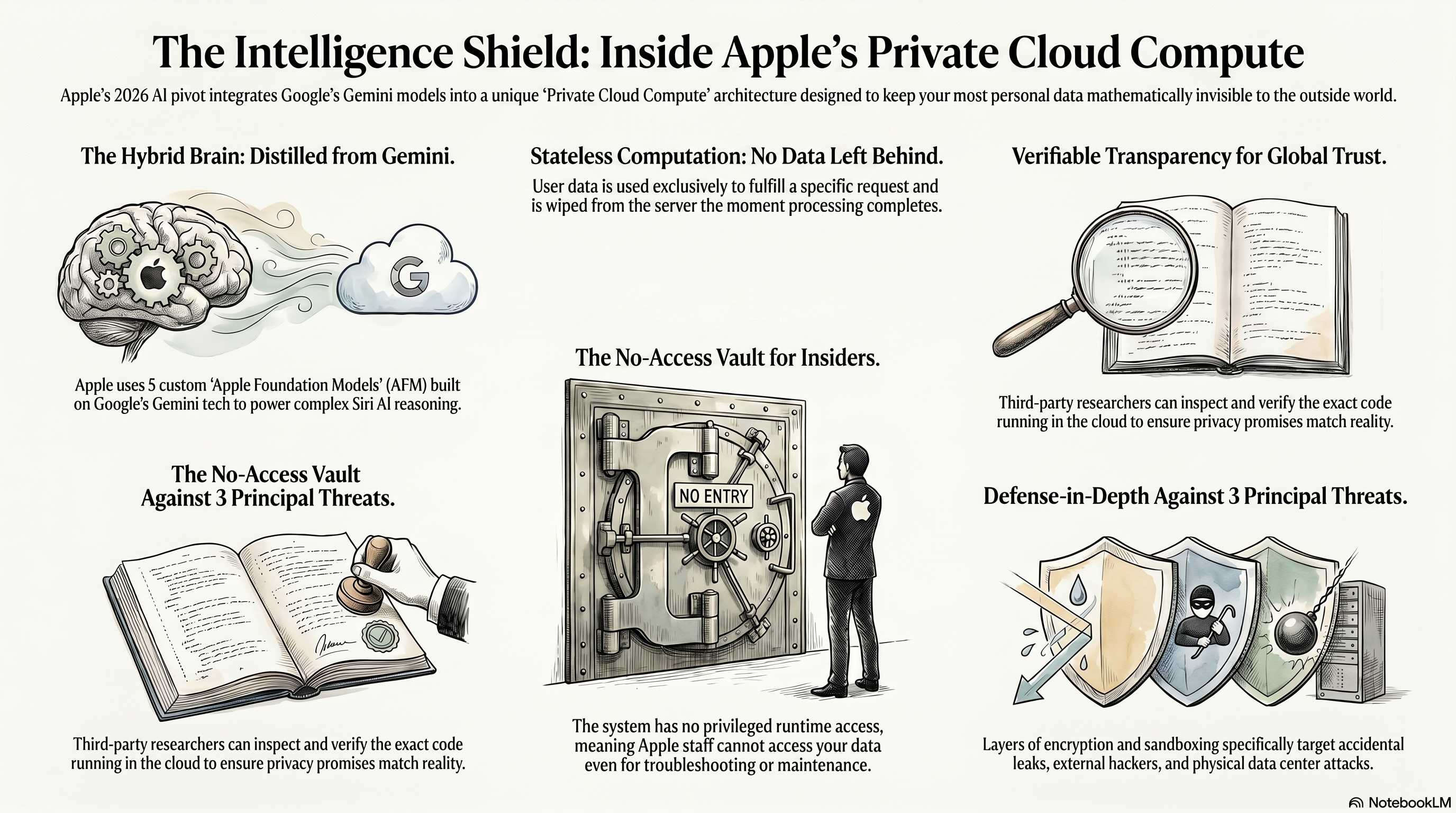
When a user's prompt is too complex for the on-device AFM 3 Core models, Apple routes the request to the cloud. Historically, sending personal data to a hyperscaler's server is a privacy nightmare. Apple turned this vulnerability into its greatest strength with Private Cloud Compute (PCC).
In 2026, Apple expanded PCC to run on Google Cloud servers equipped with NVIDIA GPUs. But Apple didn't just hand the keys to Google. They designed a stateless, secure cloud environment using NVIDIA Confidential Computing, Intel CPUs with Trust Domain Extensions (TDX), and Google’s Titan security chips.
When your iPhone pings the cloud, the payload is end-to-end encrypted. The Google server processes the data in "Ephemeral Data Mode"—meaning the moment the task is complete, the data is cryptographically destroyed. It is never written to persistent storage, ensuring that neither Apple, Google, nor any malicious actor can access user queries. Apple even maintains a cryptographically verifiable ledger of all Google Cloud hardware in the PCC fleet to prevent supply chain attacks.
This is Orchestrated Sovereignty in action. Apple is using its competitor's servers, powered by a different competitor's GPUs, but maintaining absolute sovereign control over the data through Apple's cryptographic operating system locks.
--------------------------------------------------------------------------------
The Operating System Integration: Siri AI and iOS 27
What does this mean for the end consumer? Apple has recognized that chatbots are a feature, not a product. With iOS 27, watchOS 27, and macOS Golden Gate, Apple isn't asking you to open a chat window; they have woven AI directly into the fabric of the operating system.
The new Siri AI acts as an invisible orchestrator. Powered by a rebuilt system-wide search index, Siri is granted onscreen awareness and deep personal context. If you call an airline to change a flight, the new "Call Context" feature proactively pulls your confirmation code from a buried email and displays it on your phone screen.
Other ecosystem integrations include:
Visual Intelligence: Point your iPhone camera at a check to split the bill, or at a plate of food to estimate nutritional macros.Describe a Shortcut: Use natural language to tell your phone, "Turn on the porch lights when my food delivery arrives," and the Shortcuts app writes the automation code for you.Advanced Image Editing: "Spatial Reframing" and "Extend" use diffusion models to cleanly adjust photo horizons or seamlessly expand the borders of an image.Automatic Password Fixing: The Passwords app uses AI to proactively log into websites, navigate account settings, and replace weak or compromised passwords on your behalf.
And in a brilliant monetization move, Apple introduced the "Extensions" framework. Realizing that power users might want specialized models, Apple allows users to install third-party AI assistants (like ChatGPT, Claude, or Copilot) directly into the OS. Siri acts as the broker, routing queries to these third parties. Just as Apple takes a 30% cut of the App Store, it is perfectly positioned to extract high-margin transaction fees on premium AI subscriptions purchased through its ecosystem.
(Note: Apple is currently withholding these features from the European Union, citing concerns that the EU's Digital Markets Act (DMA) would force them to grant unfettered system access to third-party AI apps, thereby compromising their hard-fought privacy guarantees. A convenient excuse? Perhaps, but it effectively weaponizes user privacy against regulators.)
--------------------------------------------------------------------------------
The Capital-Light Financial Masterstroke
The most damning critique of Apple has been its financial passivity. Amazon expects its 2026 capital expenditures to approach an eye-watering $200 billion. Alphabet and Meta are guiding well over $100 billion. They are digging massive financial holes to buy NVIDIA GPUs and build the cooling infrastructure to support them.
Apple? Its CapEx for fiscal 2025 was a mere $12.7 billion. It has consistently kept infrastructure spending at around 3% of revenue.
Is Apple passive? No, it is financially disciplined. By licensing Gemini 3, Apple avoided the massive financial risk of building data centers that will inevitably face rapid depreciation as silicon iterates. Apple preserved its staggering $54 billion in quarterly operating cash flow to fund dividends and aggressively repurchase its own stock.
Apple’s strategy is clear: Let the hyperscalers burn hundreds of billions of dollars fighting over who has the smartest "brain." Apple owns the "face." Apple controls the two billion active devices in consumers' pockets. By sitting out the data center arms race, Apple bypassed the risk of commoditization and established itself as the tollbooth of the AI era.
Conclusion: The Apex Predator
To judge Apple’s role in the AI competition solely by the number of GPUs it owns is to fundamentally misunderstand the tech industry's value chain.
Is Apple behind? In raw, proprietary frontier model training, yes. But they realized early on that training frontier models is a zero-sum game with terrible profit margins. Through strategic alliances with Google, the deployment of Private Cloud Compute, and the unmatched local-capacity moat of Mac Studios and Mac Minis, Apple has successfully converted raw, expensive artificial intelligence into a seamlessly integrated, privacy-first commodity.
Apple isn't the dinosaur of the AI era. It's the casino owner. It doesn't matter whether Google, Meta, or OpenAI wins the hand; as long as the game is played on an iPhone or a Mac, the house always wins.




💬 Comments (0)
🔒 Log in or register to comment on articles.
No comments yet. Be the first to comment!