
There’s something symbolic about it: the company that prints the world’s most advanced circuits has become Europe’s most valuable listed business, with a valuation hovering around $700 billion. And some are already eyeing the next round number—a trillion—betting on the perfect fuel to close the gap: artificial intelligence. But reducing the question to a financial wager would be shortsighted. The real issue isn’t whether ASML will hit that ceiling, but what its trajectory tells us about the architecture underpinning LLM adoption in controlled environments.
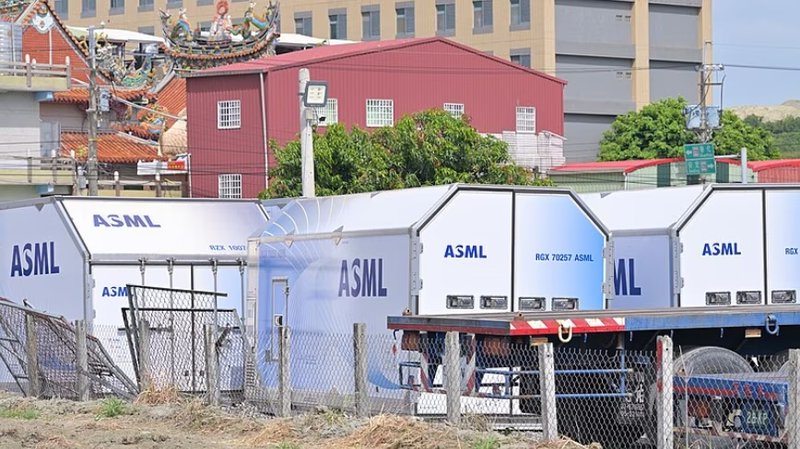
The extreme ultraviolet (EUV) lithography machines made by the Dutch company are the irreplaceable link in the production of chips at 5nm and below. Every GPU, every AI accelerator, every compute unit capable of running on-premise inference on large models originates there. And the current generative AI boom has turned that industrial niche into a systemic chokepoint. Advanced silicon supply can’t keep pace with demand, lead times stretch, and procurement costs soar. For an organization evaluating on-premise deployment to keep data under its own control, this isn’t an external variable—it’s the element that determines TCO and the project’s very feasibility.
Then there’s the geopolitical concentration effect. The fabs that use ASML’s tools—primarily TSMC and Samsung—are clustered in just a few parts of the world. A data sovereignty strategy that rests on buying hardware manufactured in a single hemisphere risks simply shifting dependency from the cloud provider to the silicon provider. It’s no small paradox: you abandon hyperscaler lock-in only to embrace a physical lock-in, where the supply chain has a unique, irreplaceable bottleneck. ASML’s trillion isn’t just a milestone for shareholders; it’s a thermometer of how the entire local AI ecosystem is growing on shakier foundations than it appears.
For those watching these dynamics from an infrastructure perspective, the signal is clear. The tension between compute demand and production capacity will push more and more companies to explore software optimization techniques—aggressive quantization, smaller model orchestration, distributed inference pipelines over heterogeneous clusters—just to work around the shortage of cutting-edge hardware. This isn’t a fallback solution; it’s an inevitable development path for anyone unwilling to remain hostage to a supply chain with a single point of failure. In this scenario, ASML’s trillion-dollar chase isn’t a tech fairy tale: it’s the warning light of a market running with a single supplier of wind turbines as the wind picks up. And the real question, for those doing on-premise deployment, isn’t whether ASML will become a trillion-dollar company, but how to build a hardware strategy that survives the next supply chain shock.







💬 Comments (0)
🔒 Log in or register to comment on articles.
No comments yet. Be the first to comment!