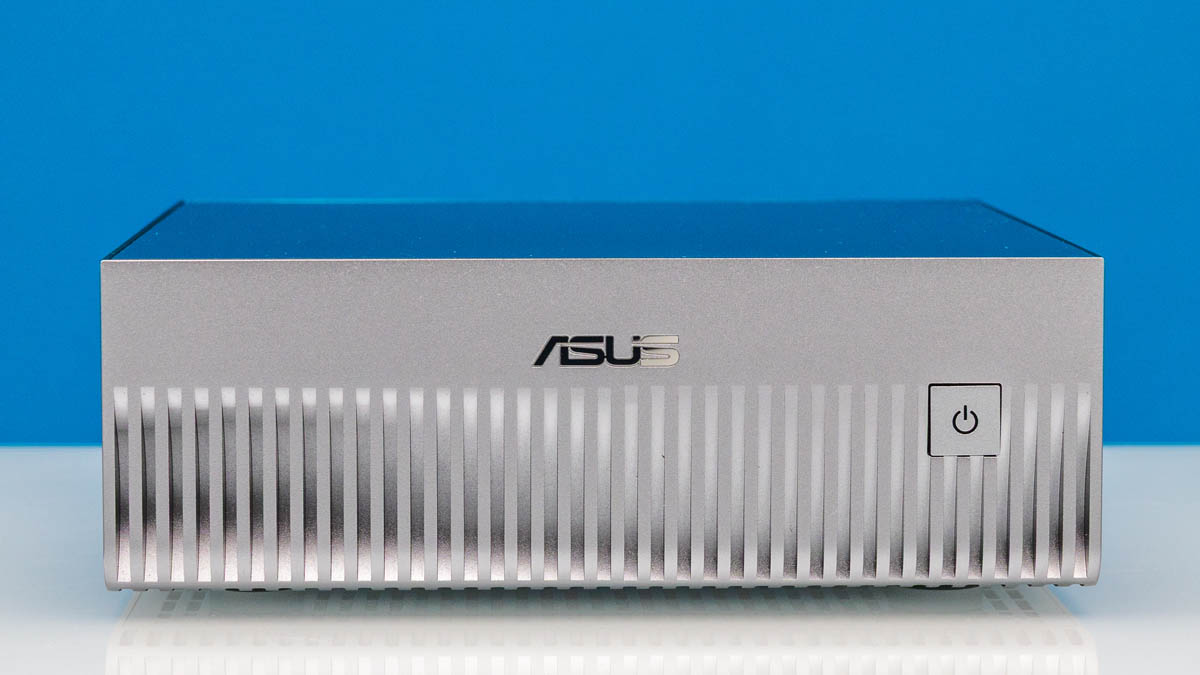
1. The Dawn of the Desk-Side Supercomputer
The artificial intelligence industry is currently witnessing a violent correction in compute strategy: the retreat from total cloud-dependency back toward localized, high-performance "AI on Premises." The ASUS Ascent GX10 is the tip of this spear. Positioned as the scaled-down successor to the enterprise DGX server line, the GX10 attempts to condense data-center-class performance into a diminutive 1.6L chassis.
From the AI-Radar perspective, this is a calculated play for the "Sovereignty" market. For AI startups and researchers, the ability to prototype, fine-tune, and run inference on massive models without the recurring "token tax" or the privacy risks of public APIs is a paradigm shift. While the datasheet markets this as a compact power-user tool, we view it as a specialized laboratory instrument designed to democratize high-parameter development.
2. Architectural Deep Dive: The NVIDIA GB10 Grace Blackwell Superchip
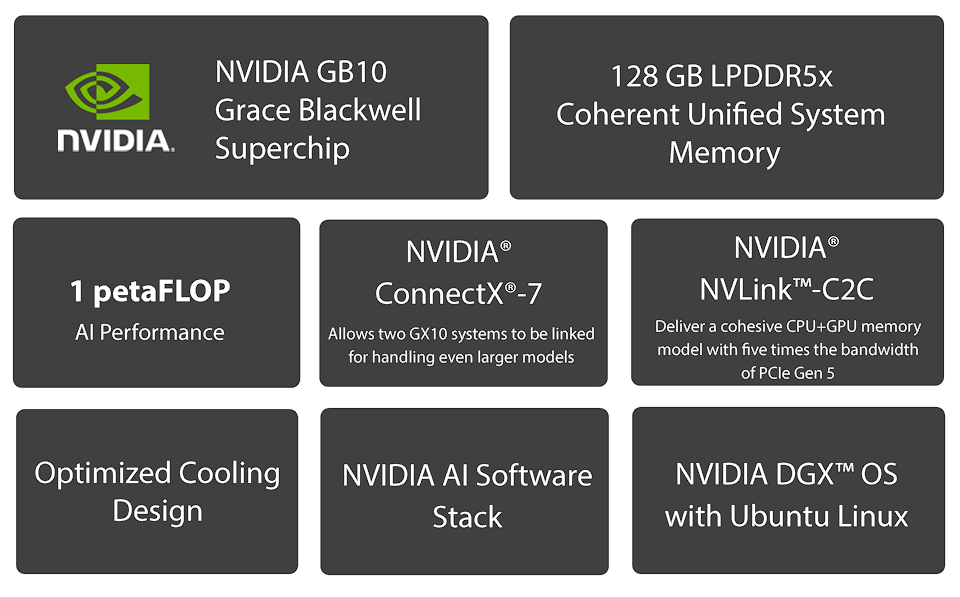
The silicon heart of the GX10 is the NVIDIA GB10 Grace Blackwell Superchip, an integrated SoC that leverages a unified memory architecture to bridge the traditional gap between CPU and GPU tasks.
- Silicon Analysis: The GB10 features a 20-core ARM v9.2-A CPU, utilizing 10 high-performance Cortex-X925 cores paired with 10 Cortex-A725 efficiency cores. This architecture is tightly coupled with a Blackwell-architecture GPU featuring fifth-generation Tensor Cores and 6,144 CUDA cores.
- Unified Memory Mastery: The system is equipped with 128 GB of LPDDR5x Coherent Unified System Memory. Operating on a 256-bit interface at 8533 MT/s, it delivers 273 GB/s of bandwidth. As an architect, I must be blunt: while 273 GB/s is impressive for a desktop SoC, it is the platform’s Achilles' heel compared to the >800 GB/s bandwidth found in Apple’s M4 Ultra. This LPDDR5x ceiling is the primary constraint for autoregressive generation speeds.
- The NVFP4 Innovation: To mitigate the bandwidth bottleneck, NVIDIA has introduced the proprietary NVFP4 (4-bit floating-point) format. This format utilizes Microscaling (MX) logic—a technical deep dive into MXFP4 reveals that by scaling blocks of weights, NVIDIA maintains accuracy while slashing memory requirements. This enables the GX10 to achieve a headlined 1 petaFLOP of sparse performance. Note the caveat: "sparse" performance assumes a 2:1 sparsity ratio; the dense compute is likely half that figure. However, this is precisely what allows a 1.6L box to locally execute models up to 200B parameters.
3. Physical Design and Connectivity: Industrial Engineering at 1.6 Liters
The GX10 is an exercise in high-density engineering, cramming a 140W TDP SoC into a 150 x 150 x 51 mm frame.
- Chassis and Thermals: The "QuietFlow Cooling" system utilizes dual Vapor Chambers and a three-fan array. This is not consumer-grade cooling; it provides 1.6x the thermal efficiency of standard compact designs. The chassis meets MIL-STD 810H durability standards and features a toolless design, allowing for easy access to the M.2 slots (supporting up to 4TB PCIe 5.0).
- Power Logic: The system ships with a 240W external supply. Our power-budget analysis confirms that while the GB10 SoC is rated for a 140W TDP, the additional 100W is essential for the ConnectX-7 NIC, NVMe storage, and the high-performance I/O tree.
- I/O and Networking Ecosystem:
| Port Location | Type | Specifications |
|---|---|---|
| Front | 1 x Power Button | Standard Toggle |
| Back | 3 x USB 3.2 Gen 2x2 | Type-C, 20Gbps, DP 2.1 Alt Mode |
| Back | 1 x USB 3.2 Gen 2x2 | Type-C, 180W EPR PD3.1 Power Input |
| Back | 1 x HDMI 2.1 | High-Definition Display Output |
| Back | 1 x ConnectX-7 SmartNIC | 200 Gbps QSFP Networking (TLS/IPsec Offload) |
| Back | 1 x 10G LAN | High-speed RJ-45 Ethernet |
| Back | 1 x Kensington Lock | Physical Security Slot |
The integration of the NVIDIA ConnectX-7 SmartNIC is vital for sovereignty. It features hardware-level acceleration for TLS, IPsec, and MACsec, ensuring that even in a clustered environment, data transmission remains encrypted without stealing CPU cycles. Reference SOURCE_IMAGE_1 and SOURCE_IMAGE_2 for the specific QSFP112 configuration.
4. AI on Premises: Security, Sovereignty, and Agentic Workflows
The GX10 is marketed for On-Premises Data Sovereignty, but the real value is in the execution of agentic workflows.
- NemoClaw and OpenShell: NVIDIA NemoClaw serves as an open-source reference stack that layers privacy controls over the OpenClaw community framework. It leverages NVIDIA OpenShell to enforce policy-based privacy guardrails using isolated sandboxes. This prevents "agent drift" where autonomous models might inadvertently leak sensitive data to external endpoints.
- Local Agentic AI: By running models like NVIDIA Nemotron or Hermes Agent locally, researchers can maintain "always-on" autonomous agents without incurring the exponential API costs or latent risks of cloud-based inference.
5. Performance Benchmarks: Raw Compute vs. Real-World Throughput
Performance on the GX10 is heavily software-defined. The CES 2026 firmware update was a landmark, delivering a 2.5x gain via TensorRT-LLM and Eagle3 speculative decoding. In testing the Qwen-235B model, these optimizations transformed the device from a prototyping curiosity into a viable inference node.
LLM Inference Analysis (GPT-OSS 120B Model)
| Performance Metric | DGX Spark / GX10 (NVFP4) |
|---|---|
| Prefill (Tokens/sec) | 1,723.1 |
| Decode (Tokens/sec) | 38.55 |
The data reveals a stark performance dichotomy. The Blackwell Tensor Cores crush the compute-bound prefill phase, ingesting large contexts at 1,723 tokens/sec. However, the memory-bound decode phase (38.55 tokens/sec) reveals the LPDDR5x bandwidth limitation. This is acceptable for a single developer, but it marks the system’s boundary for multi-user production environments.
6. Scalability: The Power of Stacking
For workloads exceeding the 128GB unified memory threshold, the GX10 supports Dual-Unit Clustering.
Critically, while the GB10 SoC uses NVLink-C2C internally for CPU-to-GPU communication, external clustering is achieved strictly via the NVIDIA ConnectX-7 networking technology. By linking two units with the 0.4M QSFP112 DAC cable (see SOURCE_IMAGE_3), the system effectively doubles its memory pool. This configuration is the minimum requirement to run the massive Llama 3.1 405B model locally at reasonable speeds.
7. Competitive Landscape: Comparing the Heavyweights
| Feature | ASUS Ascent GX10 | Framework Desktop | Apple Mac Studio | DIY 3x RTX 3090 Rig |
|---|---|---|---|---|
| Processor | 20-core ARM GB10 | AMD Strix Halo (Max+) | M4 Ultra | Core i9 / Threadripper |
| Accelerator | NVIDIA Blackwell | Integrated RDNA3 | 80-core Apple GPU | 3x RTX 3090 (Ampere) |
| Memory | 128GB LPDDR5x | 128GB LPDDR5x | Up to 512GB LPDDR5x | 72GB Total (Discrete) |
| Bandwidth | 273 GB/s | ~256 GB/s | >800 GB/s | High (Per Card) |
| Peak AI Compute | 1 PFLOP (Sparse FP4) | High (No FP4) | High (No FP4) | ~105 TFLOPS (FP32) |
| Price | $3,999 - $4,699 | ~$2,348 - $2,950 | $3,999+ | ~$2,500 - $3,000 |
Architectural Pros & Cons
- ASUS Ascent GX10
- Pros: Native CUDA/TensorRT-LLM support; proprietary FP4 hardware acceleration; unified 128GB pool.
- Cons: LPDDR5x bandwidth limits generation; premium pricing (effectively a 20% supply-chain tax for the Blackwell name).
- Framework (AMD Strix Halo)
- Pros: Superior price-to-performance; open ROCm stack.
- Cons: Lacks hardware-level FP4 support; ROCm ecosystem remains a step behind CUDA in library maturity.
- Apple Mac Studio (M4 Ultra)
- Pros: Dominant memory bandwidth (>800 GB/s); massive capacity (512GB).
- Cons: No FP4 hardware acceleration; Metal ecosystem limits deployment flexibility for Linux-standard research code.
- DIY 3x RTX 3090 Rig
- Pros: Highest raw throughput for models that fit within a single card's VRAM.
- Cons: Massive vRAM fragmentation; loading a 120B model across three PCIe slots introduces severe latency; high power/heat.
8. Software Stack and Developer Experience
The GX10 ships with NVIDIA DGX OS, a hardened, Ubuntu-based Linux distribution optimized for the ARM64 architecture. This environment is designed to bypass the "dependency hell" of AI development.
The system comes preloaded with CUDA 13.0.2, PyTorch, TensorFlow, Ollama, and NVIDIA NIM. The "NVIDIA Advantage" here is out-of-the-box code compatibility. Research code written for H100 clusters can be moved to the GX10 with zero code adjustments—a level of friction-free development that ROCm and Metal still struggle to replicate.
9. Market Positioning and Target Audience
The GX10 is a specialized instrument for the AI elite.
- Primary Audience: AI Researchers, ML Engineers, and Startup Founders requiring a local "DGX experience."
- Vertical Markets: Healthcare (private data), Fin-Tech (secure demand forecasting), and Industrial AI (robotics development via NVIDIA Isaac).
- The Cost of Entry: Pricing currently sits between $3,999 and $4,699 (Stellar Grey model). The upper end of this range is a direct result of recent LPDDR5x supply shortages, which we view as a "scarcity tax" on high-memory localized hardware.
10. Conclusion: The Final Verdict on the Ascent GX10
The ASUS Ascent GX10 is a meticulously crafted "AI Lab in a Box." It is not the most cost-effective way to get tokens on a screen, but it is the most sophisticated way to develop high-parameter models on a desk.
AI-Radar Recommendation: For teams focused on Local RAG and Agentic AI, the GX10 is the gold standard. While Apple has the bandwidth lead and DIY rigs have the raw throughput, neither offers the combination of 128GB of unified memory, native FP4 hardware acceleration, and the enterprise-grade NVIDIA software stack. It is a niche, expensive, and indispensable tool for the next generation of AI development.
11. Technical Specifications Appendix
| Category | Specification |
|---|---|
| Dimensions | 150 x 150 x 51 mm (1.6L volume) |
| Weight | 1.48 kg (3.26 lb) |
| Color | Stellar Grey |
| CPU | ARM v9.2-A (GB10 Grace Blackwell) |
| GPU | Integrated NVIDIA Blackwell (6,144 CUDA cores) |
| Memory | 128 GB LPDDR5x Unified Memory (273 GB/s) |
| Storage | 1TB/2TB PCIe 4.0 or 4TB PCIe 5.0 M.2 2242 NVMe |
| Networking | NVIDIA ConnectX-7 SmartNIC (200G), 10G LAN |
| Wireless | Wi-Fi 7 (Gig+), Bluetooth 5.4 |
| Power | 240W External Adapter / 180W Max Device Input |
| Certification | BSMI/CB/CE/FCC/UL/CCC/C-Tick/WiFi/RF/VCCI |
| OS | NVIDIA DGX OS (Ubuntu-based) |
| Warranty | 1-Year Limited Hardware Warranty |





💬 Comments (0)
🔒 Log in or register to comment on articles.
No comments yet. Be the first to comment!