Atomicwork Redefines AI Agent Management in the Enterprise
Atomicwork, the Palo Alto-based enterprise IT platform, has recently introduced a new category of solutions for enterprise service teams: a "governed AI workforce." This initiative aims to integrate artificial intelligence agents into organizational structures with an unprecedented level of control and supervision. The goal is to provide companies with the tools to manage these new digital entities in a structured and predictable manner.
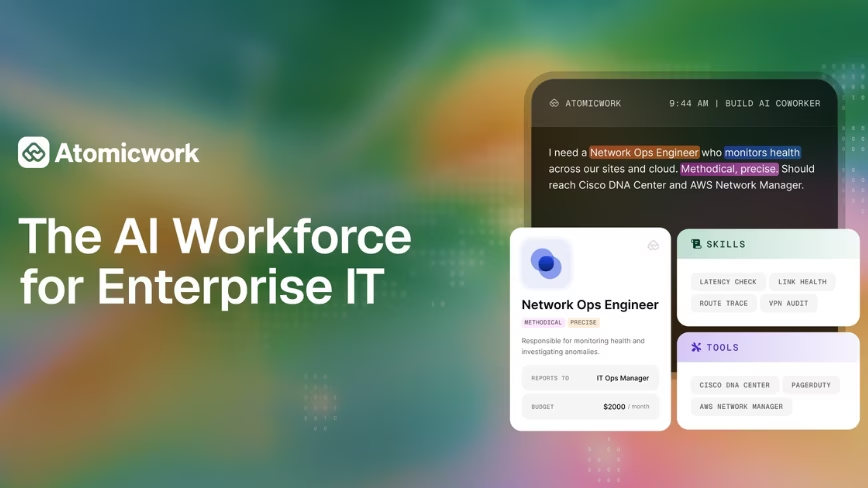
Atomicwork's proposal allows organizations to deploy AI agents, which the company has dubbed "AI Coworkers." These agents are designed to operate with defined job roles, skills, budgets, and permissions. The underlying idea is that IT departments should manage AI agents with the same logic and processes applied to managing human employees, thereby ensuring transparency and accountability.
A Governed Approach for AI Agent Deployment
The concept of a "governed AI workforce" addresses a growing need in the enterprise landscape: to integrate artificial intelligence not as a black box, but as a manageable and controllable resource. Defining roles, skills, and permissions for AI agents means they can be assigned to specific tasks, have their access to sensitive data limited, and their activities monitored—a crucial aspect for security and regulatory compliance.
Furthermore, the ability to allocate a specific budget for each "AI Coworker" introduces a dimension of control over operational costs, allowing IT teams to optimize expenses related to AI resource utilization. This is particularly relevant for companies considering on-premise or hybrid deployments, where hardware and software resource management directly impacts the Total Cost of Ownership (TCO). Transparency in costs and performance becomes a key factor in justifying investments in dedicated AI infrastructure.
Implications for Data Sovereignty and Compliance
The emphasis on governance and auditability of AI agents is of fundamental importance for companies operating in regulated sectors or handling sensitive data. The ability to define and control access permissions for each "AI Coworker" helps strengthen data sovereignty and ensure compliance with regulations like GDPR. In an on-premise deployment context, where data remains within the company's perimeter, granular access management by AI agents becomes a cornerstone of the security strategy.
Managing AI agents akin to human employees also implies the need for robust audit tools. IT departments can thus track agent actions, verify their adherence to protocols, and identify any anomalies. This level of control is essential for mitigating risks associated with automation and maintaining trust in AI-powered tools, especially when operating in air-gapped environments or with high-security requirements.
Future Prospects for Enterprise IT
The introduction of a "governed AI workforce" by Atomicwork marks a significant step towards greater maturity in enterprise AI adoption. It shifts the focus from mere model implementation to their strategic and operational integration within existing IT infrastructure. For CTOs, DevOps leads, and infrastructure architects, this approach offers a model for addressing the challenges related to scalability, security, and cost management of LLMs and other AI workloads.
While the source does not specify hardware details or performance metrics, the principle of governance is universal. For those evaluating on-premise deployments, the ability to define roles and budgets for AI agents aligns perfectly with the need for total control over infrastructure and data. This model could facilitate the adoption of self-hosted solutions, providing a framework to integrate AI responsibly and measurably, balancing flexibility and control in a rapidly evolving technological ecosystem.







💬 Comments (0)
🔒 Log in or register to comment on articles.
No comments yet. Be the first to comment!