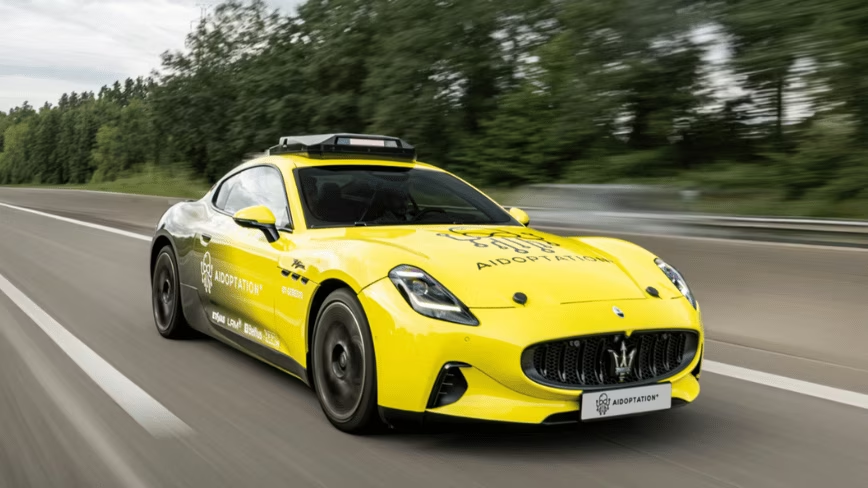
Aidoptation has just received a green light that sounds like an anomaly in an industry stubbornly convinced that artificial intelligence is the only way forward. The Belgian company can now test its fully self-driving car on a 100-kilometer stretch of the E313 and E314 motorways in Limburg, at 120 km/h, without any human intervention. It is the first Level 4 permit granted to a vehicle that, by design, uses no neural networks, deep learning, or trained models.
The Aidoptation system relies on a deterministic stack: classical computer vision algorithms, optical flow, depth estimation, boolean logic, and rule-based planning. No data is used to train a model, and no cloud connection is needed while driving. The vehicle makes real-time decisions at the edge, never consulting a remote server.
The approach flips the dominant paradigm. While major players accumulate petabytes of driving footage to feed ever-deeper architectures, Aidoptation bets on what can be formally proven. The choice is far from ideological: deterministic systems offer clearer certification paths, reduce the risk of unexplainable behaviors, and make every decision traceable. In an increasingly demanding regulatory landscape – the European AI Act requires transparency for high-risk systems – a car that can be audited line by line has a significant regulatory edge.
On the hardware side, the absence of neural networks translates into a modest computational load. No GPUs with tens of gigabytes of VRAM are needed, nor specialized accelerators. The entire stack can run on automotive-grade embedded processors, with low power consumption and manageable thermal output. This lowers total cost of ownership (TCO) and, crucially for commercial fleets, slashes the energy required for inference.
Then there is the matter of data sovereignty. A car that does not learn has no need to send images, positions, or behaviors to a central server. Data stays on board, erasable or accessible only locally. For public administrations or logistics operators concerned about data leaks or unauthorized access, this self-sufficiency offers a level of trust hard to achieve with cloud-dependent architectures.
Of course, the approach has limits. Rule-based systems excel in structured environments like highways but struggle with the unpredictability of urban scenes. Aidoptation pragmatically chose its operational domain: well-marked lanes, predictable traffic, no pedestrians or cyclists. It’s a realistic bet that could spark a redefinition of business models: not a single universal intelligence, but vertical solutions optimized for specific contexts, where formal certainty counts more than flexibility.
For those dealing with on-premise and edge deployments in critical domains, the Belgian case contains a lesson. Adding more layers of AI is not always the best path. Sometimes, forgoing machine learning restores governability, cuts costs, and guards against surprises. The Limburg permit might remain a rarity, or it could become the first piece of a different kind of autonomy, more sober and controllable.



💬 Comments (0)
🔒 Log in or register to comment on articles.
No comments yet. Be the first to comment!