
Aylight, a Swiss startup founded in 2025 from the research of Bahareh Marzban and Dmitry Kazakov at ETH Zürich, has just secured €4.5 million to move out of the lab a laser technology that could ease the most critical bottleneck inside AI data centers: chip-to-chip data exchange. The pre-seed round, co-led by Elaia and Swisscom Ventures with participation from Verve Ventures and Plug and Play, will fund the first semiconductor-foundry prototypes and the expansion of the R&D team.
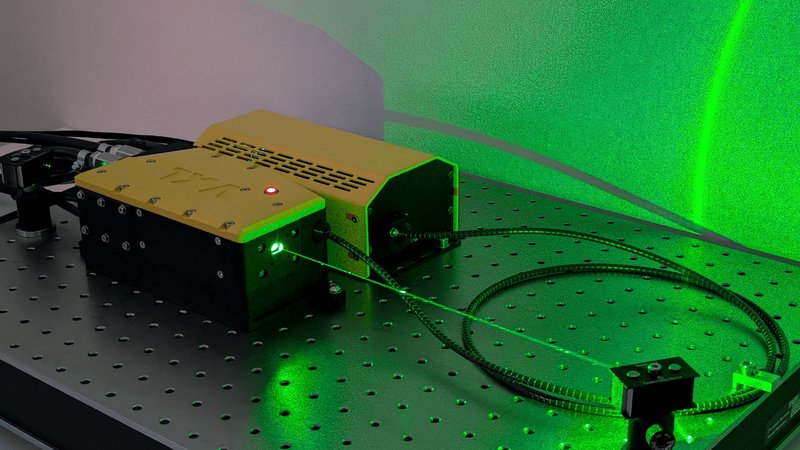
The company develops chip-scale multi-wavelength lasers, an architecture that generates multiple precisely spaced wavelengths from a single component, based on a frequency-modulated comb (FM comb). The immediate target is optical interconnects within AI data centers, where communication between accelerators (GPUs or other specialized processors) has become as important as raw compute power. Compared to traditional electrical links, optics reduce latency and energy consumption for a given bandwidth, but the need to use many discrete lasers has so far been a barrier in terms of both cost and complexity. Aylight claims its technology, which can be manufactured with standard photonic foundry processes, eliminates the proliferation of separate laser sources, simplifying integration into communication systems.
“We started from a problem rather than a technology,” said CEO Bahareh Marzban. “The laser had become one of the constraints on scaling AI infrastructure. This funding will help us bring our technology from research to our first products.” The statement captures an aspect often overlooked by those who focus only on models and software: data center efficiency increasingly depends on interconnect hardware. As models grow larger and parallelism increases, the amount of data that must travel between compute nodes expands exponentially, and any internal network bottleneck hurts real-world performance and total cost of ownership (TCO).
For organizations evaluating on-premise AI deployments – driven by needs for data sovereignty, long-term cost control, or low latency – the availability of more efficient and less expensive optical interconnects could become a deciding factor. Aylight is certainly not alone in this space, but its bet on an integrated chip compatible with existing production lines points toward industrial simplification. If the prototypes deliver on their promise, the technology could help curb energy consumption and reduce the physical footprint of clusters, enabling denser and more scalable architectures.
Beyond optical interconnects, the company is already eyeing adjacent applications: semiconductor inspection, metrology, industrial automation, and precision robotics, all areas that require high-resolution three-dimensional sensing via FMCW. Yet the core of the roadmap remains AI infrastructure. The fact that Swisscom Ventures co-leads the investment alongside a specialized fund like Elaia suggests a concrete interest from network and data center operators, rather than a mere financial bet. In the coming months, the first foundry-prototype results will provide the first real measure of this technology’s potential.






💬 Comments (0)
🔒 Log in or register to comment on articles.
No comments yet. Be the first to comment!