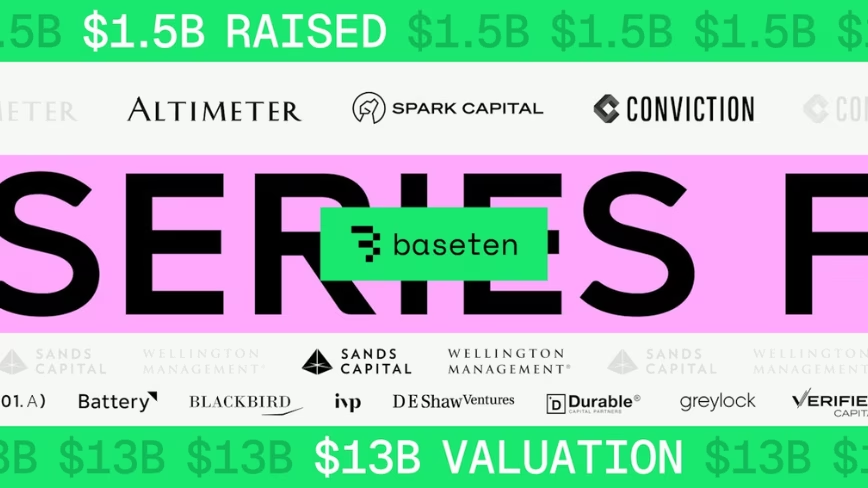
With a $1.5 billion Series F round and a valuation that could reach $13 billion, Baseten marks the largest single investment ever made by an Australian venture capital firm. Blackbird VC put in an unprecedented figure for the Australian landscape, betting on a startup that has climbed the AI infrastructure ranks in just 18 months.
The news confirms a market in full swing: providing the software and hardware layers to run large language models at scale has become one of the most capitalized businesses of the moment. Baseten doesn’t manufacture GPUs but offers a platform that simplifies model deployment and scaling, reducing complexity for data science teams.
The rise of infrastructure as a service
Baseten belongs to a category of startups — alongside names like Modal, Banana, or Replicate — that have turned inference into a managed service. Instead of buying hardware and configuring clusters, companies can expose models via APIs on a pay-per-use basis. An agile business model that attracts capital because it bets on the explosion of compute demand.
Yet this record figure raises a tension many IT teams know well. On one hand, the cloud promise is to lower upfront costs and delegate infrastructure management. On the other, for predictable but inference-intensive workloads, recurring operating expenses can quickly surpass the capital investment in on-premise hardware. Moreover, those working in regulated sectors or with sensitive data often cannot afford to move information onto public clouds.
The on-premise trade-off
For those evaluating local deployment, the question is not just “how much will I spend today,” but “how much control do I have over my data, latency, and long-term costs.” Baseten solves a real problem for startups and companies that want speed, but it doesn’t address the constraints of those needing air-gapped setups, strict GDPR compliance, or traffic volumes large enough to make hardware ownership more economical.
AI-RADAR closely follows these dynamics: it analyzes frameworks and configurations for on-premise LLMs, comparing TCO, throughput, and VRAM requirements. In a context where Baseten’s round shows how much capital flows toward cloud, it’s crucial to remember that the choice between cloud and on-premise is not ideological, but technical and financial.
What it means for the future
The $1.5 billion injection will allow Baseten to expand its infrastructure, likely forging even tighter relationships with GPU suppliers and data center operators. More cloud power, more managed services, more abstraction. For the on-premise ecosystem, this represents a spur to improve orchestration tools and make local deployments as simple as cloud ones.
The direction is clear: AI is shifting from experimental to industrial. And the infrastructure — distributed, hybrid, or fully owned — is the ground on which the next match will be played.








💬 Comments (0)
🔒 Log in or register to comment on articles.
No comments yet. Be the first to comment!