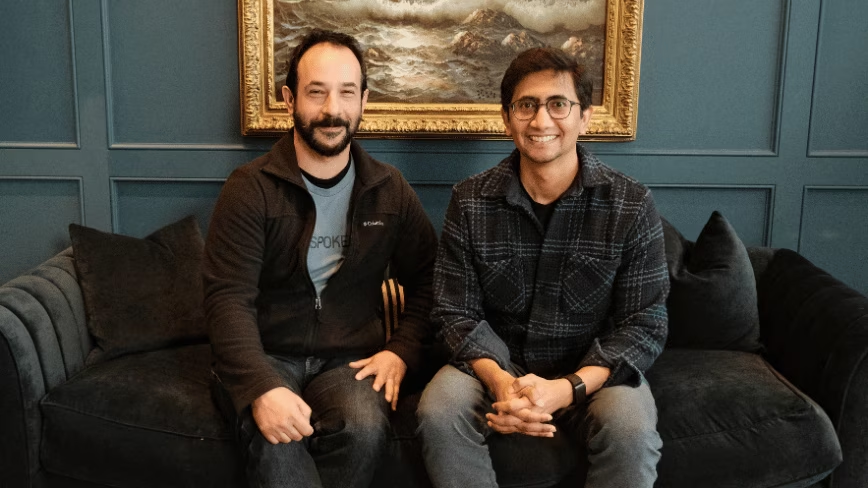
The announcement from Mountain View has the flavor of a market signal: Bespoke Labs has raised $40 million to build what it calls “training grounds” for AI agents. The idea is as simple as it is urgent: today an agent can write code or answer questions, but as soon as the task grows long and messy, it falls apart, often unpredictably. Bespoke Labs promises to tackle the problem at the root, creating simulation environments where agents are trained and tested on realistic, extended scenarios.
Behind the funding lies a collective realization: the bottleneck for AI is no longer just the model, but its real-world reliability. Large Language Models, even when quantized and optimized for on-premise inference, show fragility on tasks requiring extended planning, contextual memory, and coordination of multiple tools. Companies evaluating self-hosted deployment know this well: a code assistant that gets lost after a hundred interactions is a hidden cost, not a help.
That’s where Bespoke Labs’ approach becomes compelling: it’s not about the model itself, but the ecosystem surrounding it—automated test pipelines, endurance benchmarks, feedback loops that improve the agent without tweaking weights at every iteration. It’s a shift in perspective: agent training becomes a software engineering and quality problem, not just model research.
For those watching from the on-premise infrastructure side, the issue is thorny. Bespoke Labs’ test environments run in the cloud, but the logic they offer—validate an agent across thousands of scenarios before production—is identical to what’s needed when handling sensitive data. In regulated sectors, testing an agent on real corporate data requires the entire evaluation environment to stay under direct control. The structural signal is this: demand will grow for portable evaluation frameworks that can run on bare-metal or air-gapped clusters, without exposing anything externally. It’s not just about performance: it’s data sovereignty and Total Cost of Ownership, two pillars that AI-RADAR regularly analyzes for those assessing alternatives to public cloud deployment.
Nor should we ignore the reproducibility challenge. An agent that works in a proprietary simulated environment may behave differently when it lands on a client’s hardware stack, with different accelerators and VRAM constraints. Bespoke Labs’ promise is attractive, but the market will demand open standards and verifiable tools, not black boxes. The venture capitalists’ interest doesn’t guarantee the solution is suitable for regulated contexts, but it signals that the battle for agent reliability is officially underway.






💬 Comments (0)
🔒 Log in or register to comment on articles.
No comments yet. Be the first to comment!