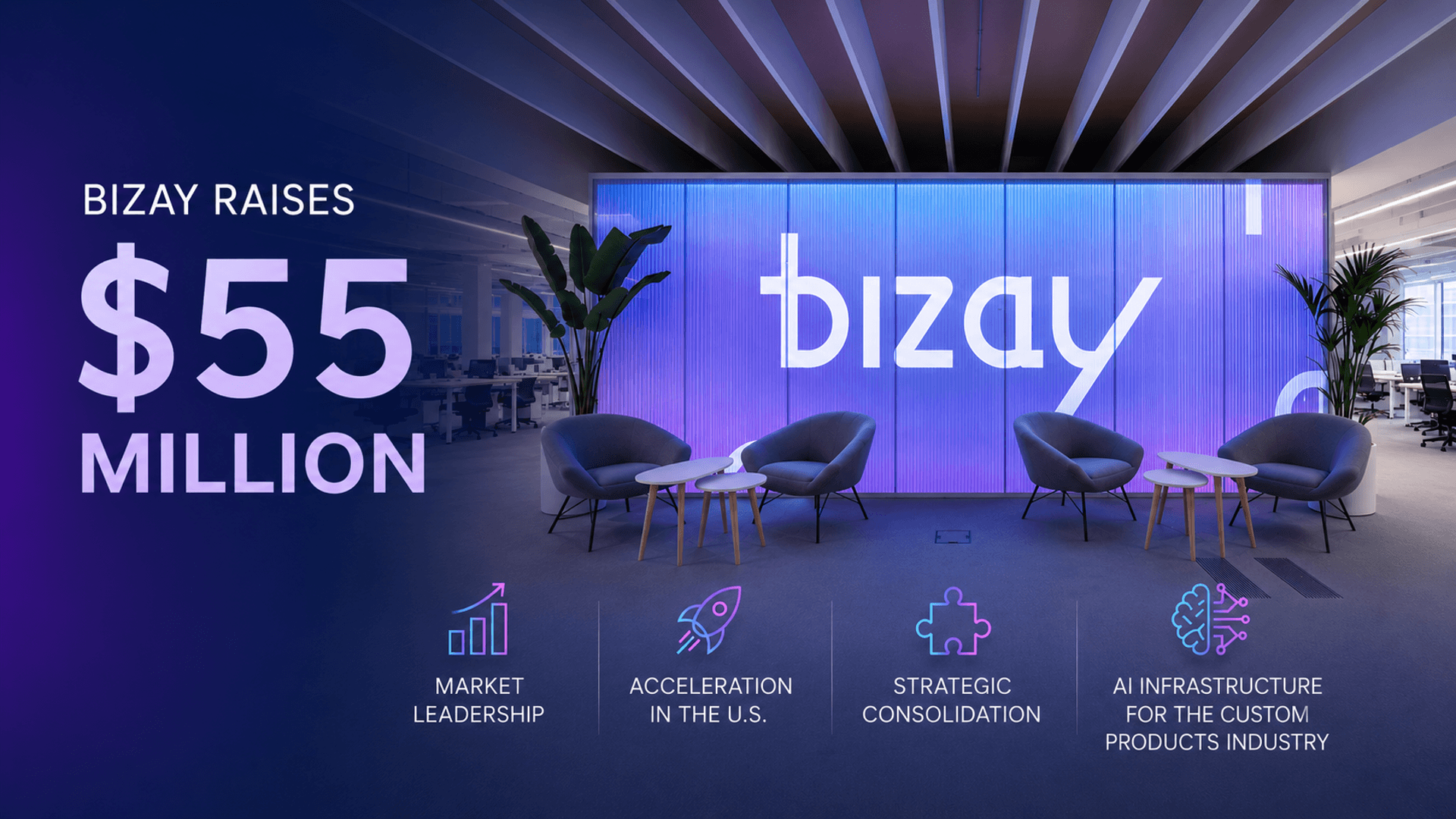
Fifty-five million dollars is more than fuel for a commercial offensive — it signals what's happening deep in the fabric of digital manufacturing. BIZAY, the Portuguese platform founded in 2014 to streamline production of customized items from marketing materials to packaging, has closed a Series D round led by Indico Capital Partners, with Lince Capital, Cedrus, and BPF participating. The stated goal is to accelerate US growth and launch an acquisition campaign in a highly fragmented market.
But it's the investment's direction that catches the eye: alongside geographic expansion, BIZAY is extending its AI capabilities to automate catalogue management, production operations, and customer support. This isn't generic “AI integration” from a press release — it's infrastructure that touches the heart of the process, from the moment a customer uploads a logo or design to printing and delivery.
The critical factor, for those watching model deployment in industrial contexts, is the nature of the data at hand. A company ordering branded gadgets, window decals, or customized boxes isn't just handing over technical specs; it's entrusting its visual identity. Sending every logo variation to the cloud for inference is a risk many enterprises are no longer willing to take. That's why BIZAY's platform reinforcement, with fresh capital and expertise, could translate into an increasingly self-hosted AI stack, where design file processing and variant generation stay under the manufacturer's direct control.
The move has structural implications. On one side, hardware vendors for on-premise inference — from consumer GPUs adapted to enterprise workloads up to edge solutions with modest but optimized VRAM — gain a rapidly growing segment. Custom manufacturing platforms don't need trillion-parameter models: a specialized LLM for catalogue metadata or a vision model for quality control requires locally manageable compute resources, with latency and confidentiality guarantees that generic cloud services can't match.
On the other side, BIZAY's announced market consolidation — through targeted acquisitions of local players — may accelerate adoption of deployment standards that place data sovereignty front and center, especially in a market like the US where privacy regulation is patchy but enterprise customer sensitivity runs high.
It's no coincidence the company expects its first profitable year in 2026, with revenue topping $100 million: the economic discipline touted by CEO Sérgio Vieira aligns with a technology strategy that aims to internalize AI costs rather than outsourcing them to cloud providers with per-token fees. Customers paying for customized goods aren't priced on a per-inference basis; margins stay healthy only when inference runs on owned resources, amortized over time.
In this scenario, the real test isn't the fundraise itself, but BIZAY's ability to integrate acquired companies onto a common, scalable AI infrastructure — most likely run on proprietary servers or at colocation facilities. The message for the market is clear: the mass customization game will be won on compute proximity to data, not on cloud delegation.







💬 Comments (0)
🔒 Log in or register to comment on articles.
No comments yet. Be the first to comment!