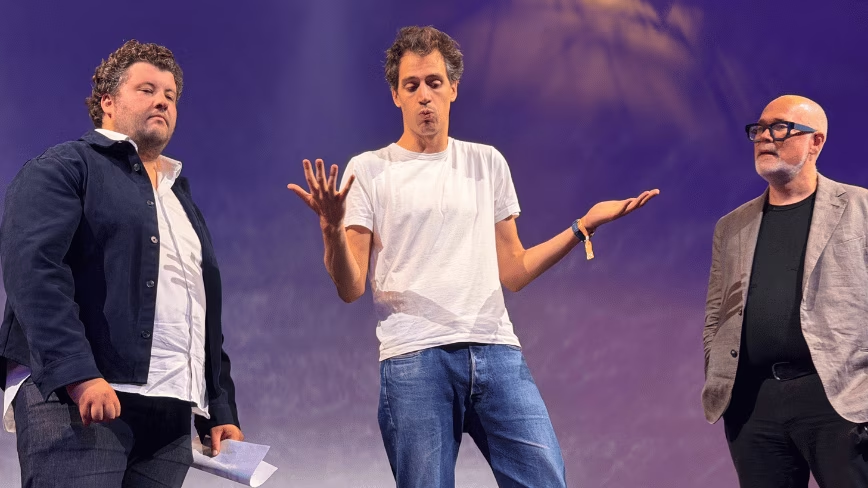
Paris. Mistral CEO Arthur Mensch and Mozilla president Mark Surman were making the case for open-source AI reliability in front of the RAISE Summit crowd. Trust, transparency, no vendor lock-in: the usual refrain. Then, in a perfectly timed twist, the main stage lost power, and their fireside chat continued almost entirely in the dark.
The episode isn’t just anecdotal – it’s a brutal reminder of what reliability actually means in artificial intelligence. For too long, the conversation has centered on licenses, open weights, and downloadable models. But that blackout instantly resets the discussion: you can have the freest model on the planet, yet if whoever runs the infrastructure – the remote datacenter, the cloud provider, even the electrical panel of a conference hall – lacks full operational continuity, the promise of resilience vanishes with a single switch.
For those weighing where to run LLMs, the structural signal is clear. Open-source AI moves sovereignty to the code level, but dependence on others’ physical resources stays: electricity, networking, cooling, connectivity. The RAISE outage is a trivial incident, yet it makes tangible what happens when a critical business process is handed to a stack you don’t fully own. Mistral’s inference can be self-hosted, of course – but if there’s no on-premise energy redundancy behind it, you’re still exposed to the same short circuit.
The irony of that Parisian scene is that open-source’s value isn’t denied; it’s just downsized. Without first-person infrastructure governance, the word “reliability” is as fragile as a circuit breaker. It’s no coincidence that organizations most focused on data sovereignty – from European public administrations to regulated sectors like finance and defense – are evaluating fully local deployments, complete with backup generators and isolated power systems, where the model runs within the same physical perimeter as its users.
The RAISE Summit blackout doesn’t disprove Mistral or Mozilla. It acts instead as a reality check: true resilience doesn’t live in GitHub repos but in a rack inside a secured cabinet, far from shared outlets. For anyone calculating the TCO of on-premise solutions, the equation can’t stop at GPU costs; it must include energy resilience and control over every single point of failure. That’s where AI-RADAR provides frameworks to assess trade-offs that go beyond benchmarks.
Open-source AI deserves trust. But only when the final link in the chain – the electrical current – is firmly in your own hands.




💬 Comments (0)
🔒 Log in or register to comment on articles.
No comments yet. Be the first to comment!