The Incident and Unexpected Resilience
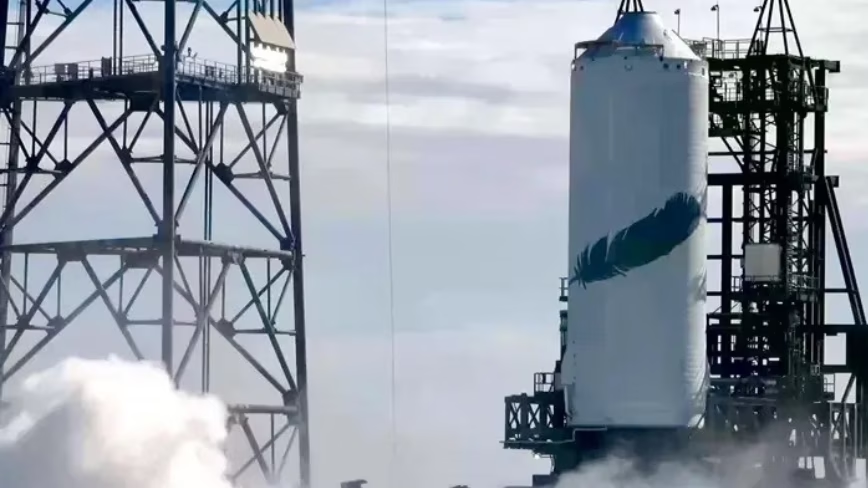
Last week, an explosion involving Blue Origin's New Glenn rocket occurred at Cape Canaveral, an event that generated concern within the aerospace industry. However, the company recently provided an update that mitigates the initial implications of the incident. According to CEO Dave Limp, the launch pad's fuel tanks, containing methane, hydrogen, and oxygen, survived the explosion.
Not only the tanks, but also several other critical components of the pad's infrastructure remained intact. This unexpected resilience suggests a faster recovery path than initial images of the blast had indicated. Blue Origin has reiterated its commitment to return the New Glenn to flight by the end of the year, an ambitious goal that underscores the importance of recovery capability in complex engineering projects.
Resilience Lessons for Complex Infrastructures
The Blue Origin incident, although related to the aerospace sector, offers significant insights for the design and management of complex technological infrastructures, including on-premise Large Language Models (LLM) deployments. The survival of critical components in a destructive event highlights the importance of robust and modular design. In contexts such as data centers hosting AI workloads, this translates into the need for resilient hardware, redundant systems, and well-defined recovery pipelines.
For CTOs, DevOps leads, and infrastructure architects, the ability to minimize downtime and ensure operational continuity is fundamental. Careful hardware selection, such as GPUs with adequate VRAM and robust power delivery systems, is as crucial as designing an architecture that can withstand partial failures and enable rapid recovery. The lesson is clear: robustness is not an option, but a requirement for long-term stability and efficiency.
Total Cost of Ownership and Operational Continuity
Incidents like the New Glenn explosion, while not directly related to AI, underscore the hidden costs of downtime and the intrinsic value of resilient design in the Total Cost of Ownership (TCO) equation for on-premise LLM infrastructures. While cloud solutions may offer a perception of simplicity, self-hosted deployments require meticulous planning for business continuity, disaster recovery, and hardware lifecycle management.
This includes evaluating the impact of component failures on overall system availability and the time-to-recovery, factors that directly influence operational costs and adherence to Service Level Agreements (SLAs). For organizations evaluating on-premise Large Language Model deployments, infrastructural resilience and TCO are critical factors, and resources such as those available on AI-RADAR/llm-onpremise offer analytical frameworks to explore these trade-offs in depth.
Future Prospects and the Imperative of Robustness
Blue Origin's commitment to return to flight within the year reflects a common mindset in the technology sector: the relentless pursuit of robust and reliable systems. Whether it's space exploration or the deployment of Large Language Models on self-hosted infrastructures, the ability to address and overcome technical challenges with minimal impact on operational continuity remains an imperative.
For technology decision-makers, this means prioritizing resilience in AI deployment strategies, investing in architectures that not only maximize performance and data sovereignty but also ensure recovery capability from unforeseen events. Infrastructural robustness is key to unlocking the full potential of on-premise AI, ensuring that innovations can thrive even in the face of adversity.








💬 Comments (0)
🔒 Log in or register to comment on articles.
No comments yet. Be the first to comment!