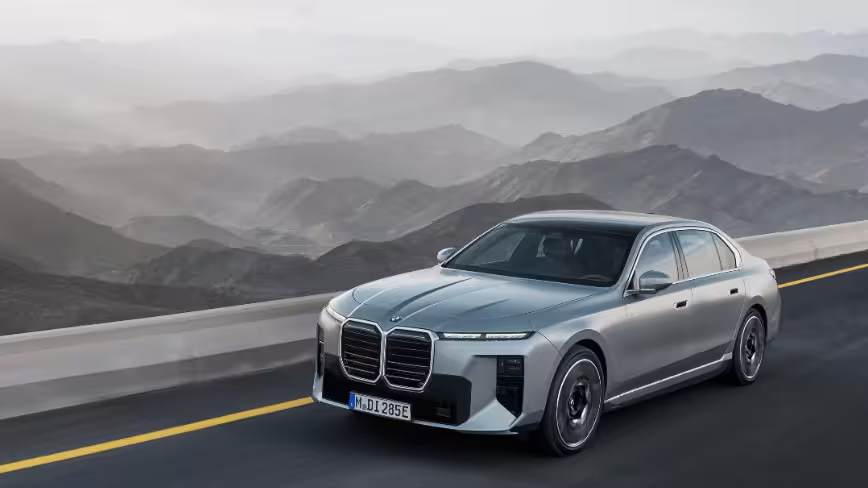
BMW i7: 2027 Facelift Introduces Rimac Batteries and Innovative Motors
BMW has unveiled the facelift of its electric flagship, the i7, for the 2027 model year. The presentation took place simultaneously at two prominent locations: Grand Central Terminal in New York and Auto China, underscoring the global importance of this update. Key innovations include the adoption of next-generation batteries, more efficient powertrains, and an evolution in charging capabilities, elements that redefine the vehicle's technological profile.
This update positions the i7 as a benchmark for innovation in the luxury electric sedan segment. The focus has been on optimizing energy efficiency and sustainability, crucial aspects for the current market. The engineering choices reflect a clear direction towards increasing performance and range, while also considering production dynamics and environmental impact.
Technical Details: Gen6 Batteries, Rare-Earth-Free Motors, and Fast Charging
At the heart of the 2027 BMW i7's technical innovations are the Gen6 cylindrical cells supplied by Rimac, a company known for its cutting-edge solutions in high-performance batteries. This collaboration aims to significantly improve the vehicle's energy density and charging speed. Complementing this, the new electric motors have been designed to be rare-earth-free, a move that reduces dependence on critical and often controversial materials, integrating silicio carbide (SiC) inverters for greater efficiency.
Fast charging capability has been enhanced, reaching 250 kW, a value that drastically reduces charging stop times. Regarding range, the i7 60 xDrive variant aims to exceed 350 miles according to the EPA cycle and achieve 728 km in the WLTP cycle. The i7 50, on the other hand, is rated for 611 km WLTP, while the performance-oriented M70 version targets 686 km WLTP. These figures highlight a significant step forward in terms of mileage on a single charge, meeting the needs of consumers seeking electric vehicles with high ranges.
Implications and Context: The Decision on Level 3 Autonomous Driving
A notable aspect of the facelift is BMW's decision to drop Level 3 autonomous driving functionality for the i7. This choice, although its full motivations are not specified in the source, may reflect regulatory complexities, technical challenges, or liability considerations associated with implementing advanced autonomous driving systems. Many manufacturers are carefully weighing the trade-offs between technological innovation and safety, as well as public acceptance and infrastructure maturity.
The adoption of rare-earth-free motors represents an important strategic direction for the automotive industry. Rare earths are essential minerals for the production of many electronic components and electric motors, but their extraction and processing are often associated with significant environmental impacts and complex geopolitical dynamics. The search for sustainable alternatives is therefore a hot topic, and BMW's choice to integrate this technology into the i7 underscores a commitment to greater sustainability and a more resilient supply chain.
Future Prospects for Luxury Electric Mobility
The 2027 BMW i7 facelift highlights the continuous evolution in the luxury electric mobility sector. The integration of advanced battery and motor technologies, combined with faster charging and extended range, positions the vehicle competitively in the market. While the decision to withdraw Level 3 autonomous driving may surprise some, it reflects strategic prudence in a rapidly evolving field.
These developments underscore how manufacturers are constantly balancing innovation, performance, sustainability, and safety. For technology decision-makers, BMW's focus on hardware optimization and critical resource management offers interesting insights into the future directions of automotive engineering and, more broadly, the integration of advanced components into complex systems.




💬 Comments (0)
🔒 Log in or register to comment on articles.
No comments yet. Be the first to comment!