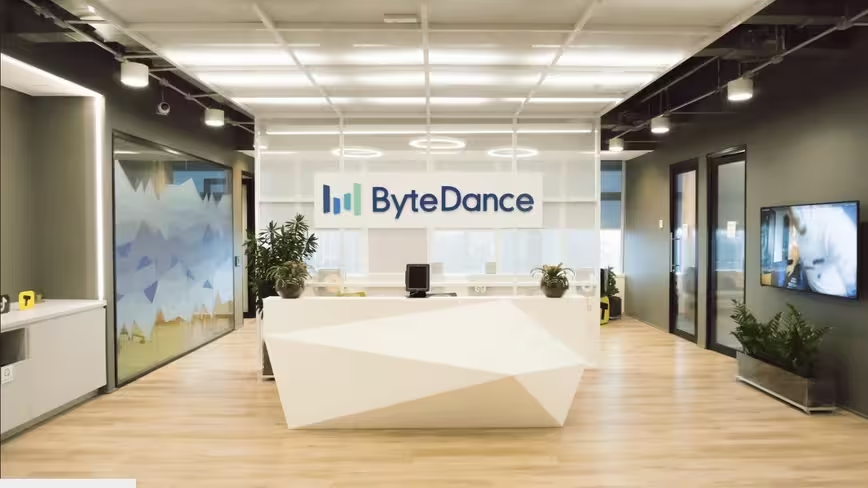
ByteDance, Microsoft, and Billion-Dollar AI Spending
ByteDance, the parent company of TikTok, has emerged in recent years as Microsoft's single largest customer in the artificial intelligence sector. According to a Bloomberg report, the Chinese company is on track to exceed $1 billion in annual spending for Microsoft's AI and cloud services. This substantial figure underscores the increasing reliance of major tech companies on third-party infrastructure and models to fuel their AI ambitions.
This strategic partnership highlights how even tech giants, with their vast engineering resources, choose to rely on external providers to accelerate the development and deployment of AI-driven solutions, focusing on their core business rather than managing the underlying infrastructure.
The Role of Azure and OpenAI Models
The core of this massive expenditure lies in the purchase of OpenAI models, made available through Microsoft's Azure cloud platform. ByteDance's strategy reflects a broader trend in the industry, where companies choose to outsource the development and deployment of Large Language Models (LLM) to specialized cloud service providers. Access to pre-trained models and scalable infrastructure like Azure allows for accelerated innovation and reduced initial CapEx costs, shifting them towards an OpEx model based on consumption.
However, this choice also entails significant considerations regarding data control and customization. While cloud services offer agility and almost limitless scalability, companies must carefully weigh the trade-offs between ease of use and the need to maintain full sovereignty over their data and specific model configurations.
Geopolitical Context and Data Sovereignty
What makes this agreement particularly noteworthy is its geopolitical context. The collaboration between ByteDance and Microsoft is solidifying even as Washington continues to view Chinese AI as a potential threat. This dynamic raises questions about data sovereignty and information security for companies operating globally.
When critical AI workloads, which often process sensitive data, are hosted on external cloud infrastructure, issues related to data residency, regulatory compliance, and governance become central. Organizations must balance the need for scalability and access to cutting-edge technologies with the requirement to maintain strict control over their information assets, especially in air-gapped environments or those with stringent security requirements.
Implications for AI Deployment Strategies
ByteDance's decision to rely on an external cloud provider for its AI needs offers valuable insight for CTOs, DevOps leads, and infrastructure architects. While a cloud-first approach guarantees flexibility and rapid time-to-market, self-hosted or hybrid solutions can offer greater control, customization, and, in some scenarios, a more favorable Total Cost of Ownership (TCO) in the long run, especially for intensive and predictable workloads.
The choice between on-premise and cloud deployment for LLMs and other AI applications depends on a careful evaluation of the trade-offs between costs, performance, security, compliance, and data sovereignty. For organizations evaluating self-hosted alternatives, AI-RADAR provides analytical frameworks on /llm-onpremise to compare the trade-offs between control, TCO, and performance, offering tools for informed and strategic decisions.









💬 Comments (0)
🔒 Log in or register to comment on articles.
No comments yet. Be the first to comment!