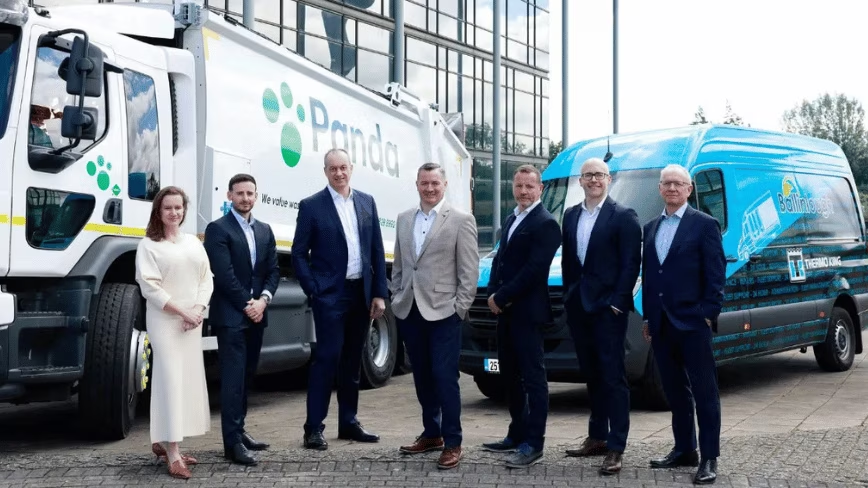
CameraMatics and the Global Expansion of AI for Safety
CameraMatics, an Irish company founded in Dublin in 2016, has announced that it has secured significant funding, amounting to approximately €49 million. This capital is earmarked to support an ambitious expansion strategy, focused on the North American and European markets. The company distinguishes itself by developing an advanced video-telematics platform, specifically designed for commercial fleets, with the primary goal of enhancing road safety.
CameraMatics' technology leverages artificial intelligence to prevent accidents even before drivers perceive them. The system integrates cameras and proprietary software that simultaneously monitor both the road and the vehicle's cabin. This proactive approach aims to identify and mitigate risks, offering a superior level of safety compared to traditional systems. The planned expansion positions CameraMatics in direct competition with established players like Samsara in the US market, highlighting the growing demand for AI solutions in fleet management.
Technical Challenges of AI Video-Telematics for Fleets
Implementing AI-powered video-telematics systems in commercial fleet contexts presents significant technical challenges, particularly regarding data processing and deployment infrastructure. CameraMatics' platform, which analyzes real-time video streams from the road and cabin, requires high-performance, low-latency processing capabilities. This is crucial for accident prevention, where every millisecond can make a difference. The sheer volume of video data generated daily by hundreds or thousands of vehicles is immense, raising questions about storage, transmission, and processing strategies.
To manage such intensive workloads, companies must carefully evaluate the trade-offs between edge processing (directly on vehicles or in local hubs) and cloud processing. Edge computing can reduce latency and data transmission costs, as well as improve data sovereignty by keeping information closer to the source. However, it requires robust hardware and the ability to manage AI models directly in the field. A hybrid deployment, combining critical real-time processing at the edge with long-term analysis and storage in the cloud or on-premise data centers, often emerges as a balanced solution to address these complexities.
Data Sovereignty and TCO in Fleet Deployments
The collection of video data, especially from inside the cabin, raises important questions regarding privacy and regulatory compliance, such as GDPR in Europe. For companies operating international fleets, the ability to ensure data sovereignty and adhere to local regulations is paramount. In this context, on-premise or air-gapped deployments offer greater control over data, allowing organizations to keep information within their jurisdictional boundaries and implement customized security policies.
Beyond compliance, the Total Cost of Ownership (TCO) represents a decisive factor. While cloud services offer scalability and flexibility, operational costs can rapidly escalate with high volumes of video data and intensive processing requirements. A TCO analysis for complex AI workloads must consider not only the initial hardware costs (GPUs, storage) for an on-premise deployment but also energy expenses, maintenance, and specialized personnel. For large fleets, a self-hosted or hybrid infrastructure might prove more advantageous in the long run, offering greater control over costs and resources.
Future Prospects for AI in Fleet Management
The investment in CameraMatics underscores the growing confidence in AI's potential to revolutionize safety and efficiency in fleet management. As AI technology becomes more sophisticated, the ability to process and interpret complex data in real-time will unlock new opportunities for predictive maintenance, route optimization, and driver training. However, the success of these innovations will largely depend on the robustness and scalability of the underlying deployment architectures.
Infrastructure decisions, whether involving on-premise, cloud, or hybrid solutions, will be crucial for companies seeking to fully leverage AI's potential. For those evaluating on-premise deployments for AI/LLM workloads, AI-RADAR offers analytical frameworks on /llm-onpremise to assess the trade-offs between control, data sovereignty, and TCO. The ability to balance performance, costs, and regulatory requirements will be key to success in the evolving landscape of AI-powered fleet telematics.









💬 Comments (0)
🔒 Log in or register to comment on articles.
No comments yet. Be the first to comment!