Cargofy Raises $11 Million for AI Agent Expansion
Cargofy, a logistics technology company, has announced the successful closure of an $11 million Series A funding round. The investment comprises $6 million in primary capital and $5 million in secondary transactions. The round was led by u.ventures, Toloka, and Movens Capital, with participation from Des Traynor, co-founder of Intercom, and several angel investors. This capital is earmarked to support the company's ambitious international expansion plans and the continuous development of its AI-powered digital agents.
The company focuses on creating "digital workers" powered by AI, designed to automate freight operations for logistics companies. Their activities currently span Europe, the United States, and the Caspian region, offering solutions aimed at transforming the operational efficiency of the sector.
The Technology Behind Digital Agents
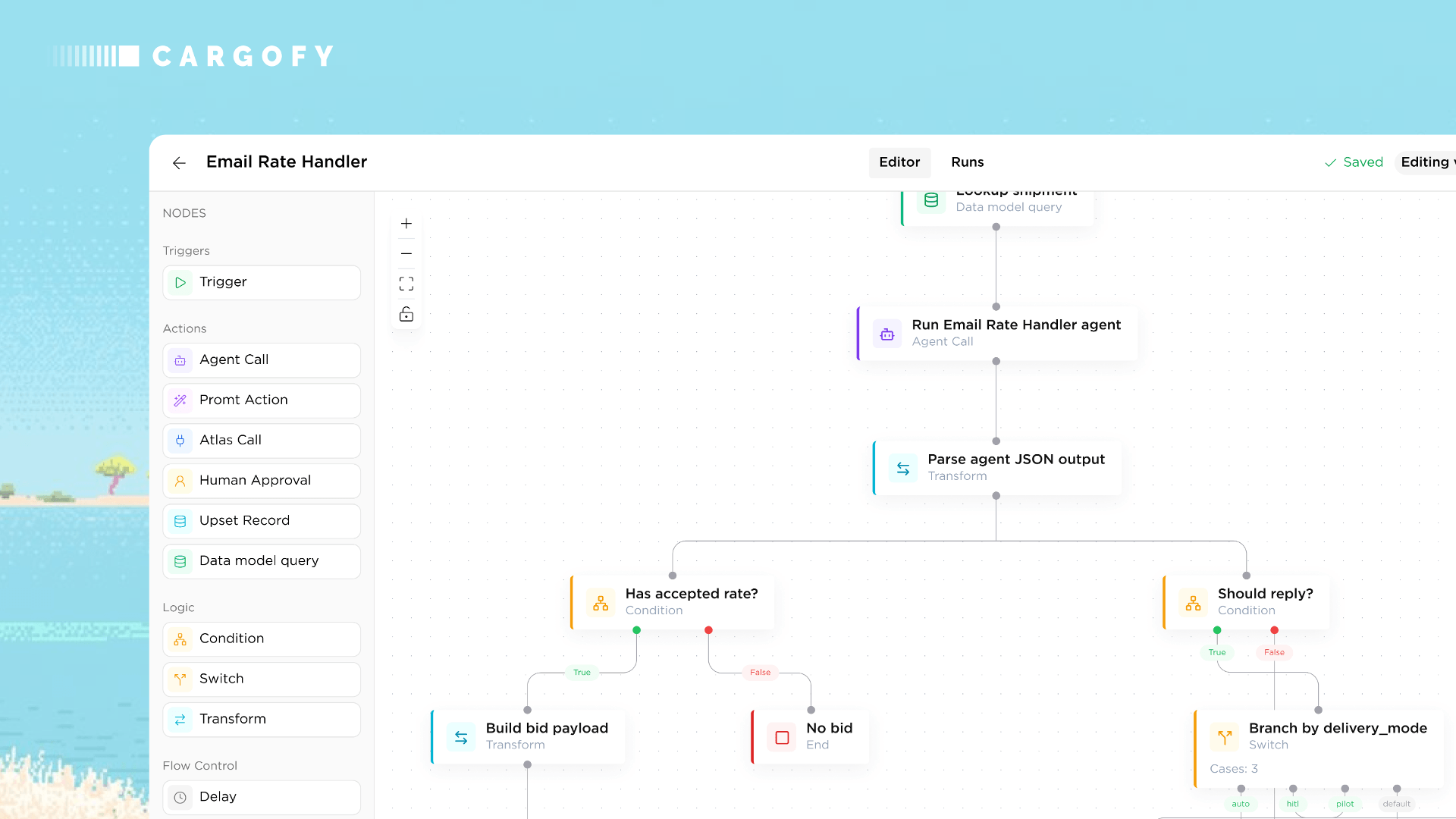
Cargofy dedicated several years to in-depth analysis of freight operations, collecting a vast volume of proprietary data. This preparatory phase preceded a strategic pivot in 2023, which saw the company focus on building AI agents trained on this specific data. Today, Cargofy provides AI agents capable of replicating the workflows of logistics professionals, without requiring companies to change their existing processes.
The platform integrates with over 70 logistics tools, including transportation management systems (TMS), ERP platforms, load boards, compliance systems, and communication channels. These AI agents can handle a wide range of tasks, from carrier communication and document processing to dispatch coordination and follow-up activities, operating 24/7 across multiple languages and markets. According to the company, this technology enables logistics teams to significantly increase operational efficiency, allowing individual dispatchers to manage larger fleets and helping customers reduce operating costs.
Strategic Vision and Deployment Implications
Stakh Vozniak, CEO and founder of Cargofy, emphasized the company's vision: "We're not building logistics software - we're building AI infrastructure where companies can hire digital employees for their operations. One person can now do the work of ten, and revenue per employee grows. That's how we see the future of this industry." This perspective highlights a paradigm shift, where AI is not just a tool, but an integrated virtual workforce.
The new funding will support Cargofy's international expansion, including the launch of new operational hubs across Germany, the Netherlands, France, Spain, and additional regions in the United States. The company also plans to strengthen its global team and extend the automation capabilities of its AI agents, moving from customer-facing processes to back-office functions such as billing, compliance, and carrier coordination. For companies evaluating the adoption of similar AI solutions, the choice between on-premise and cloud deployment represents a critical factor. Considerations such as data sovereignty, compliance requirements, and Total Cost of Ownership (TCO) often drive these decisions. The ability to integrate AI agents with existing systems, like those offered by Cargofy, can simplify adoption, but managing the underlying infrastructure remains a key variable. AI-RADAR offers analytical frameworks on /llm-onpremise to evaluate these trade-offs.
The Future of AI in Logistics
The investment in Cargofy reflects the market's growing confidence in the potential of artificial intelligence to revolutionize traditional sectors like logistics. The ability to automate repetitive and complex tasks, while improving efficiency and reducing costs, positions AI agents as a fundamental component for companies' future strategies.
With the expansion of its operations and the enrichment of its agents' functionalities, Cargofy aims to consolidate its position as a key player in AI infrastructure for logistics. Its strategy of deep integration with existing tools and focus on global scalability suggest a significant impact on how freight operations will be managed in the future, pushing towards increasingly efficient and automated operational models.








💬 Comments (0)
🔒 Log in or register to comment on articles.
No comments yet. Be the first to comment!