
ChatGPT Enters Personal Finance: AI Analysis for US Pro Users
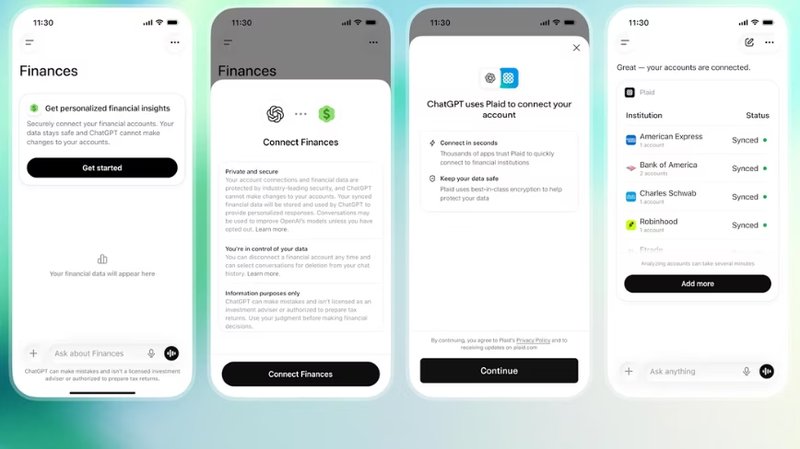
OpenAI has announced the introduction of a new personal finance experience within ChatGPT. This feature, currently available as a preview for Pro users in the United States, marks a significant step in the evolution of LLMs, moving them from generic tasks to increasingly specialized and high-value roles. The initiative aims to provide users with advanced tools for managing their finances, leveraging the power of artificial intelligence to offer personalized insights.
The integration of financial services into general-purpose AI platforms raises important questions regarding security, privacy, and data sovereignty. For companies and users operating in regulated sectors, the management of sensitive information is an absolute priority, and OpenAI's approach will be closely watched to understand how innovation and data protection are balanced.
A New Frontier for AI-Assisted Financial Management
The new experience allows users to securely connect their financial accounts directly to ChatGPT. This connection enables the system to generate AI-powered insights and guidance that are deeply rooted in the user's specific financial context, long-term goals, and immediate priorities. The objective is to transform how individuals interact with their finances, offering proactive and personalized guidance.
The ability of an LLM to process and interpret complex financial data to provide targeted recommendations represents a notable evolution. However, the security of such connections and the protection of personal and banking information are crucial aspects. Solutions must ensure that sensitive data is handled with the highest standards of encryption and compliance, a non-negotiable requirement for any service managing financial information.
Implications for Data Sovereignty and LLM Deployment
The introduction of financial functionalities in a cloud-based LLM like ChatGPT highlights a growing trend: the application of AI to domains that require high levels of trust and control over data. For financial institutions and large enterprises considering the adoption of LLMs for similar purposes, the question of deployment becomes central. The choice between cloud solutions and on-premise or hybrid deployment often depends on regulatory constraints, compliance requirements, and the need to maintain data sovereignty.
An on-premise deployment, for example, can offer more granular control over infrastructure, security, and data localization—fundamental aspects for complying with regulations like GDPR or other privacy laws. While cloud solutions offer scalability and reduced initial operational costs, the Total Cost of Ownership (TCO) and risks related to data governance can push towards self-hosted or air-gapped architectures for particularly sensitive workloads. AI-RADAR offers analytical frameworks on /llm-onpremise to evaluate these trade-offs, providing tools for informed decisions.
Future Prospects and the Role of On-Premise Technology
ChatGPT's expansion into personal finance foreshadows a future where LLMs will become increasingly sophisticated assistants in every aspect of our digital lives. However, the success of these applications will largely depend on the ability to address challenges related to data security, privacy, and regulatory compliance. For organizations looking to develop and deploy similar AI solutions, the ability to maintain complete control over their data and models through on-premise deployment will be a distinguishing factor.
The capability to perform LLM inference on local hardware, with specifications such as sufficient VRAM and high throughput, allows for the management of sensitive workloads without compromising data sovereignty. This approach not only strengthens security but can also optimize long-term TCO, reducing reliance on external providers and ensuring greater flexibility. The debate between cloud and on-premise for LLMs is set to intensify, with increasing attention to solutions that guarantee maximum control and protection of information.








💬 Comments (0)
🔒 Log in or register to comment on articles.
No comments yet. Be the first to comment!