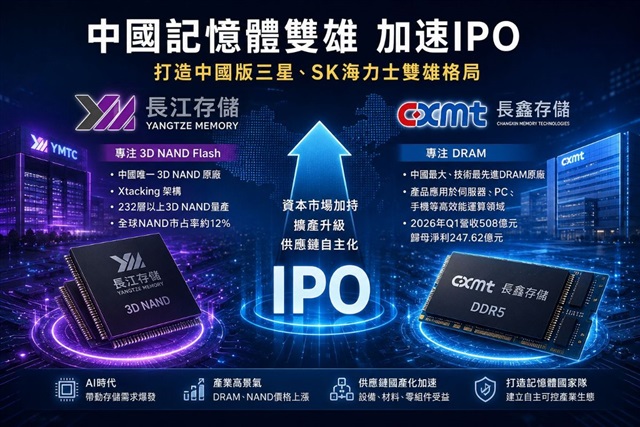
China's Memory Strategy in the AI Era
China is outlining an ambitious strategy to strengthen its domestic memory industry, a fundamental sector for global technological advancement. This initiative, described as building "twin engines" for memory, aims to consolidate internal production capacity and ensure self-sufficiency in a critical component. Central to this push is the intensified effort to list two key industry players on the stock market: YMTC (Yangtze Memory Technologies Co.) and CXMT (Changxin Memory Technologies).
The objective of this strategy is twofold: on one hand, to secure a resilient and nationally controlled supply chain; on the other, to support the rapid growth of the artificial intelligence sector. Dependence on external suppliers for essential components like memory can represent a strategic vulnerability, especially in complex geopolitical contexts. The move to push YMTC and CXMT towards IPOs is a clear signal of the desire to attract significant capital for expansion and research and development, indispensable elements for competing on a global scale.
The Crucial Role of Memory in AI Workloads
The phrase "Powered by AI" accompanying this initiative underscores the indissoluble link between memory and the development of artificial intelligence. AI workloads, particularly those involving Large Language Models (LLMs), are notoriously demanding in terms of memory resources. The capacity and speed of memory, such as GPU VRAM, are limiting factors for the size of models that can be loaded, the batch size during inference, and overall throughput.
Increasingly larger AI models require growing amounts of VRAM to run efficiently. For example, a 70-billion-parameter LLM can require tens of gigabytes of VRAM for FP16 inference, making high-capacity GPU memory like NVIDIA A100 80GB or H100 essential. The availability of high-bandwidth memory is equally critical to feed the computing cores of GPUs, avoiding bottlenecks that slow down token processing. A solid industrial base for memory production is therefore a prerequisite for any nation aspiring to be an AI leader, especially for those aiming for large-scale deployments.
Implications for Data Sovereignty and On-Premise Deployment
China's strategy to strengthen memory production has profound implications for data sovereignty and on-premise deployment decisions. For organizations operating in regulated sectors or handling sensitive data, the ability to control the entire hardware supply chain, including memory components, is fundamental. A robust domestic memory industry reduces reliance on external suppliers, mitigating risks related to supply chain disruptions or potential security vulnerabilities.
For companies evaluating self-hosted or air-gapped deployments for their AI workloads, the availability of locally produced hardware components can simplify regulatory compliance and enhance security. Control over silicon production, including memory, contributes to greater control over the long-term Total Cost of Ownership (TCO) and infrastructure resilience. For those evaluating on-premise deployments, there are significant trade-offs between adopting cloud solutions and building proprietary infrastructures, and the availability of critical components is a decisive factor in this analysis.
Future Prospects and Trade-offs in the Global Market
China's push for memory self-sufficiency, fueled by AI demands, will have a significant impact on the global semiconductor market. The emergence of strong domestic players like YMTC and CXMT could alter competitive dynamics, leading to greater supply diversification but also potential trade tensions. This strategy reflects a broader trend towards the regionalization of technology supply chains, driven by national security and economic autonomy considerations.
For global companies, the availability of diverse memory sources could offer new opportunities but will also require careful evaluation of trade-offs in terms of cost, performance, and reliability. The ability to innovate rapidly and produce high-performance memory, such as HBM (High Bandwidth Memory) essential for the latest generation GPUs, will be crucial for long-term success. Competition in the memory sector is set to intensify, with direct implications for the cost and availability of AI infrastructures worldwide.







💬 Comments (0)
🔒 Log in or register to comment on articles.
No comments yet. Be the first to comment!