A Laser in a Backpack: The New Face of Anti-Drone Defense
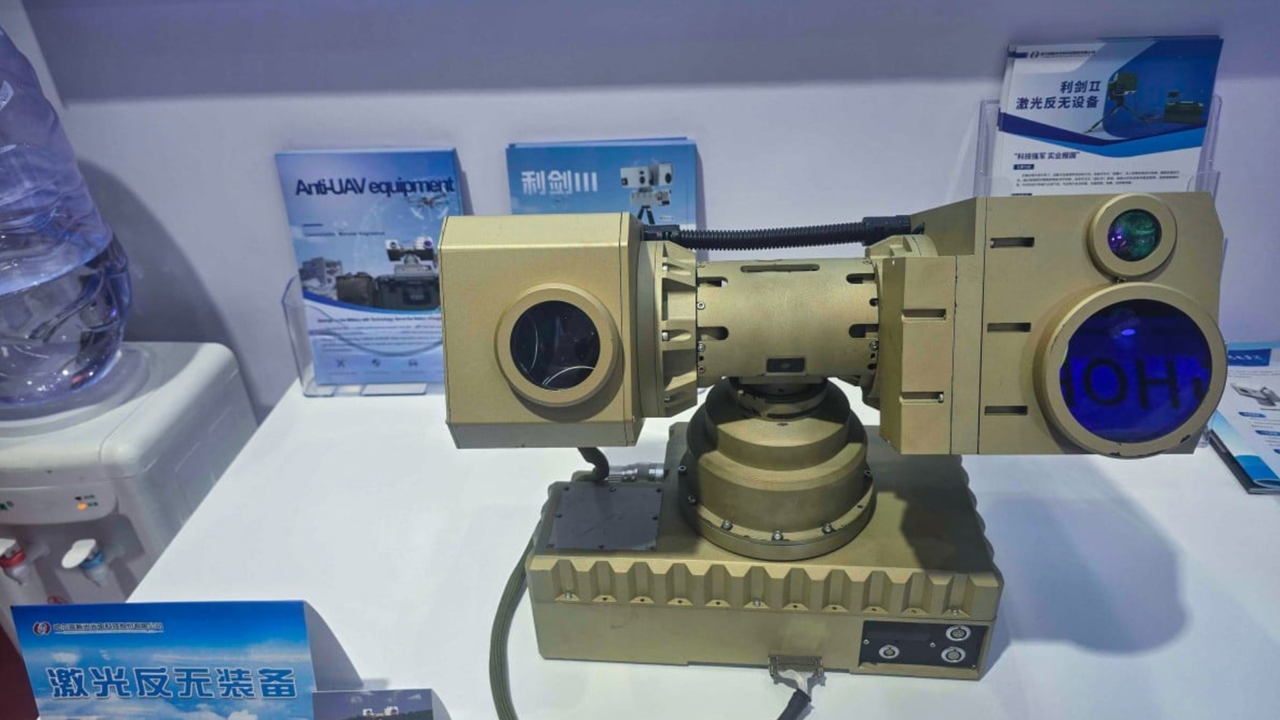
Picture a soldier on patrol. A hostile drone appears suddenly in sight. Instead of requesting remote support or wielding heavy systems, that soldier aims a compact device, nearly a backpack, activates the targeting system, and within four seconds the aircraft is neutralized by an invisible beam. This is not a video game scene but what the Chinese government claims about its new man-portable anti-drone laser. The announcement—accompanied by stark images—describes a 2-kilowatt weapon, backpack-sized, weighing about 55 pounds (25 kg), and carried by a single soldier. Its effective range reaches 1,600 feet (500 meters), and the engagement time is sufficient to 'burn through' a drone in just 4 seconds.
The revolution lies not only in laser miniaturization but in the integration of an AI-based targeting system that operates entirely locally, without any need for external connectivity. This seemingly operational detail carries profound implications for anyone, military or industrial, who views AI inference as a key to maintaining data control and security, reducing latency, and eliminating failure points tied to remote communication.
Onboard AI: Intelligent Targeting Without the Cloud
The released specifications don't detail the targeting system's architecture, but it's plausible that the AI uses computer vision models trained to recognize and track aerial threats in real time, likely leveraging optimized variants of convolutional neural networks such as YOLO or similar. What matters, for those dealing with deployment, is that the entire decision process—from detection to target confirmation—happens on the unit itself, with no data exchange with remote servers. Zero network latency, zero interception risk, maximum information sovereignty.
For a battery-powered device constrained by weight and thermal dissipation, running real-time AI models is a significant engineering challenge. Techniques like quantization come into play to reduce model memory footprint and speed up inference on embedded processors—possibly FPGAs or low-power dedicated components. This is the same reasoning driving the migration of LLMs toward enterprise on-premise setups: smaller, more efficient models that are still effective enough to accomplish the assigned task, sacrificing brute scale to gain operational autonomy and security.
The Rise of Edge Inference: From Cloud to Individual Weapon
This anti-drone laser is an extreme, almost sci-fi case, but it perfectly embodies the path AI is taking: from centralized cloud to increasingly distributed processing, down to wearable portable devices. For businesses, the same questions—where to run models? how to balance power and autonomy? what performance trade-offs are we willing to accept to keep data in-house?—come up daily when evaluating the adoption of an LLM for automation or analytics tasks.
The answer is never one-size-fits-all. The Total Cost of Ownership equation, when moving inference locally, intersects hardware costs (GPU, NPU, bare metal), energy consumption, the expertise needed to manage a self-hosted pipeline, and, of course, privacy. A reality where China fields a portable AI weapon shows that the technology to perform sophisticated edge inference exists, is mature, and can work even in adverse conditions. The enterprise sector can draw lessons on how to build robust, redundant architectures completely independent from third parties.
Beyond the Battlefield: Lessons for Enterprise Deployment
We're not just talking about weapons. The capability of a system to destroy a drone in seconds via a computer vision algorithm running in a backpack-sized module is a powerful reminder for those who govern critical infrastructure: AI doesn't need boundless data centers to be lethal, efficient, or, more prosaically, useful. In civilian settings too, edge applications—from intelligent video surveillance to industrial inspection in harsh environments—are adopting ever more compact and performant models.
Those evaluating an on-premise approach to Large Language Models, or migrating from cloud solutions for GDPR compliance or digital sovereignty reasons, can look precisely at these examples of forced miniaturization. The question to ask is: which hardware, quantization level, and framework provide the right balance between performance and isolation? AI-RADAR offers analytical tools and metrics for those facing these assessments, without offering ready-made solutions, because each context has deeply different latency, throughput, and OpEx vs. CapEx balance needs.
The image of a soldier with an AI-integrated laser shows, ultimately, that the future of sovereign AI applications is already here—sometimes in unexpected forms—and that the path to autonomous and secure infrastructure passes through the ability to process the most sensitive data in-house.










💬 Comments (0)
🔒 Log in or register to comment on articles.
No comments yet. Be the first to comment!