
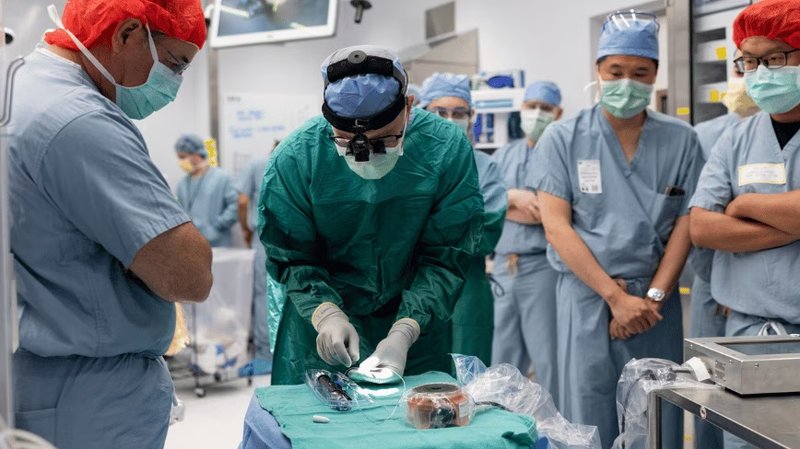
Surgeons at Shanghai’s Huashan Hospital have performed the first-ever implant of a commercially approved brain-computer interface (BCI). The patient, who lost hand function after a spinal cord injury a decade ago, now carries a coin-sized chip under the skull, designed to decode neural signals and restore motor control. The news, reported by the South China Morning Post, marks a shift from academic experiments to a market-ready medical device.
The chip’s reduced dimensions compared to Neuralink’s implant — intentionally smaller — are not a design flourish. They lie at the core of an architecture that strives for on-device processing autonomy. A chip this compact cannot afford to stream raw data to a smartphone or remote server; it must process neural signals locally, within a tight energy budget and with zero latency. That makes the real hardware here an on-body inference system, running decoding algorithms inside the patient’s body.
At a time when data sovereignty has become a critical factor for businesses and governments, a brain implant represents the extreme case: a person’s most intimate information cannot leave the biological perimeter without raising enormous ethical and regulatory questions. China’s decision to field a device that processes locally, without leaning on the cloud, is more than a technical necessity — it’s a statement of principle. Any company aiming to commercialize BCIs will need to convince patients and regulators that neural data remains confined. That translates into hardware that minimizes the attack surface by eliminating non-essential external transmissions.
It’s no coincidence that the same logic is fueling growing interest in on-premise deployment of LLMs in healthcare, legal, and financial sectors. If a hospital can train and serve language models on local servers, keeping medical records under its control, why should a neural interface behave differently? The Chinese chip thus becomes an extreme case study in edge computing: it shows that even in a minimal form factor, inference can be performed without depending on external infrastructure. For the AI hardware market, that is a signal: demand for ultra-low-power accelerators capable of running neural networks in real time on wearable or implantable devices is set to rise.
Second-order implications go beyond medicine. If a chip measuring a few square millimeters can decode movement intention today, tomorrow it could manage more complex human-machine interfaces — perhaps a personal AI assistant that responds to neural commands, hosted entirely on-device to prevent every thought from ending up in a data center. Aggressive miniaturization isn’t just a race between companies; it’s the enabling condition for a truly personal and sovereign AI.
In short, the Shanghai surgery doesn’t just report a clinical first. It testifies to an industry already picking its side in the data sovereignty game: as close to the body as possible, away from servers beyond one’s control. A principle that, for anyone evaluating how to deploy AI inside an enterprise today, rings familiar.







💬 Comments (0)
🔒 Log in or register to comment on articles.
No comments yet. Be the first to comment!