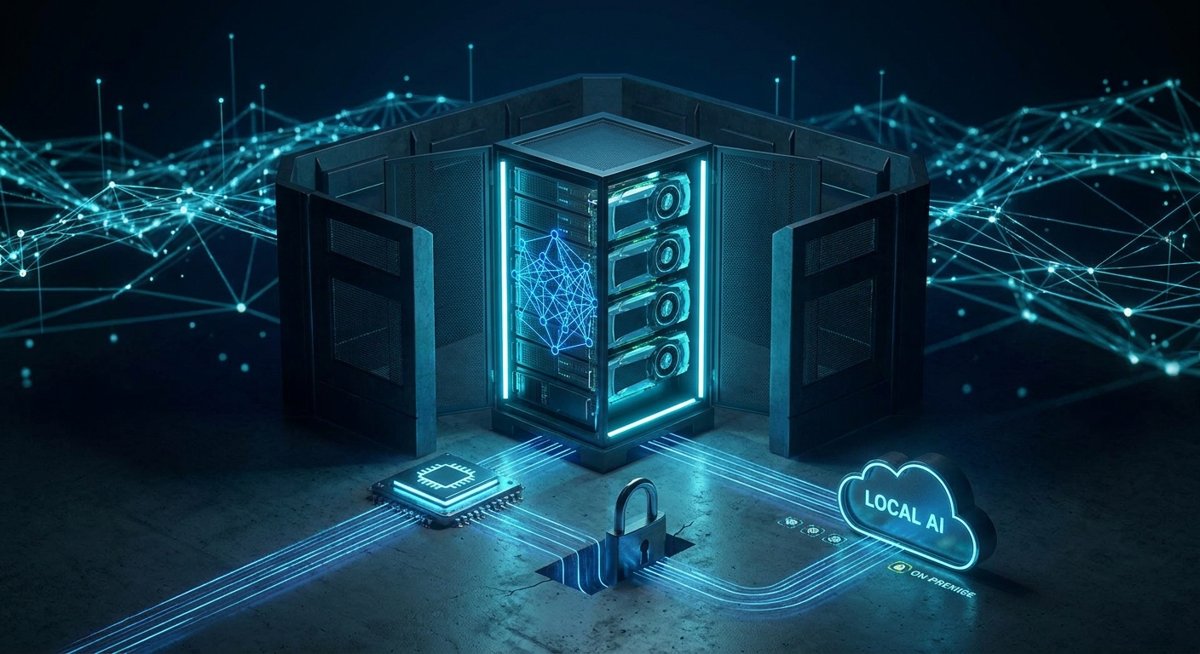
The signal: an API-first vendor puts local runtime on the roadmap
Cohere's announcement carries weight beyond technical compatibility. Nick Frosst does not frame it as a simple update: integrating the visual encoder of North Micro Vision Instruct into llama.cpp closes a loop the local-first community has awaited for months. The visual module was the last missing block. The Large Language Model in North Micro Vision Instruct shares architecture with North Mini Code and Command A+, already supported thanks to community work. With the visual encoder now in the runtime, all recent Cohere architectures become compatible with llama.cpp.
This matters because it shifts the company's competitive center of gravity. Cohere started as an API-first vendor with a cloud-oriented offer. Investing to make its models runnable outside the cloud signals that distribution has become a strategic problem, not an accessory. For AI-Radar the message is clear: self-hosting is no longer a fallback for marginal users, but a channel a proprietary vendor chooses to serve.
The choice of llama.cpp is not accidental. The runtime is the de facto standard for local, quantized inference on CPUs and consumer GPUs. Joining this standard means entering an ecosystem already populated by tools, conversions, and workflows that organizations can activate without cloud APIs. The announcement does not solve all operational issues, but it removes a concrete bottleneck.
llama.cpp as de facto standard: why the bottleneck was the runtime
llama.cpp is not just a tool for running models locally. It has become a compatibility interface: if a model does not run on llama.cpp, it remains outside a growing portion of self-hosted, air-gapped, and on-premise pipelines. This explains why removing the visual bottleneck carries such specific weight. For Cohere's text models the path was already open thanks to the community; for the multimodal model, the missing piece prevented local use.
The problem was not the LLM itself, but the visual component. In local inference, every module must be serializable, quantizable, and executable in the runtime. If the visual encoder is not integrated, the model remains available only via API, with constraints on latency, privacy, and per-token costs. That constraint is now removed, at least at the compatibility level.
For organizations with data residency requirements, this changes the evaluation perimeter. The question is no longer only "how much does a token cost via API," but "how much does it cost to run on our own hardware and with what VRAM footprint." The operational answer requires data the announcement does not provide, but the direction is clear: local runtime becomes an entry condition, not an optional feature.
TCO and self-hosting: comparing marginal cost and per-token cost
The underlying economics are well known to infrastructure managers. A dedicated server has fixed costs that spread over usage volumes; as load grows, marginal cost tends to fall, especially when hardware is amortized and energy is part of data center costs. A consumption-based API follows a different pattern: per-token cost tends to remain linear or grow with volume, barring negotiated discounts. This makes self-hosting a TCO lever to evaluate seriously when inference becomes a stable service component.
Quantization plays a central role in this calculation. Reducing weight precision allows models to run on cheaper hardware with less VRAM, lowering the entry cost of local infrastructure. Cohere's announcement does not specify recommended quantization levels or minimum VRAM requirements. That absence is a concrete limitation for server sizing, but it does not invalidate the strategic signal.
Self-hosting is not free. It requires maintenance, security updates, deployment and monitoring skills, and the ability to handle load peaks without cloud elasticity. TCO is not just hardware cost. For intermittent or unpredictable workloads, the API may remain more convenient. For predictable, regulated, or sovereignty-bound workloads, dedicated hardware can become an asset.
Cohere's move does not claim self-hosting is always preferable. It says the vendor recognizes both modes as part of the same offer. Those evaluating North models can now set up a real comparison between per-token cost and dedicated server cost, without changing provider as volume grows.
Local fine-tuning and sensitive data: Transcribe in Unsloth completes the framework
The arrival of Cohere Transcribe in Unsloth and Unsloth Studio adds a complementary piece. It is not only about running models locally, but about adapting them on private data without cloud APIs. Unsloth is a framework designed for efficient fine-tuning: placing Transcribe in this ecosystem signals that the local path does not stop at inference, but includes model customization.
The stakes are particularly high for speech-to-text models. Audio and transcripts raise privacy, trade secret, and regulatory compliance issues. Being able to fine-tune Transcribe on internal conversations without moving recordings outside the corporate perimeter is a concrete incentive for regulated sectors such as healthcare, finance, legal, and public administration. The announcement does not enter operational details, but the principle is clear: data must not leave the organization.
Local fine-tuning still has constraints. It requires data preparation, version management, qualitative evaluation, and often a subsequent quantization step to make the model deployment-ready. It is not a zero-cost operation. However, by removing the cloud pass, it lowers one of the most frequent barriers to adoption in regulated contexts.
Competition and sovereignty: who loses when local compatibility becomes a criterion
The competitive effect is immediate. Cloud-only inference services that lack a local equivalent lose ground, at least in the segment of organizations with sovereignty requirements or air-gapped environments. Compatibility with llama.cpp stops being an extra for the community and becomes a condition for entering evaluation.
This changes procurement language. An IT team can now ask a vendor: "Does this model run on our hardware?" If the answer is no, the vendor exits the shortlist, even if per-token cost is competitive. In regulated sectors, keeping data inside the corporate perimeter is worth more than a small unit saving.
For other proprietary vendors, Cohere's move raises pressure. Investing in local runtime support requires resources and a maintenance strategy, but ignoring this channel means conceding the self-hosted segment. The choice is not neutral: it concerns deployment control, update management, and the relationship with the local-first community.
A too-clear reading should be avoided, however. Compatibility with llama.cpp does not automatically guarantee feature parity with the API. Multimodal features, tool use, long contexts, and edge-case handling can behave differently in the local runtime. Evaluators must verify real use cases, not just the presence of support.
What to watch now: benchmarks, VRAM, and operational maturity
The most evident limitation of the announcement is the lack of operational data. There are no benchmarks, VRAM requirements, or recommended quantization levels. For server sizing, open questions remain: how much memory is needed to run North Micro Vision Instruct self-hosted? Which quantization maintains acceptable quality for the use case? What impact does the visual encoder have on latency?
The next signals to monitor are concrete. Publication of model cards with hardware requirements, official GGUF conversions, deployment examples, and maintenance guidance. Without these artifacts, adoption will remain limited to experiments and proof of concept. With these data, self-hosting can enter production evaluations.
A second front concerns ongoing support. llama.cpp compatibility requires continuous updates, because the runtime evolves quickly and new model versions can introduce different architectures. The signal will be stronger if Cohere maintains support as part of the release cycle, not as a one-off contribution.
Finally, the ripple effect matters. If other proprietary vendors follow the same path, local runtime will become a market prerequisite. If it remains an isolated case, it will be a competitive advantage for Cohere in the self-hosted segment. AI-Radar will continue to track operational maturity, not announcements: for organizations, the difference is between being able to say "it is compatible" and being able to say "it is in production."


💬 Comments (0)
🔒 Log in or register to comment on articles.
No comments yet. Be the first to comment!