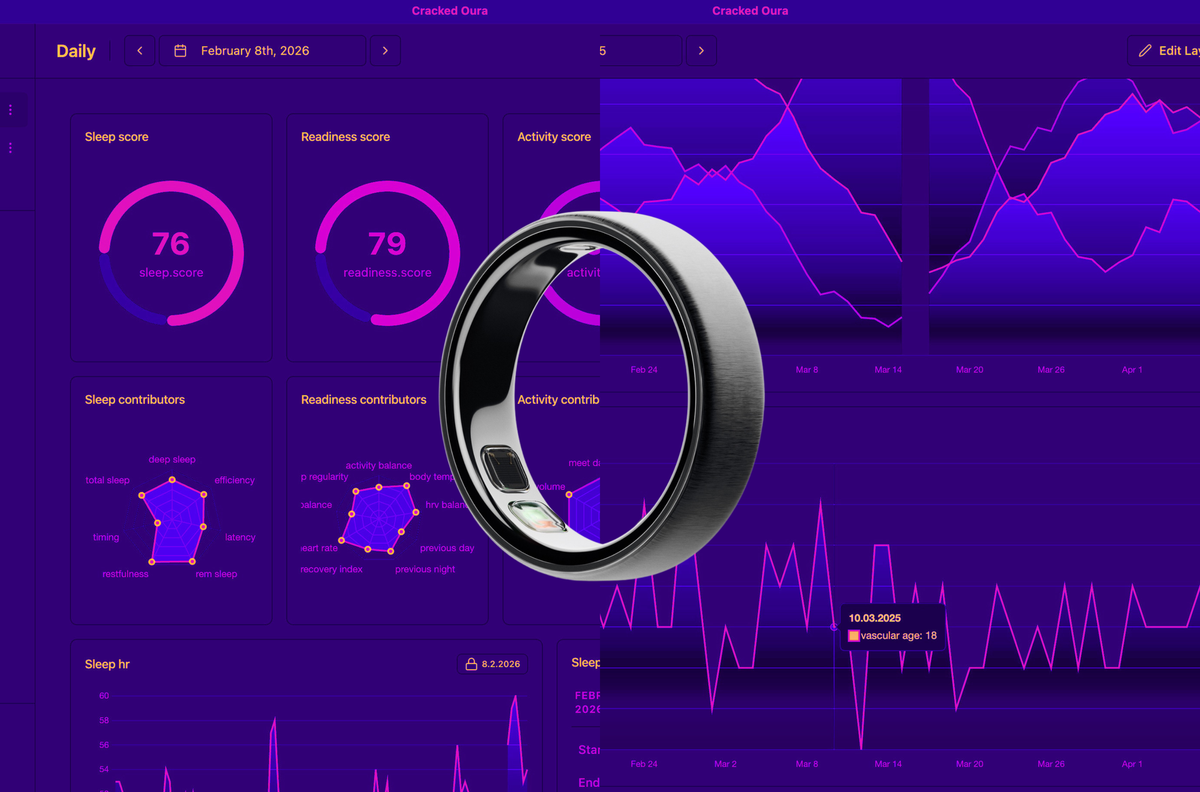
Cracked Oura: An Open Source Alternative for Personal Data Management
In the landscape of wearable devices, the Oura Ring has established itself as a popular tool for health monitoring. However, like many modern services, it requires a monthly subscription to unlock full functionalities and gain meaningful insights from the collected data. This dynamic has prompted Elmo Ahorinta, an independent developer, to create "Cracked Oura," an Open Source application that promises to change the rules for users of the renowned ring.
The announcement of the new Oura Ring 5, lighter and thinner, with a price ranging between $399 and $499, has reignited the debate on the added value of subscriptions. With an annual cost of approximately $70 to access essential metrics on sleep, stress, and exercise, many users question the long-term sustainability of such models. Cracked Oura positions itself as a direct response to this need, offering an alternative path for autonomous management of personal data.
Functionality and Technical Implications
Cracked Oura, published on GitHub, operates by leveraging the data export function offered by Oura's website. The application automates the process of downloading CSV files containing the user's health data and populates them into a local database. This architecture ensures that data remains on the user's device, reinforcing the principle of personal data sovereignty.
While the application does not replicate all advanced features of the official Oura app, such as women's health tracking or the "symptom radar," it does offer visualization of key data points. Its Open Source nature invites the community to contribute to its development, improving functionalities and addressing any issues. Notably, "Claude" is listed among the contributors on GitHub, indicating the use of artificial intelligence tools in the development process.
Data Sovereignty and Total Cost of Ownership (TCO)
The Cracked Oura project raises fundamental questions about the ownership and control of personal data, a topic of increasing relevance even in enterprise contexts. The choice to keep data local to the device, rather than relying on subscription-based cloud services, aligns with the needs of those seeking greater control and privacy. This approach is particularly significant for organizations evaluating on-premise deployments for their AI/LLM workloads, where data sovereignty and regulatory compliance are absolute priorities.
The subscription model imposed by Oura, which effectively limits full access to data generated by the user themselves, directly impacts the Total Cost of Ownership (TCO) of the device. Cracked Oura offers a way to mitigate this recurring cost, transforming an operational expense (OpEx) into a one-time investment for the device, with the ability to manage data independently. This perspective is crucial for CTOs and infrastructure architects analyzing the trade-offs between self-hosted solutions and cloud services for their AI strategies.
The Future of Wearables and Open Source
The existence of Cracked Oura highlights a broader trend: growing user impatience with platform lock-ins and subscription barriers that limit access to their own data. Elmo Ahorinta has expressed hope that other developers will contribute to the project and that similar initiatives might emerge for other wearable devices that gate access to data via subscriptions.
This scenario reflects a desire for greater transparency and control, pushing towards solutions that prioritize the user. For those evaluating on-premise deployments of complex infrastructures, such as those for Large Language Models, the lesson is clear: data control and architectural flexibility are decisive factors for long-term success and sustainability. AI-RADAR, for example, offers analytical frameworks to evaluate the trade-offs between self-hosted and cloud solutions, providing tools for informed decisions in this area.









💬 Comments (0)
🔒 Log in or register to comment on articles.
No comments yet. Be the first to comment!