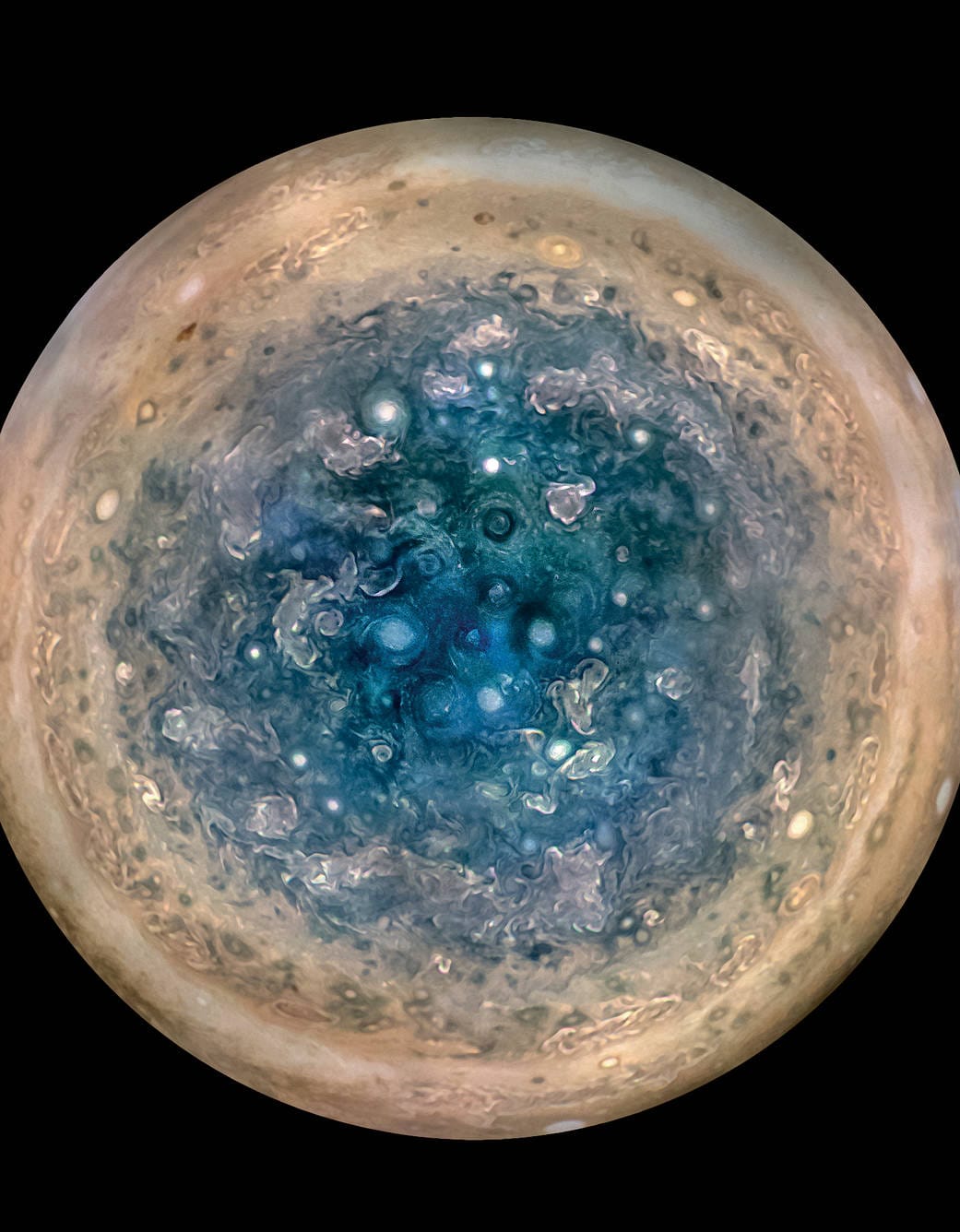
Vortex Crystals: Miniature Jovian Storms
A recent study published in Earth and Planetary Science Letters describes how astronomers have managed to recreate laboratory models of vortex crystals similar to those found at Jupiter's poles. These crystals are actually enormous cyclonic storms that cluster together in geometric configurations, such as equilateral triangles.
The experiment, conducted by Djihane Benzeggouta and her team at Aix Marseille University, used tanks containing stratified fluids, a mixture of fresh and saltwater, to simulate Jupiter's atmospheric conditions. The researchers released three similar cyclonic vortices into the upper layer of the rotating fluid, observing how they spontaneously organized into a stable and long-lasting vortex crystal.
Experiment Details
The experimental model made it possible to observe the formation and stability of vortex crystals for hundreds of rotations, equivalent to several minutes. This provided important information on fluid dynamics and the forces governing the organization of these complex atmospheric structures.
The results of this study open new perspectives for understanding atmospheric phenomena not only on Jupiter, but also on other planets. The ability to reproduce these phenomena in the laboratory allows researchers to study them in a controlled manner and to develop more accurate models for predicting atmospheric behavior.
The ultimate goal, according to the researchers, is to achieve the spontaneous emergence of vortices and crystals from background turbulence, a fundamental step in fully understanding the complexity of these systems.





💬 Comments (0)
🔒 Log in or register to comment on articles.
No comments yet. Be the first to comment!