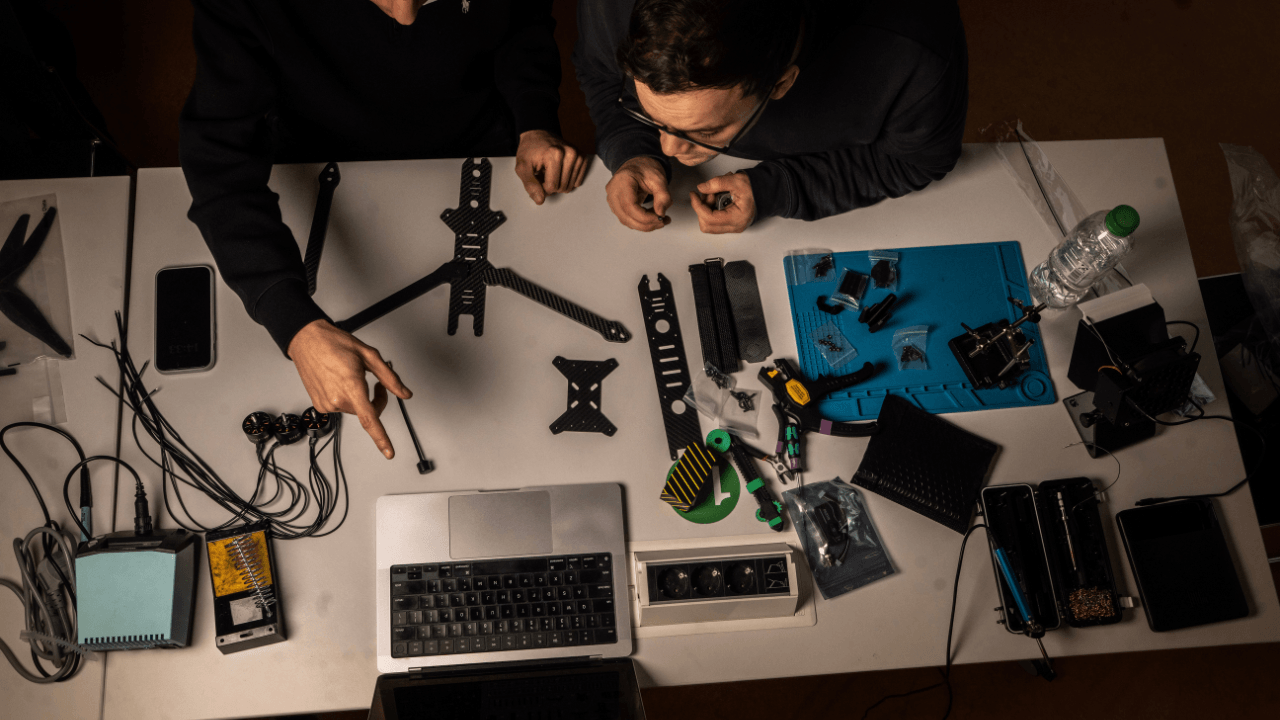
In June 2024, around 150 people gathered in Munich for the first European hackathon exclusively dedicated to defense technology. None of them had the reputation of a big military contractor, but in 48 hours they built 34 working prototypes — from air defense systems to demining tools. Today that event has turned into a pan‑European ecosystem with 35 hackathons already held in cities such as Kyiv, Copenhagen, Paris, Berlin and Rome, more than 400 teams involved, and around 40 companies born from those weekends.
The spark: physicists, startups and the urgency to act
Benjamin Wolba, co‑founder of the European Defence Tech Hub (EDTH), holds a PhD in condensed matter physics and has no military background. “I wanted to build technology with real‑world impact,” he says. In February 2024 he was in Silicon Valley when he learned about a defense hackathon in El Segundo, California. Together with his friend and physicist Jonatan Luther‑Bergquist, he decided to replicate it in Europe. Four months later, the first EDTH came to life with support from the Ukrainian Ministry of Defence, Quantum Systems and many other organizations. “We were complete outsiders, yet the response was overwhelming.”
The format: soldering irons, not slides
Each weekend starts with intensive technical workshops: machine learning for defense, FPV drone building, data fusion, software‑defined radios. Then participants — registered individually for security clearance even if they already belong to a team — form groups of two to six and spend 48 hours designing and assembling prototypes. Soldering stations, 3D printers and electronic components are provided. On Sunday afternoon there are no slide decks: teams present working hardware and software, judged by military experts, companies and investors, with Ukrainian representation always present for direct operational feedback. “For us, Sunday isn’t the end of the hackathon; it’s the beginning of what comes next,” Wolba explains.
Thinking drones: Zero Industries and onboard inference
The best‑known success story from EDTH is Zero Industries, a startup that has developed a Visual Positioning System (VPS) for autonomous drones. In environments where GPS is absent, jammed or spoofed, the VPS combines computer vision, advanced mapping and onboard AI inference directly on the aircraft. Computation happens locally, with no dependency on the cloud — a choice forced by operational reality but one that also reflects the need for total control over data in critical contexts. The founders met during the hackathons, worked closely with Ukrainian operators and are now venture‑backed.
Zero Industries is not an isolated example: roughly half of the companies born from the community have already completed testing in Ukraine. “Founders build at home, then come to Kyiv to demonstrate progress and receive feedback from those with direct front‑line experience,” says Wolba. EDTH has organized three hackathons in Kyiv, the most recent inside the National Aviation University hangar, which Wolba describes as the “Champions League” of European defense tech.
The Ukrainian lesson and Europe’s capability gap
According to Wolba, Europe underestimates how much warfare has changed. “The overwhelming majority of defense spending still goes to legacy systems. We need capabilities against drone swarms, autonomous drones and new approaches to air defense. It’s not just about buying technology; we also need to understand how to use it.” Ukrainian operators know exactly how Shahed drones fly, at what altitude they approach and how to position defensive systems — operational knowledge that every European military should be learning. But achieving this requires thousands of startups tackling thousands of different problems. “If we rely entirely on governments or the big prime contractors, progress will be too slow. Europe needs a thousand defense technology startups,” Wolba states.
Beyond the cloud: technological sovereignty and local AI
The EDTH experience highlights a principle that goes far beyond the military sector: when data is sensitive and reliability is a matter of security, processing cannot be delegated to remote servers. Zero Industries’ drones operate in environments without connectivity and under electronic warfare threats; the same logic applies to many organizations that choose to run their AI models in‑house, on controlled hardware, to meet privacy, latency and digital‑sovereignty requirements. The hackathon movement shows that bottom‑up innovation can produce both the software and the hardware that work offline, creating rapid feedback loops with end users — an approach that anyone evaluating on‑premise deployment of LLMs and AI systems should study carefully.
The next hackathon is under way in Rome, while the following week Berlin will host Berlin Defense Tech Week, with a forum, hackathon and meetings among builders, investors and policy‑makers. Wolba’s invitation is explicit: “Come along. Attend a meetup. Join one of our webinars. Everyone can contribute — you don’t have to be an engineer building drones. You might organize events, introduce founders to customers or investors, write software, bring operational expertise. We haven’t waited for governments; we began building together.” A movement that, piece by piece, is writing the future of European defense.








💬 Comments (0)
🔒 Log in or register to comment on articles.
No comments yet. Be the first to comment!