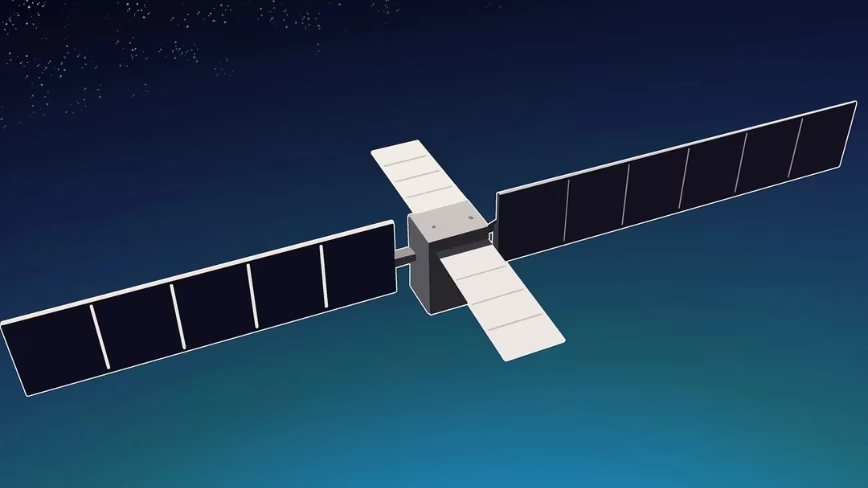
AI Expands Beyond Earth: Orbital Aims for Orbital Data Centers
The exponential growth of artificial intelligence is putting global infrastructure under pressure, raising questions about the availability of power and physical space to host increasingly complex workloads. In this scenario, a Los Angeles-based startup, Orbital, proposes a radical solution: moving AI data centers into low Earth orbit. The company recently announced it has raised $5 million in a pre-seed funding round, led by a16z speedrun, with the goal of developing space infrastructure dedicated to AI.
This initiative emerges at a time when the tech industry is seeking innovative approaches to sustain AI's expansion. Orbital's vision focuses on creating an environment where power, potentially continuous thanks to constant solar exposure in orbit, and space no longer represent the constraints found on Earth. A former scooter company founder is leading this ambitious project, which aims to redefine the paradigms of deployment for Large Language Models and other intensive workloads.
Earth's Energy and Space Challenges for AI
Training and inference of Large Language Models (LLMs) require massive amounts of energy and a considerable physical footprint. Terrestrial data centers, which host these operations, are increasingly under scrutiny for their environmental impact and their ability to scale further. The availability of buildable land, access to stable power grids, and the management of heat generated by high-performance GPUs are just some of the challenges companies face.
For organizations evaluating on-premise deployments, these factors translate into an in-depth analysis of the Total Cost of Ownership (TCO), which includes not only hardware acquisition but also the operational costs related to energy, cooling, and maintenance. Orbital's proposal, though extreme, highlights the pressure driving the industry to explore alternative solutions, outside of traditional hyperscaler cloud models or ground-based self-hosted infrastructures.
Potential Benefits and Considerations for Space Infrastructure
The idea of data centers in low Earth orbit presents several potential advantages, albeit accompanied by significant technical and logistical challenges. One of the key points mentioned is the possibility of harnessing solar energy almost uninterruptedly, reducing reliance on terrestrial energy sources and, potentially, long-term operational costs related to power. This could offer an interesting alternative for AI workloads requiring continuous and energy-intensive operation.
However, the realization of such infrastructures involves complex considerations. Communication latency with Earth, protection from space radiation for sensitive hardware, and prohibitive launch and maintenance costs are critical factors. Nevertheless, Orbital's approach fits into the broader debate on data sovereignty and the need for controlled environments, albeit in a radically different context from that of a traditional air-gapped data center. For those evaluating on-premise deployments, Orbital's innovation underscores how current constraints are pushing the limits of engineering creativity.
The Future of AI Deployment: Beyond Conventional Boundaries
Orbital's project represents a striking example of how the industry is seeking unconventional answers to AI's computing needs. While most companies continue to optimize their local stacks or negotiate with cloud providers, the idea of space-based data centers opens a new frontier for the deployment of Large Language Models and other artificial intelligence applications. This vision, however futuristic, reflects the growing awareness that current infrastructural solutions may not be sufficient in the long term.
The investment in Orbital by a16z speedrun highlights the seriousness with which the market is evaluating these bold proposals. Although large-scale feasibility and implementation timelines are yet to be defined, initiatives like this stimulate reflection on the trade-offs between cost, performance, sustainability, and control that characterize every AI deployment decision. For CTOs and infrastructure architects, Orbital's case is a reminder that the landscape of AI solutions is constantly evolving, pushing the boundaries of technology and engineering.







💬 Comments (0)
🔒 Log in or register to comment on articles.
No comments yet. Be the first to comment!