Generative AI and the New Threat Landscape
The rapid adoption of generative AI in enterprise environments is transforming operational paradigms, from automating complex workflows to accelerating code generation and refining document analysis. This shift, while promising immense efficiencies, simultaneously ushers in a new frontier of cybersecurity challenges. Traditional security frameworks, conceived in an era predating large-scale AI integration, are often not equipped to identify and mitigate the specific threats that emerge from the use of Large Language Models (LLM) and other AI platforms.
Enterprises are embedding generative AI into their daily operations at an accelerated pace, making these platforms a critical part of the operational infrastructure. However, this integration brings with it a growing concern: organizations must confront a new category of threats that traditional monitoring systems were never designed to handle. This scenario necessitates a rethinking of security strategies and the adoption of specialized solutions.
Daylight's Expansion and the Protection of Claude Enterprise
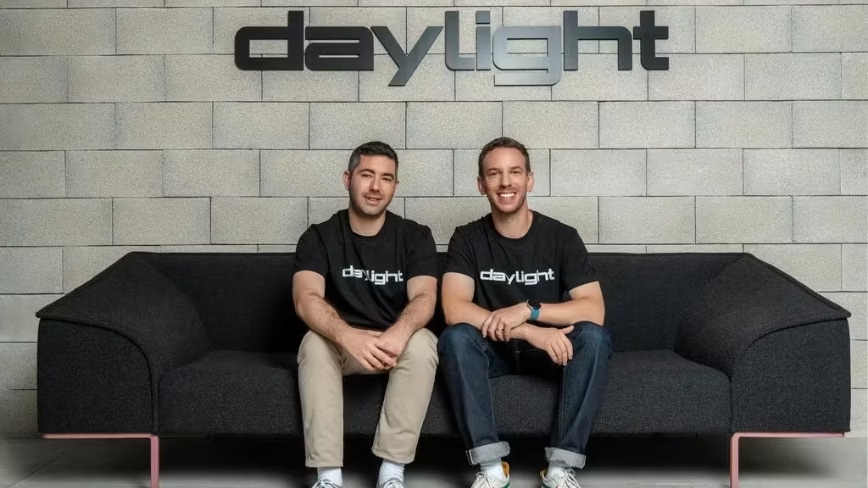
In this context, Daylight has announced the extension of its Managed Detection and Response (MDR) offering to specifically cover Claude Enterprise, Anthropic's AI platform. This strategic move underscores the growing awareness that AI platforms are no longer mere tools but critical infrastructural components that require dedicated protection. The goal is to address the emerging AI security risks that accompany the enterprise-wide implementation of generative AI.
Threats associated with LLMs can range from prompt injection attacks, aimed at manipulating model behavior or extracting sensitive data, to risks related to data governance and compliance. Legacy monitoring systems, designed for traditional endpoints and networks, struggle to interpret the complex interactions and data flows within an LLM, necessitating an MDR solution that understands the specificities of AI security.
Implications for AI Infrastructures and Data Sovereignty
For organizations evaluating LLM deployment, whether in cloud or self-hosted environments, security becomes a decisive factor in architectural choices. The protection of sensitive data, regulatory compliance (such as GDPR), and data sovereignty are crucial aspects influencing deployment decisions. Integrating AI-specific MDR solutions, like the one proposed by Daylight, can mitigate risks, but requires careful evaluation of the Total Cost of Ownership (TCO) and integration capabilities with existing infrastructure.
For those considering on-premise deployments, there are significant trade-offs between direct control over hardware and data and the complexity of managing security in an air-gapped or hybrid environment. AI-RADAR offers analytical frameworks on /llm-onpremise to evaluate these trade-offs, highlighting how infrastructure choice directly impacts the security posture and the ability to respond to new AI threats.
Future Perspectives and the Need for Specialized Solutions
The evolution of AI-related threats is a dynamic field, requiring a proactive approach and specialized security solutions. As LLMs become more sophisticated and pervasive, the ability to monitor, detect, and respond to AI-specific security incidents will become a non-negotiable requirement for any company intending to fully leverage the potential of generative artificial intelligence.
Collaboration between security providers and AI platform developers will be fundamental to building a more resilient and secure ecosystem. This will ensure that innovation is not hindered by unmanaged vulnerabilities, allowing companies to continue integrating AI responsibly and securely, while maintaining control over their data and operations.








💬 Comments (0)
🔒 Log in or register to comment on articles.
No comments yet. Be the first to comment!