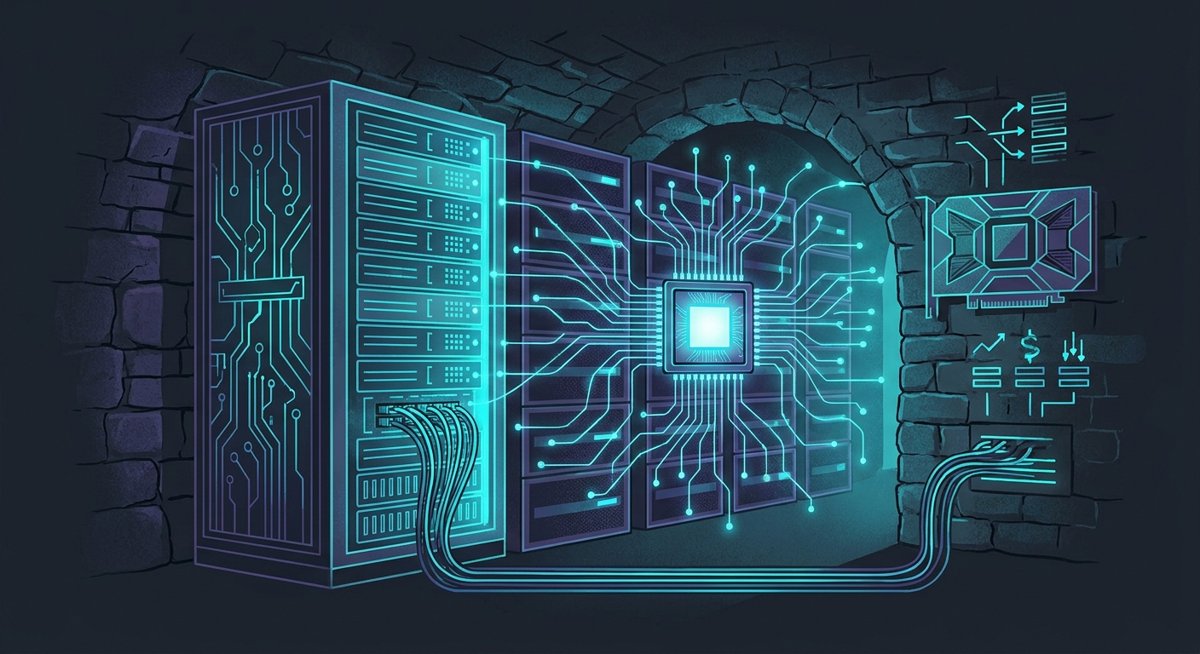
The basement that shifts the inference bar
The news is not that a model with around 151 GB of weights runs at 24 tokens/s. The news is that it happens in a basement, on a machine the owner described as «relatively low rent». The Reddit account points to a precise configuration: an Epyc 7663 processor, 256 GB of ECC DDR4-3200 memory and a single RTX 5090 with 32 GB. No dedicated electrical framework, no GPU cluster, no server room: a self-assembled box that, according to the description, hosts deepseek-v4-flash-0731 with Q8_K_XL quantization.
The reported numbers are just as concrete. Inference throughput sits between 23.8 and 24.6 tokens/s. Prompt processing starts at 60 tokens/s on the first prompt and rises to 385 tokens/s in the final stages, when the cache fills tasks with 100-128k context windows. These are not production-service numbers, but for personal use or long-context tests they have operational meaning.
The point is not to celebrate an enthusiast's achievement. It is to recognize that a large model can run locally on a single accelerator if the surrounding platform has abundant system memory and a server CPU. For those watching on-premise deployments, this is a field data point that contradicts the narrative that multiple GPUs with aggregate VRAM matching the weights are always necessary.
A single case does not make statistics, of course. But it is a directional signal: the technical threshold for self-hosted inference of a large LLM is more porous than many roadmaps suggest. And that changes how investments should be read.
MoE and CPU: VRAM does not need to hold the whole model
The configuration works because deepseek-v4-flash-0731 uses a MoE architecture. In such a model, not all experts are activated for every token. This allows work to be split between CPU and GPU: the CPU with ECC RAM handles part of the experts or layers, while the GPU accelerates what passes through VRAM. The GPU does not have to host the entire graph of weights.
The Epyc account makes this visible. The 151 GB of weights exceed the RTX 5090's available VRAM by nearly five times. Yet the system produces tokens. System memory becomes an extension of VRAM, not just a parking lot. The CPU and DDR4-3200 memory channels form the base for work the GPU cannot contain.
This is a first-order implication for anyone designing on-premise infrastructure. System memory capacity and memory bandwidth become constraints as important as VRAM. Buying the most powerful card is not enough: the combination of CPU, RAM and accelerator determines whether a 151 GB model can be loaded and served without saturating the system.
The result, in this case, remains workstation-class rather than data-center-class. But it is enough for personal use or long-context tests. The fact that a single enthusiast can explore this space on a relatively modest budget is the real change.
Bandwidth, PCIe and regressions: the balance is fragile
The structural limit does not disappear. DDR4-3200 on an Epyc platform is not the highest memory bandwidth available. Data must travel from RAM to GPU over PCIe, with lower latency and bandwidth than VRAM. The RTX 5090 with Blackwell accelerates compute, but it cannot fully compensate for the physical distance between system memory and GPU.
The regression details are instructive. DFlash made the system slower, not faster. Temporarily adding an RTX 3090 did not help; it actually worsened performance. The fact that a second GPU introduces disadvantages suggests that the balance between compute and memory is delicate. Adding just any GPU is not enough: it takes a coherent combination of CPU, RAM, accelerator and orchestration software.
The point is that performance on this kind of system cannot be captured by a single number. Prompt processing starts at 60 tokens/s and rises to 385 tokens/s in the final stages, when the cache fills tasks with 100-128k context. Variability is high. Those evaluating on-premise deployments should look at the full curve, not a single peak figure.
The RTX 3090 case is particularly useful for dismantling the idea that more accelerators automatically mean more performance. On a machine with only one PCIe slot in use, adding a second GPU can introduce synchronization overhead, contend for the bus and unbalance layer distribution. The orchestration software becomes as important as the hardware.
Data sovereignty and TCO: the entry cost falls
If a 151 GB model runs in a basement without a dedicated electrical framework and without over 10,000 dollars in accelerators, the marginal cost of data sovereignty falls. It is not about building a data center: it is about accepting higher latency and lower token/s throughput in exchange for control over data.
The trade-off is concrete. Small teams, labs and organizations subject to residency requirements can evaluate bringing local models that were previously out of reach. Cloud API providers serving intermittent workloads may lose exactly the segment of users that was previously forced to use the cloud for models too large for local hardware.
TCO calculation does not stop at component purchase. Such a machine consumes energy, requires abundant ECC RAM and needs maintenance. But the entry cost for self-hosted inference of a large LLM appears lower than many forecasts suggest. It is not zero, but it is more accessible.
For those evaluating on-premise deployments, AI-RADAR offers analytical frameworks on /llm-onpremise to compare these trade-offs: memory capacity, bandwidth, power draw and integration complexity. The message is not that cloud will disappear, but that the decision between cloud and self-hosted becomes more nuanced.
Who loses and who gains: the new on-premise map
The described configuration does not crown a single vendor. It signals that the race for on-premise inference shifts from raw teraflops to component balance. Server CPU and ECC memory makers enter the AI conversation with more force, while GPU makers must confront a scenario where a single high-end card may suffice in contexts that previously required multiple accelerators.
Small teams and labs gain room to maneuver. A system assembled with previous-generation server components and one recent GPU can open experimental spaces for long contexts and sensitive data. Cloud retains advantages in elasticity and operational management, but it is no longer the only option for large models.
For cloud API providers, the risk is not mass migration, but erosion of intermittent and sensitive workloads. Organizations that cannot send data outside now have a concrete reference for evaluating a local alternative. The cost of leaving the cloud is measured in skills and maintenance, not just dollars.
The second-order effect concerns model design itself. MoE architectures with sparse activation and large but distributed weights may favor hybrid CPU+GPU configurations. This could push LLM providers to optimize models for offloading, not just for aggregate VRAM.
What to watch from here
The first signal to monitor is the combination of CPU, RAM and accelerator, more than any single card. Platforms with many ECC memory channels and CPUs with good memory bandwidth become the battleground for self-hosted inference of large models.
The second is the evolution of quantization and offloading techniques. The Q8_K_XL quantization mentioned in the account reduces footprint without collapsing throughput, but the equilibrium point changes with models and hardware. It will be interesting to see whether new layer-distribution techniques further reduce the PCIe transfer penalty.
The third is the behavior of regressions. The fact that DFlash and an RTX 3090 worsened performance shows that optimization is not linear. Teams wanting to replicate this kind of setup should proceed by measurement, not by accumulating components.
The fourth is entry cost. If a basement with «relatively low rent» components can serve a 151 GB model, the threshold for data sovereignty falls. AI-RADAR will continue to observe these configurations, because the future of on-premise inference is not only a matter of GPUs, but of system architecture.


💬 Comments (0)
🔒 Log in or register to comment on articles.
No comments yet. Be the first to comment!