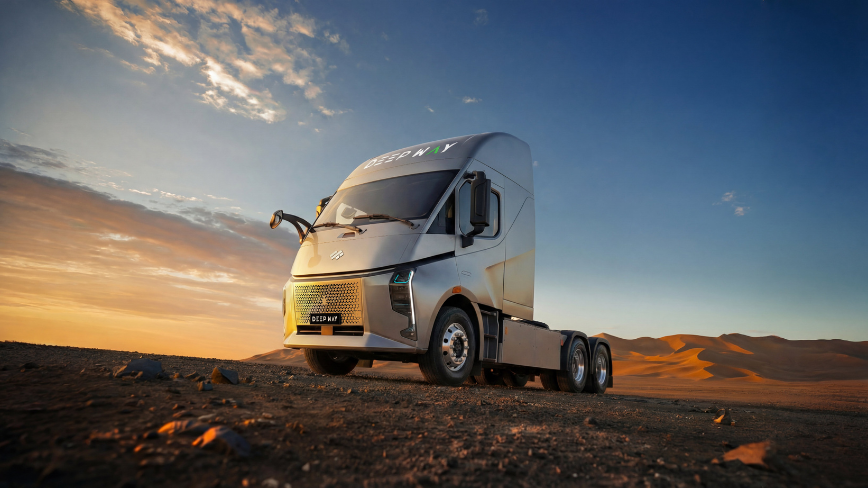
DeepWay Secures $310M for Global Autonomous Electric Truck Expansion
DeepWay, the Chinese company backed by tech giant Baidu, has announced the closing of a significant pre-IPO financing round, raising $310 million. This capital is earmarked to support the company's ambitious plan to expand its fleet of autonomous heavy-duty electric trucks globally, aiming for a listing on the Hong Kong stock market. The news underscores growing institutional investor interest in sustainable and autonomous transport solutions, as evidenced by the attraction of an Australian superannuation fund among its latest investors.
The Hefei-based company has already demonstrated its operational capability by delivering 6,400 intelligent electric trucks in China. This achievement highlights the maturity of its technology and domestic market confidence, laying the groundwork for an internationalization strategy. Despite its delivery success and capital injection, DeepWay has not yet turned a profit, a common situation for many capital-intensive startups in the automotive and artificial intelligence sectors.
The Role of Artificial Intelligence and Infrastructure Challenges
The autonomous vehicle sector, particularly for heavy-duty trucks, represents one of the most complex and promising applications of artificial intelligence. DeepWay's autonomous trucks integrate advanced perception, planning, and control systems, which rely on Large Language Models (LLM) and other machine learning models to interpret the surrounding environment, make real-time decisions, and ensure operational safety. Managing these computational workloads requires robust, low-latency infrastructure.
For companies like DeepWay, the choice between cloud deployment and self-hosted or edge solutions is crucial. Autonomous driving systems require real-time data processing, often in air-gapped environments or with limited connectivity. This pushes towards architectures that prioritize on-premise processing or direct in-vehicle (edge computing) processing, where data sovereignty and latency are critical factors. The ability to perform inference for complex models on dedicated hardware, such as GPUs with sufficient VRAM, is essential for ensuring immediate and reliable responses.
Implications for Deployment and TCO
DeepWay's global expansion implies the need to address various regulations and compliance requirements in different markets. Data sovereignty, for example, becomes a central aspect, driving solutions that allow data processed and generated by vehicles to remain within specific jurisdictional boundaries. This can favor the adoption of self-hosted or hybrid infrastructures, reducing reliance on public cloud services that may not meet such constraints.
From a Total Cost of Ownership (TCO) perspective, the initial investment in on-premise hardware and infrastructure can be significant. However, for intensive and long-term AI workloads, such as those in autonomous vehicles, a self-hosted deployment can offer advantages in terms of long-term operational costs, security control, and environment customization. Efficient energy management and hardware optimization for inference are key elements to maximize return on investment in a technology-intensive sector.
Future Prospects in Autonomous Transport
DeepWay's financing not only strengthens its position in the autonomous truck market but also signals a broader trend towards electrification and automation in the heavy transport sector. The integration of advanced AI technologies into commercial vehicles raises important questions regarding scalability, cybersecurity, and interoperability with existing infrastructures.
For companies evaluating the adoption of AI solutions in critical contexts like autonomous transport, it is essential to carefully consider the trade-offs between cloud flexibility and the control offered by an on-premise deployment. AI-RADAR, for example, offers analytical frameworks on /llm-onpremise to support strategic decisions related to AI infrastructure, highlighting the constraints and opportunities associated with each approach. DeepWay's journey will be an interesting case study to observe how technological and financial challenges will be addressed in the expansion of an autonomous fleet on a global scale.











💬 Comments (0)
🔒 Log in or register to comment on articles.
No comments yet. Be the first to comment!