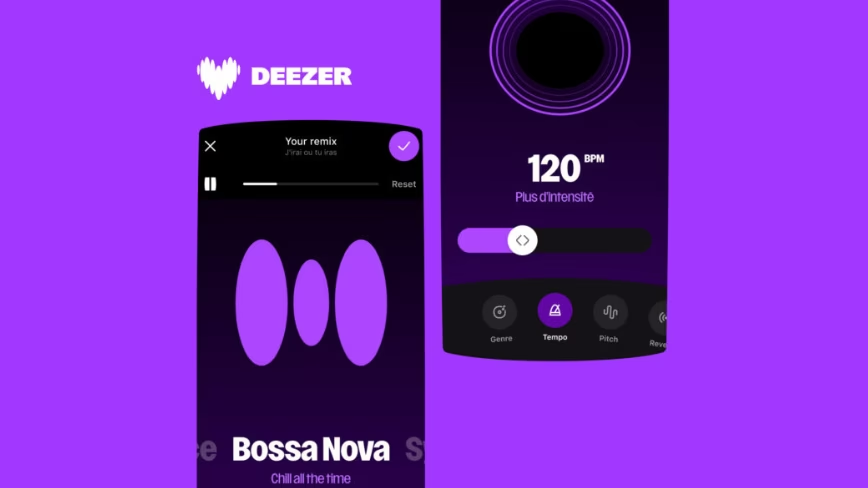
The music industry is flooded with AI‑based tools promising to split, remix, and generate tracks in seconds. Deezer has chosen the opposite route: it launched Remix Lab, an in‑app feature that lets fans create remixes without any artificial intelligence. All you need is a smartphone – no generative models, no neural networks suggesting chords. The operation is surgical: you use tools provided by the platform, but creativity remains human.
How Remix Lab works
The tool lives directly inside the Deezer app, requiring no external software or advanced production skills. After selecting an eligible track, the user can manipulate pre‑isolated elements – drums, vocals, instruments – and reassemble them into a new version. The logic resembles a simplified stem player, with an interface designed for the general public. The crucial breakthrough lies not in the underlying technology, which is already familiar, but in the authorisation path: a remix can only start if the original artist and rights holders have given their explicit consent. This is not an opt‑out checkbox; it is an active green light.
Paying every stream: the rights knot
Deezer built Remix Lab around a principle that sounds almost counter‑current: user‑generated remixes must generate royalties for the original songwriters. Unlike generative AI platforms where authorship of the result remains ambiguous, the rights chain here is traceable. The compensation model stays tied to actual listens: every stream of a remix on the platform contributes to the royalties of those who created the source material. Moreover, the artist can decide if and when to withdraw their track from the remixable catalogue, keeping control over a process that could otherwise spiral out of hand.
Why avoid artificial intelligence
While giants such as Google and Meta develop systems that can generate music from text prompts, Deezer wanted to distance itself from an approach that raises unresolved legal and creative issues. Copyright infringement lawsuits against AI music tools are multiplying, and many artists fear their works are used to train models without compensation or consent. The choice behind Remix Lab is also a strategic positioning: the French platform presents itself as an ally of musicians, offering an alternative that does not cannibalise the value of the original music but extends it, preserving full transparency on intellectual property.
Beyond the remix: what this move signals
In an ecosystem dominated by the rhetoric of ubiquitous AI, Deezer shows that there are ways to innovate without giving in to the temptation of automating everything. Remix Lab points to a direction where technology enables fan participation, but within boundaries set by the artists themselves – a concept that resonates with discussions about data sovereignty and direct control over one’s own work. It is no coincidence that the feature was announced at a time when major labels are raising barriers against unauthorised training of generative models. For anyone watching platform dynamics, Deezer’s move could trigger an emulation effect: other streaming services might follow suit, making controlled remixing a standard interaction, with related benefits in subscriber retention and engagement. The open question is whether the catalogue of remixable tracks will grow enough to turn the tool into a daily habit, but the direction is clear: less opaque AI, more measurable relationships between creators and listeners.











💬 Comments (0)
🔒 Log in or register to comment on articles.
No comments yet. Be the first to comment!