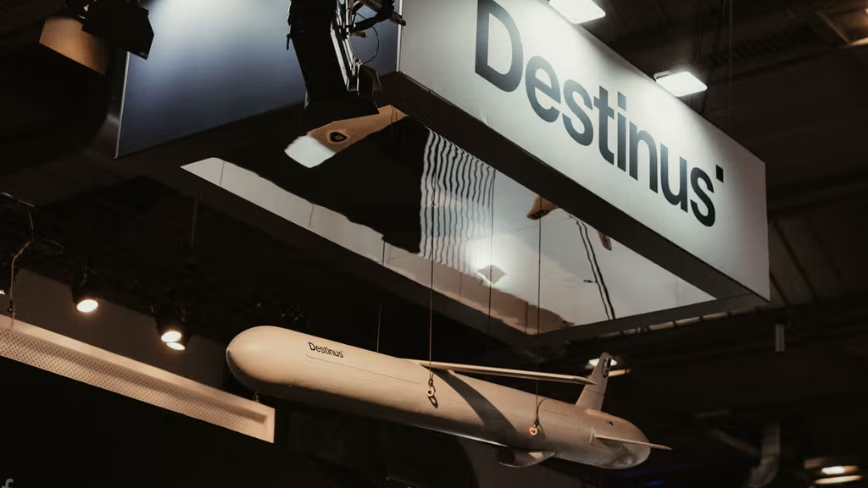
Destinus: A Pre-IPO Round in the Defense Sector
Destinus, the Netherlands-headquartered startup specializing in the defense sector, is in talks to secure approximately €200 million in funding. The company, known for manufacturing cruise missiles and autonomous drones, is thus preparing for a potential Initial Public Offering (IPO). The news was reported by Bloomberg, citing people familiar with the matter.
Destinus aims to achieve a valuation exceeding €5 billion. This ambitious estimate is based on forecast annual revenues of around €500 million. Such a funding round and high valuation underscore the growing investor interest in advanced technologies within the defense and aerospace sectors, especially those with a strong component of autonomy.
Market Context and Implications for Innovation
The defense sector is undergoing a profound transformation, driven by technological innovations and an increase in private investment. Startups like Destinus benefit from this climate, attracting significant capital that accelerates the development of cutting-edge solutions. This influx of funds allows companies to invest heavily in research and development, often in areas requiring high computational and infrastructural capabilities.
In this scenario, artificial intelligence and Large Language Models (LLM) play an increasingly central role, even if not directly mentioned in Destinus's specific context. For companies operating in sensitive sectors like defense, decisions regarding AI deployment, data sovereignty, and the Total Cost of Ownership (TCO) of infrastructure become crucial. The ability to manage complex workloads, such as large-scale AI Inference, requires careful infrastructure planning, often favoring self-hosted or air-gapped solutions to ensure security and control.
Technology and Autonomy: Challenges and Opportunities
Destinus's products, such as autonomous drones and cruise missiles, represent the forefront of technology in the defense field. These systems inherently rely on complex artificial intelligence algorithms for navigation, target recognition, and real-time decision-making. The robustness and reliability of such algorithms depend not only on software quality but also on the underlying hardware infrastructure.
For such critical applications, companies must carefully evaluate the trade-offs between the agility offered by cloud services and the control and security guaranteed by an on-premise or bare metal deployment. The need to operate in air-gapped environments, maintain full data sovereignty, and comply with stringent regulatory requirements pushes many organizations towards local infrastructure solutions. This implies investments in high-performance GPUs, sufficient VRAM, and a development and deployment pipeline that ensures data integrity and confidentiality at every stage.
Future Prospects and the Role of Capital
The success of a funding round like Destinus's not only provides the necessary capital for growth and expansion but also signals strong market confidence in the company's innovative capabilities. These funds will likely be used to accelerate research and development, enhance production capabilities, and potentially explore new markets or applications for their autonomous technologies.
For those evaluating on-premise or hybrid deployment solutions for critical AI workloads, AI-RADAR offers analytical frameworks on /llm-onpremise to assess the trade-offs between costs, performance, security, and data sovereignty. Infrastructure choice is a decisive factor for the long-term success of companies that, like Destinus, operate in technology-intensive sectors with stringent security requirements.





💬 Comments (0)
🔒 Log in or register to comment on articles.
No comments yet. Be the first to comment!