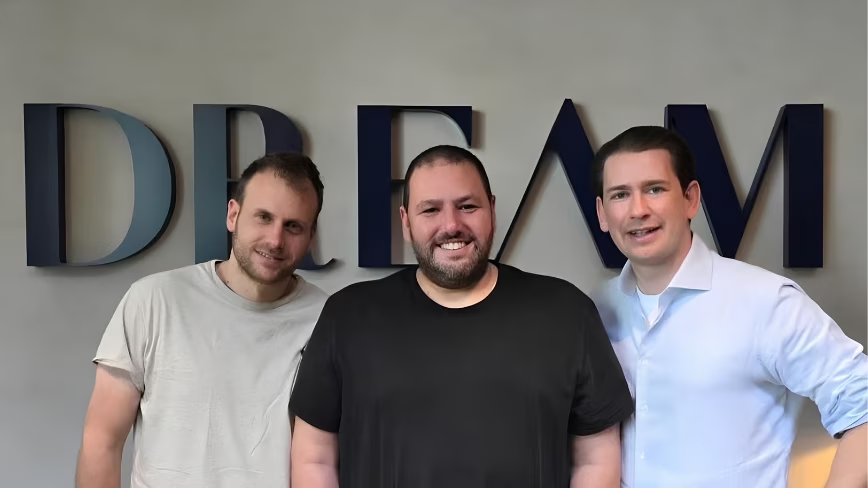
The news arrives right as the cybersecurity market for artificial intelligence searches for sustainable models: Dream, the Israeli startup born from the same hands that built Pegasus, has tripled its valuation to $3 billion and is now setting its sights on Latin America. The region is a prime target: attacks are growing 25% annually, while national defenses remain among the weakest in the world. The company, which presents itself as the ‘antidote’ for governments seeking to protect data and critical infrastructure, has chosen to focus on administrations aligned with Washington.
Behind the expansion lies a paradigm shift that goes beyond the headlines. Public institutions are accelerating the adoption of Large Language Models and on-premise inference systems, driven by demands for data sovereignty and control over information flows. In such contexts, cybersecurity is not an add-on layer but an architectural prerequisite. Dream, drawing on the experience gained from developing one of the world’s most notorious spyware tools, promises to channel that offensive expertise into defensive technologies designed for the AI era. This symbolic transition raises a pressing question for anyone building local inference stacks: if offensive talent converts to defense, what guarantees remain for the most sensitive assets?
The Latin American market serves as a useful thermometer. Scarce local resources and the surge in attacks are forcing governments to seek turnkey solutions, often hosted on government infrastructure or in sovereign clouds. Here, on-premise deployment becomes central: AI models trained on sensitive data cannot travel over the public cloud without adequate protections, and the costs of a breach — not only financial but political — are sky-high. Dream has not yet disclosed technical specifics about its platform, but the move demonstrates that the demand for on-premise AI security is real and growing, especially where traditional defenses are absent.
For those evaluating similar architectures, the case offers a concrete lesson: protecting the model lifecycle — from training to quantization to distributed inference — requires tools that integrate anomaly detection, runtime hardening, and continuous monitoring. Encrypting data or air-gapping the network is not enough; mechanisms are needed that understand model behavior and block attacks aimed at poisoning, extraction, or output manipulation. It is a level of complexity that startups born from offensive security know well, and here Dream’s pedigree could make the difference.
Latin America, with its mix of vulnerability and political will, thus becomes a testing ground. The choice to sell the antidote where the need is most acute is no accident and signals a maturing of the sector: AI security is no longer an optional extra for governments that want to maintain control over their digital operations. While the debate between on-premise and cloud often revolves around Total Cost of Ownership, examples like this remind us that the worst cost is that of a successful attack on a model handling strategic data.







💬 Comments (0)
🔒 Log in or register to comment on articles.
No comments yet. Be the first to comment!