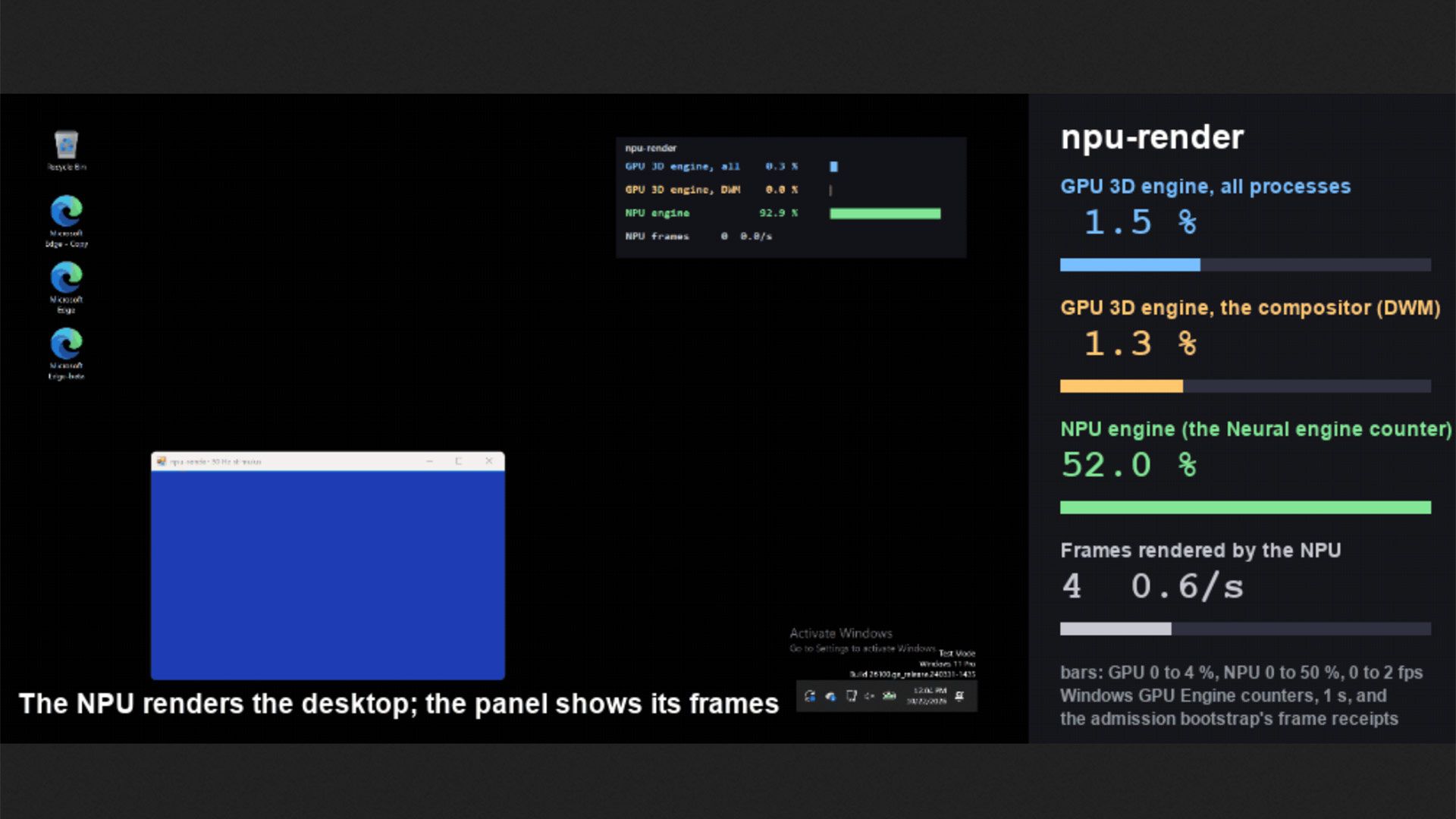
The open source npu-driver project has chosen a path that until recently looked like little more than a provocation: using the NPU to compose the Windows 11 desktop instead of the GPU. The current result is a frame rate of 2–3 Hz, far from the 30 Hz the project lists as its target. Yet the simple fact that a desktop reaches the screen through an accelerator built for neural network inference is already a structural signal, not a lab experiment without consequences.
Normally desktop composition is a GPU job: it involves textures, windows, transparency effects and scaling. An NPU is designed for matrix multiplications and low-power inference workloads, not for producing frames with the graphical complexity we are used to. The fact that npu-driver still manages to generate output, albeit at a walking pace, shows that the hardware has access to enough memory and compute for basic rendering. This is not a performance win: it is proof that the boundary between specialized accelerators and GPUs is less rigid than vendors suggest.
For now, the main beneficiaries are open source driver developers and users with laptops that include an integrated NPU. If the project reached 30 Hz, the GPU could stay idle during normal desktop navigation, with tangible energy savings on battery-powered devices. This is not fantasy: modern SoCs already place NPU blocks next to CPU and GPU, but often leave them sleeping when no AI models are running. Giving the NPU a continuous, low-intensity job would change how manufacturers design power management.
In such a scenario, proprietary graphics drivers that currently control almost every desktop pixel would lose ground. An open source driver capable of activating the NPU for rendering reduces dependence on binary stacks and opens the door to independent optimizations. This is not an attack on GPUs: gaming or 3D rendering still require performance the NPU does not have. But for everyday productivity the GPU's role could shrink, shifting technical relevance toward NPU makers and open source code.
The issue has a direct bearing on local compute. Anyone following on-premise and edge deployment knows that transparently programmable accelerators are a central issue: today NPUs are often exposed only through specific frameworks, with scarce documentation and proprietary APIs. If an open source project can use them for an unintended task, it becomes more plausible that the same access will be exploited for locally running LLMs, data preprocessing, or inference pipelines without going through the cloud. This is not a prediction, but a direction already consistent with the demand for data sovereignty and control. AI-RADAR covers these trade-offs at /llm-onpremise, without one-size-fits-all recipes.
Today npu-driver is stuck at 2–3 Hz. The 30 Hz target remains distant, but the project has already achieved something rarer than a benchmark: it has shown that the NPU can be taken out of the AI model enclosure and put to work on the operating system. The gap to close, now, is mostly a matter of optimization and exposed APIs.





💬 Comments (0)
🔒 Log in or register to comment on articles.
No comments yet. Be the first to comment!