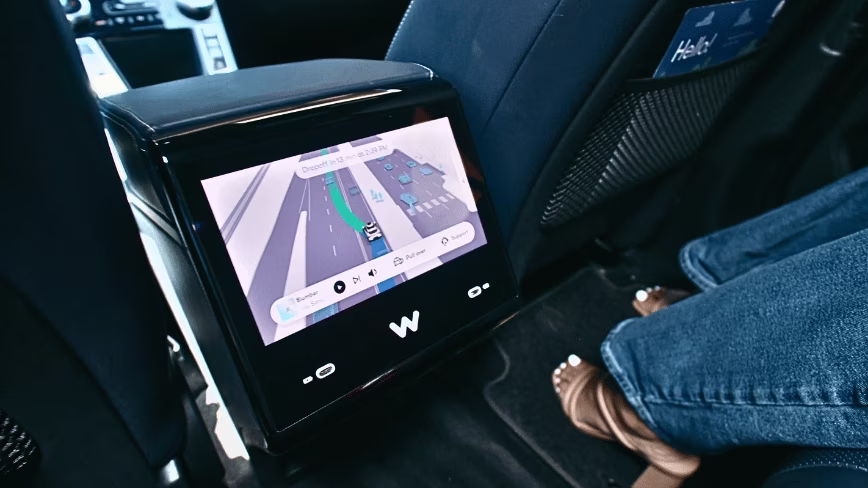
On Monday afternoon in San Mateo, a Waymo called 911. Not because of a malfunction or a crash, but to report two 15-year-olds inside who were drinking alcohol and shooting Orbeez — gel pellets — out of the window. The fleet’s remote monitors spotted them, alerted law enforcement, and pulled the vehicle over to wait for police.
The dynamic is as banal as it is revealing. A driverless car can still ‘snitch,’ and it does so by tapping into a human control center that watches passengers in real time. It’s the operational architecture many autonomous companies are adopting: onboard sensors and cameras, continuous cloud streaming, and remote staff ready to intervene. It works, but it comes at a cost — economically, in terms of latency, and, as this case shows, intrusiveness.
Leaning on a remote team for decisions that affect passenger safety and privacy is a compromise that holds together human oversight and scalability. Yet when the incident goes viral, the flipside appears: who decides what to report? With what criteria? And how much room is left for the vehicle’s own autonomous judgment?
Zooming out to the broader AI-in-the-physical-world ecosystem, the Waymo case signals a structural tension. On one hand, the cloud offers unlimited compute power and simple management; on the other, it shifts decision-making away from the point where data is generated. For critical functions — from autonomous driving to intelligent video surveillance — the latency added by network hops can be unacceptable. And as fleets scale, 1:1 human supervision becomes unsustainable.
That’s why many are turning their attention to on-device processing. Running inference directly on onboard hardware, with optimized, quantized models, cuts reliance on connectivity and gives the vehicle the ability to make immediate decisions. This isn’t just a technical issue — it’s a philosophical shift that shapes control models, data sovereignty, and the total cost of ownership (TCO) of the entire fleet.
For those weighing on-premise or edge deployments in similar contexts, there will always be trade-offs to evaluate: compute power versus autonomy, update ease versus network independence, privacy versus safety. Platforms like AI-RADAR offer analytical frameworks at /llm-onpremise to navigate these choices, with no shortcuts.
The San Mateo episode isn’t an anecdotal oddity. It’s a wake-up call for an industry that is growing comfortable delegating everything to the remote, forgetting that every 911 call placed from a cloud can turn into a legal, reputational, and architectural headache. While the teenagers may get away with a scolding, the real trial is just beginning for the autonomy industry.







💬 Comments (0)
🔒 Log in or register to comment on articles.
No comments yet. Be the first to comment!