Elastics: AI to Democratize Quantitative Trading
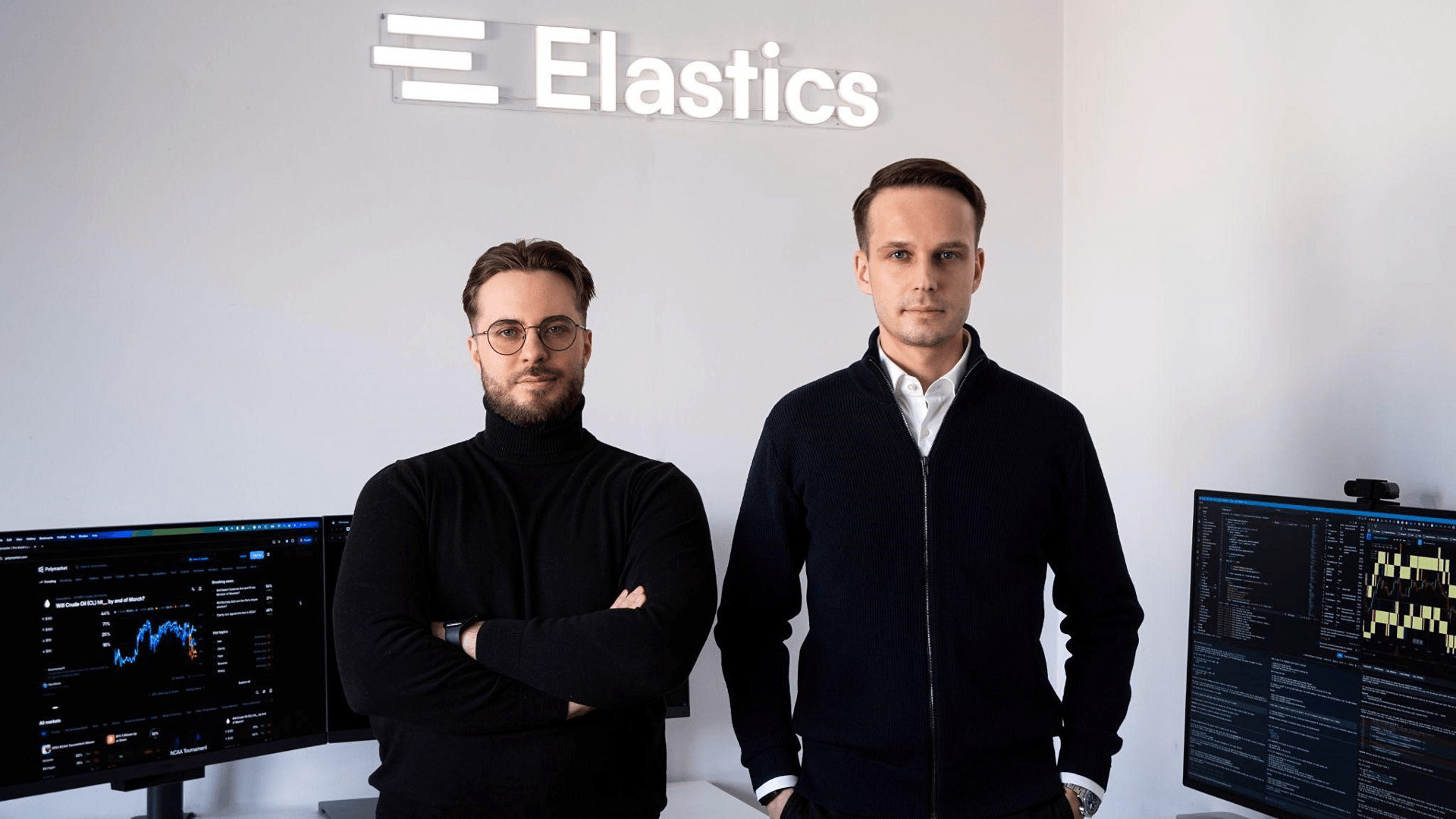
Warsaw-based startup Elastics has announced the closure of an oversubscribed $2 million pre-seed funding round. This capital is earmarked for the development of advanced AI-powered infrastructure, specifically designed for quantitative trading. The round was led by Frst, with participation from angel investors across the AI and crypto sectors, including operators and founders from leading technology companies.
Founded by Szymon Pawica, a former Goldman Sachs professional, and Mateusz Brodowicz, a mathematician with experience in quantitative modeling, Elastics aims to make sophisticated trading tools more accessible to individual investors. The company's system automates research, execution, and portfolio management, bringing capabilities typically associated with institutional environments to a broader user base.
LLM Innovation for Prediction Markets
Elastics is building what it describes as an "AI-native operating system" for prediction markets, a segment of finance that is gaining increasing attention. The technology developed enables users to interact with markets through natural language, allowing strategies to be defined conversationally and executed automatically. The product is currently in private beta, with early access available to selected users.
The company is built around the idea that the future of trading will be conversational, with Large Language Models (LLM) acting as the primary interface between users and markets. Elastics' "Trade with Words" feature, for instance, allows users to describe positions in plain language, removing the need for traditional order forms or manual inputs. This approach lowers the barrier to entry for investors seeking to leverage complex strategies.
Market Context and Implications for AI Infrastructure
Interest in prediction markets has grown alongside rising valuations of platforms such as Polymarket and Kalshi, reinforcing their emergence as a distinct asset class. However, tooling for individual traders remains limited, a gap Elastics aims to address. Szymon Pawica noted that as AI-driven automation becomes more widespread in financial markets, manual trading is becoming increasingly challenging. The company's goal is to ensure access to automation is widely available rather than a limiting factor.
For companies and professionals evaluating the implementation of similar AI solutions, the underlying infrastructure represents a critical consideration. The use of LLMs for real-time Inference, as in Elastics' case, demands significant computational capabilities. The choice between on-premise Deployment and cloud-based solutions, for example, depends on factors such as data sovereignty, latency requirements, and Total Cost of Ownership (TCO). For sensitive workloads like those in finance, the ability to maintain control over data and the execution environment can be a decisive factor.
Future Prospects and the Evolution of Automated Trading
The newly raised capital will be used primarily to expand the team, with a focus on hiring AI and quantitative talent, and to further develop the product. Over time, Elastics plans to extend its offering beyond prediction markets, continuing to build infrastructure for automated, AI-driven trading.
This evolution of trading, which places LLMs at the center of user-market interaction, highlights the growing need for robust and scalable AI infrastructures. For those evaluating on-premise Deployments, analytical Frameworks are available on AI-RADAR.it/llm-onpremise that can help assess the trade-offs between control, performance, and costs. Elastics' vision of a conversational trading future underscores a broader trend in the financial sector, where AI is not just an analytical tool, but a direct and intuitive interface for complex decisions.




💬 Comments (0)
🔒 Log in or register to comment on articles.
No comments yet. Be the first to comment!