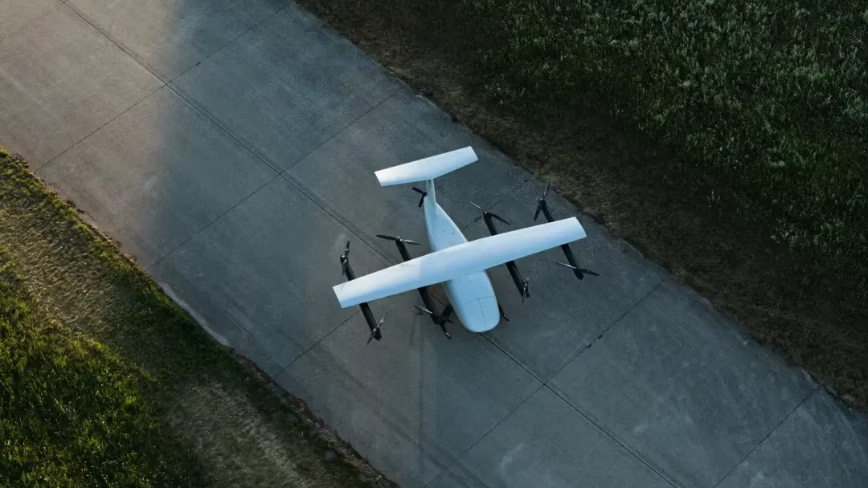
ERC System's Innovation in Air Transport
The Bavarian startup ERC System recently unveiled Victor, an innovative uncrewed hybrid-electric cargo eVTOL (electric Vertical Take-Off and Landing) aircraft. The unveiling took place at ILA Berlin 2026, one of the most important aerospace exhibitions globally. Victor has been conceived to address critical needs in sectors such as defense, advanced logistics, and emergency response, promising to redefine air transport capabilities in complex operational contexts.
The introduction of cargo eVTOL solutions represents a significant step towards the automation and optimization of supply chains and support operations. These aircraft offer the flexibility to operate in remote or difficult-to-access areas, reducing intervention times and risks for personnel. ERC System's vision with Victor aligns with a broader trend in the development of autonomous aerial platforms capable of handling heavy loads efficiently and precisely.
Technical Details and Operational Capabilities
Victor stands out for its technical specifications, designed to maximize efficiency and payload capacity. The aircraft is capable of carrying a 250kg payload, a considerable value for an eVTOL in this category. Its operational range extends up to 300km, with a cruise speed of 250km/h. These performance metrics make it suitable for missions requiring both good reach and rapid response.
Victor's hybrid-electric configuration is a key element. This architecture combines the advantages of electric propulsion (quiet operation, lower emissions, efficiency at low speeds) with those of combustion engines (greater range and payload capacity). Such an approach offers greater operational flexibility compared to purely electric systems, especially in scenarios where charging infrastructure is limited or non-existent, as often happens in defense or emergency contexts. The choice of an uncrewed design further reduces operational costs and risks associated with missions.
Deployment Strategies and Operational Control
For complex and mission-critical systems like Victor, deployment strategies and operational control are of paramount importance. Organizations intending to integrate such technologies into their operations must carefully evaluate not only the aircraft's capabilities but also the supporting infrastructure required for its management. This includes route planning, maintenance, flight data management, and communication security.
In contexts such as defense or emergency response, data sovereignty and direct control over the infrastructure are non-negotiable requirements. Analogous to AI and Large Language Models (LLM) workloads, where many companies opt for self-hosted or on-premise solutions to ensure compliance, security, and low latency, it is also essential for cargo eVTOLs to maintain control over the entire operational pipeline. This approach mitigates risks related to reliance on external providers and ensures that sensitive data remains within the organization's operational boundaries. Evaluating the Total Cost of Ownership (TCO) becomes crucial, considering not only the aircraft's acquisition but also the costs of infrastructure, training, maintenance, and lifecycle management.
Future Prospects and the Cargo eVTOL Market
ERC System aims to begin the first deliveries of Victor in 2028, a timeline that reflects the complexity of developing and certifying new-generation aircraft. Victor's entry into the cargo eVTOL market promises to further stimulate innovation in a rapidly evolving sector. The ability to offer autonomous, high-capacity air transport solutions is set to transform logistics and support operations across many domains.
The choice to invest in platforms with high levels of control and autonomy, both at the hardware and operational management levels, is a recurring theme for organizations operating in sensitive sectors. Whether it's eVTOLs for military logistics or on-premise LLM infrastructures, the ability to maintain sovereignty over one's assets and data is a distinguishing factor. AI-RADAR continues to monitor these trends, providing analysis on analytical frameworks available to evaluate the trade-offs between self-hosted and cloud solutions, an increasingly relevant aspect for technology decision-makers.








💬 Comments (0)
🔒 Log in or register to comment on articles.
No comments yet. Be the first to comment!