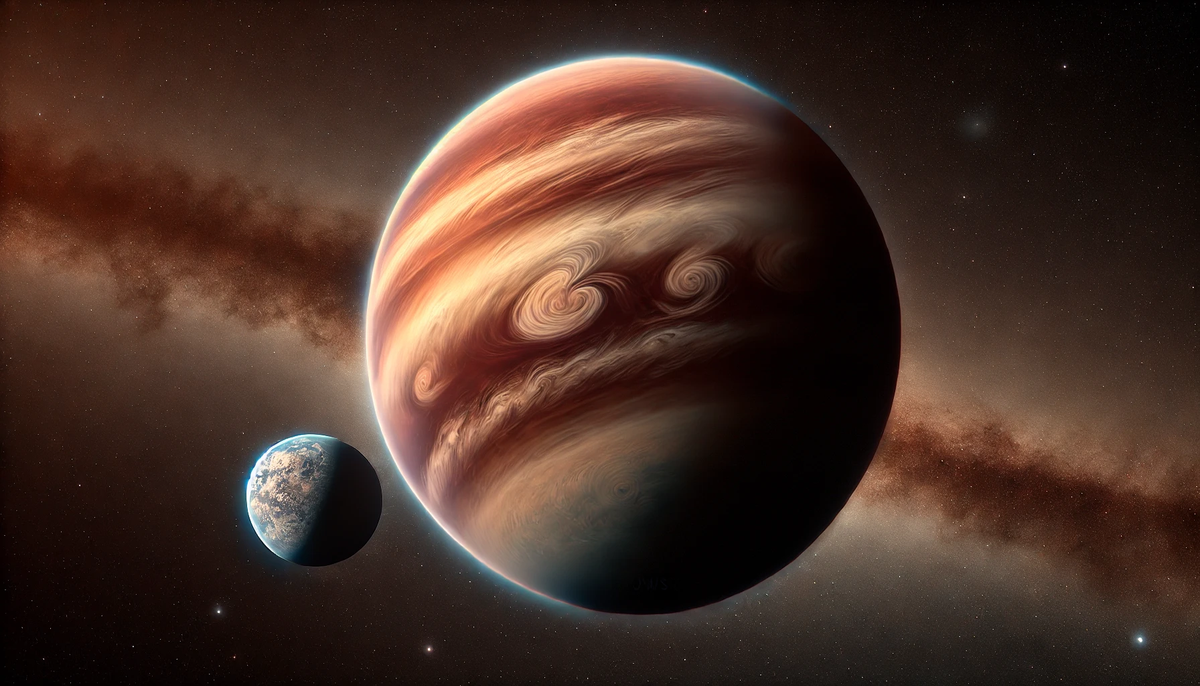
Alien Life on Exomoons of Rogue Planets?
A recent study hypothesizes that alien life could develop on exomoons, natural satellites orbiting planets not bound to stars, wandering in interstellar space.
David Dahlbüdding of the Max Planck Institute for Extraterrestrial Physics (MPE) and his team suggest that if a planet with a thick hydrogen atmosphere were ejected from its star system, taking an exomoon with it, the exomoon's orbit would become elliptical. This orbital deformation would intensify the tidal forces exerted by the planet on the exomoon, generating enough heat to maintain liquid water for billions of years.
"Close encounters before the final ejection even increase the ellipticity of the moon's orbit, boosting tidal heating over millions or billions of years, depending on the moon's and free-floating planet's properties," the researchers state. These conditions could favor RNA polymerization, a crucial process for the origin of life.
The discovery of a binary system composed of a planet and an exomoon unbound to a star would be a significant achievement, even if analyzing their atmospheres with current instrumentation may not be feasible.
Ultrasound for Hedgehog Safety
Researchers suggest testing acoustic repellents to protect hedgehogs, a species threatened by cars and robotic lawnmowers. Experiments have shown that hedgehogs perceive a broad ultrasonic range, with peak sensitivity around 40 kHz. Ultrasonic repellents could temporarily deter hedgehogs from dangerous situations.
History of the Metric System
Despite the adoption of the metric system by almost all countries, the unit of measure "the drop" persists. A new study explores how non-standard units of measure survive waves of standardization. The study also highlights the political dimensions of metrication, which also arose from "the protest of peasants and humble people against the powerful."
The Birth of a (Dead) Star
Astronomers have identified the origin of Type I superluminous supernovae: the birth of a magnetar, a highly magnetized stellar remnant. The light from a supernova observed in 2024 contained traces of the Lense-Thirring effect, a distortion of spacetime caused by massive, rapidly rotating objects, indicative of the presence of a magnetar.





💬 Comments (0)
🔒 Log in or register to comment on articles.
No comments yet. Be the first to comment!