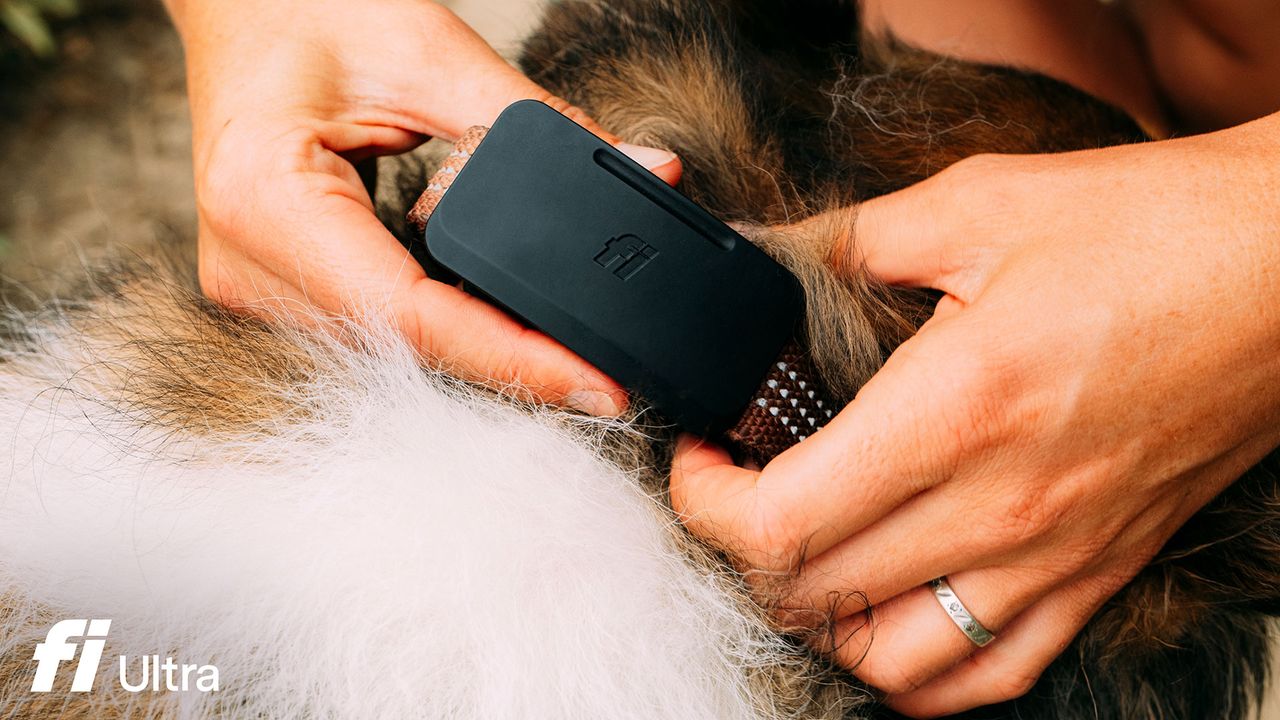
At first glance, the Fi Ultra announcement looks like another entry in the pet accessories catalog, but behind the promise of never losing Fido lies a move that redefines peripheral IoT. It is the first dog tracker to tap into the Starlink constellation, complementing its built‑in GPS and standard LTE connectivity. In practice, the collar can relay the dog’s position even where there is no cellular coverage, as long as it has line of sight to the sky.
The novelty is the integration with SpaceX’s broadband satellite network, which until now has been associated with fixed terminals or vehicles such as planes and ships. Its arrival on a wearable device the size of a collar signals a leap in miniaturization and energy efficiency that makes adoption on a far larger scale plausible. This is not just about finding pets: similar collars could manage herds in alpine pastures, shipping containers on intercontinental routes, or environmental sensors in remote areas—all cases where the lack of terrestrial coverage holds back IoT deployments.
From an architectural perspective, Fi Ultra operates over three redundant channels: GPS for positioning, LTE for low‑latency synchronization when available, and Starlink as a global fallback. It is a hybrid connectivity model reminiscent of industrial edge architectures, where data is captured and processed locally and transmission occurs only when needed, choosing the most efficient path. Even without explicit statements, the manufacturer implies that the device can autonomously manage network switching, a behavior that requires on‑board logic capable of evaluating context and transmission costs.
On the data sovereignty front, the involvement of Starlink raises questions that reach beyond the canine realm. Satellites can route packets through ground stations in different jurisdictions, and continuous tracking of a subject—whether animal or human—implies a timeline of locations that crosses borders without explicit control. For a private user the risk is theoretical, but for professional applications the question becomes concrete: where does that data reside, who can access it, and which regulations protect it? Those evaluating on‑premise or strict edge deployments know that the choice of communication channel is an integral part of the security model, on par with encryption and access control.
The hardware required to sustain a direct link with a low‑Earth orbit constellation in such a small form factor has not been detailed, but it is reasonable to assume a miniaturized antenna module with extremely optimized power consumption. The engineering challenge is comparable to what developers of local inference systems for LLMs face: squeezing the ratio of compute, memory, and energy reserve without sacrificing reliability. It is no coincidence that advances in batteries and low‑power electronics are converging with the demand for ever‑connected and ever‑more autonomous devices.
The real watershed marked by Fi Ultra is the de‑perimeterization of connectivity. “Out of coverage” no longer exists unless you enter a tunnel or a cave. For consumers, it means peace of mind; for enterprises managing mobile assets in isolated areas—agritech, logistics, environmental monitoring—it means being able to rethink workflows and data collection pipelines without having to build dedicated terrestrial infrastructure. And for those developing AI models that run on the edge, the availability of a satellite channel with enough bandwidth for telemetry and commands opens scenarios in which the model trains or sends inferences from any latitude, with data physically remaining on the device until someone deliberately chooses to transmit it.
Fi Ultra might seem like a gadget for well‑heeled dogs. In reality, it puts on the market a peripheral communication platform that previews the future normal: a planet bathed in hybrid connectivity, where every object can decide how and whether to talk to the rest of the world.









💬 Comments (0)
🔒 Log in or register to comment on articles.
No comments yet. Be the first to comment!