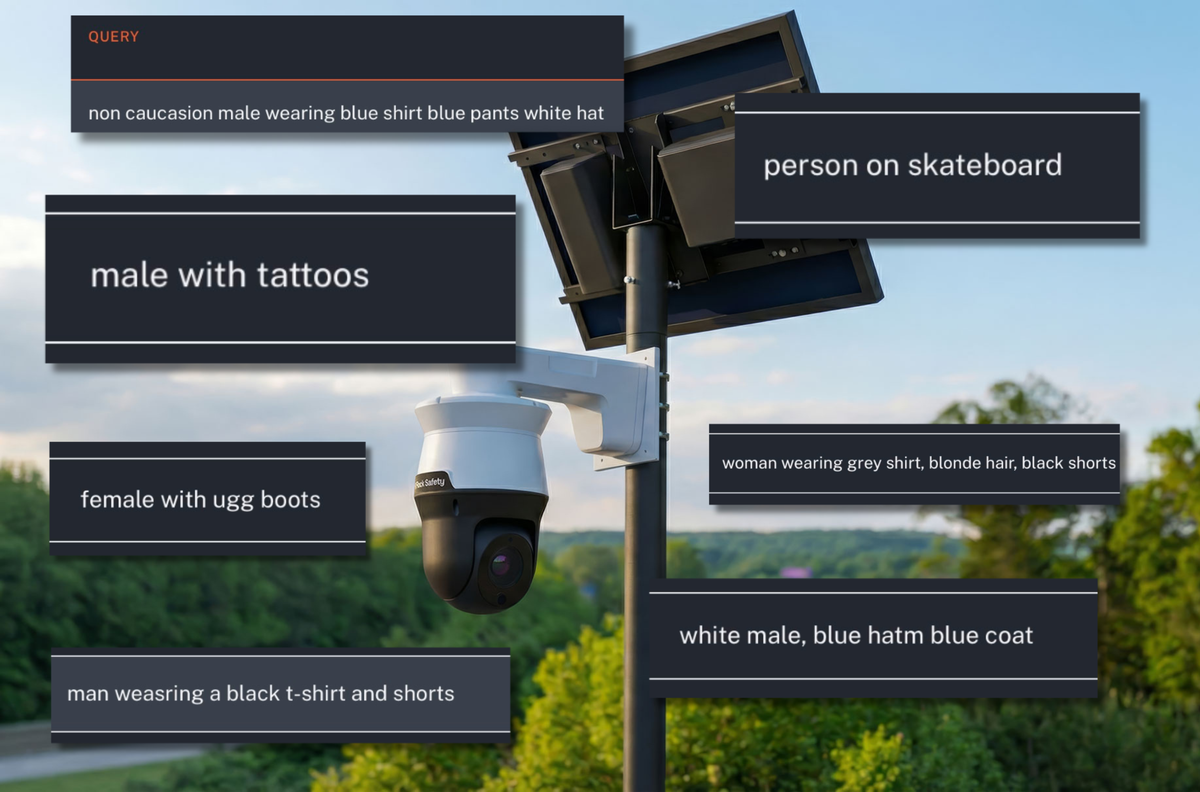
If you thought Flock cameras were only about scanning license plates, it's time to update your mental models. According to documents reviewed by 404 Media, police departments across the United States are using these same cameras to search for specific people, not vehicles, through descriptive text queries like "heavy-set male with a black and white hat," "person on skateboard," or "person wearing orange vest and construction hat." This is not science fiction: it's the present of AI-driven surveillance.
The feature is called "FreeForm" and turns Flock's interface into a search engine for the physical world. Officers type a description and the platform's artificial intelligence, trained on image recognition and visual attributes, sifts through hundreds of camera feeds simultaneously – sometimes across state lines – to find matches. It's no longer reactive policing (that plate was at the crime scene), but algorithmic proactivity: an agent formulates a hypothesis about a suspect, and the system combs public space in near real-time.
The infrastructure behind the magic: edge, cloud, and inference power
Although Flock doesn't disclose details, such systems require hardware capable of running inference on the devices – to process the footage – and a cloud or hybrid architecture to aggregate metadata and enable cross-camera searches. Each camera runs computer vision models to extract features (gender, clothing, accessories, mobility type) and indexes them. When a FreeForm query arrives, the backend compares the text against multimodal embeddings, likely using techniques akin to CLIP, to return the relevant frames. It's a pipeline not unlike visual search engines, but applied to mass surveillance.
This opens a Pandora's box for data sovereignty and control. Law enforcement in one state can query cameras installed in another without any local judicial mediation, creating a single federated panopticon that circumvents jurisdictional boundaries. In practice, the technical architecture creates uniform access to an ever-growing archive of bodies and movements, where the line between targeted search and digital dragnet becomes razor-thin.
Who wins and who loses in surveillance as a service
The adoption of these tools is not neutral. For police departments, the advantage is clear: reduced investigation times, the ability to find suspects without vehicles, expanded control. For citizens, the price is granular monitoring that affects anyone with a visible trait, including political affiliation – 404 Media mentions cases where searches referenced political symbols or attire. The right to anonymity in public spaces erodes one frame at a time.
Structurally, this news signals how AI is transforming surveillance into a standardized commercial product. Flock sells cameras and subscriptions to a platform that offers capabilities once reserved for intelligence agencies. It lowers the technological barrier and deepens the divide between those who can afford to be invisible (few) and those who cannot (the majority). For those evaluating on-premise deployments in the enterprise sector, the lesson is clear: video analytics systems with similar potential require careful consideration of compliance risks and TCO, because technical effectiveness comes with a huge legal and reputational attack surface.







💬 Comments (0)
🔒 Log in or register to comment on articles.
No comments yet. Be the first to comment!